


Brought to you by:

How ElevenLabs took outbound from 5% to 30% of pipeline
ElevenLabs moved its EMEA team off too many disconnected tools onto lemlist. One campaign hit 71% interaction and 25% replies. Jon (Their SDR lead): 'it has been built by people who really understand outbound.'

A few months ago I read a survey saying that:
Most SDR teams using AI are hitting about the same quota as the teams that aren’t. Using AI barely shows up in the results.
So a lot of people have landed on a simple takeaway:
AI doesn’t work for outbound.
But look at what most teams actually do with it. They bought the tool and stopped there. They open ChatGPT, type “write me an email,” get something decent once, then it falls apart on the next account. Or they hand it to the whole team with no system, so every rep uses it their own way and nothing moves.
The teams getting results point AI at one of 2 jobs:
Make the conversation with the prospect better: more relevant, better timed, better prepped.
Give the rep more time to actually have those conversations, by clearing the admin work around them.
Better conversations, AND more of them. That is the test. If a use of AI doesn’t do one of those two, drop it.
So I unpacked: 12 use cases, from 16 companies, 26 different examples, including the plays I run for my own clients.
Use the ones that fit your business.
1. Signal interpretation / account-state engine
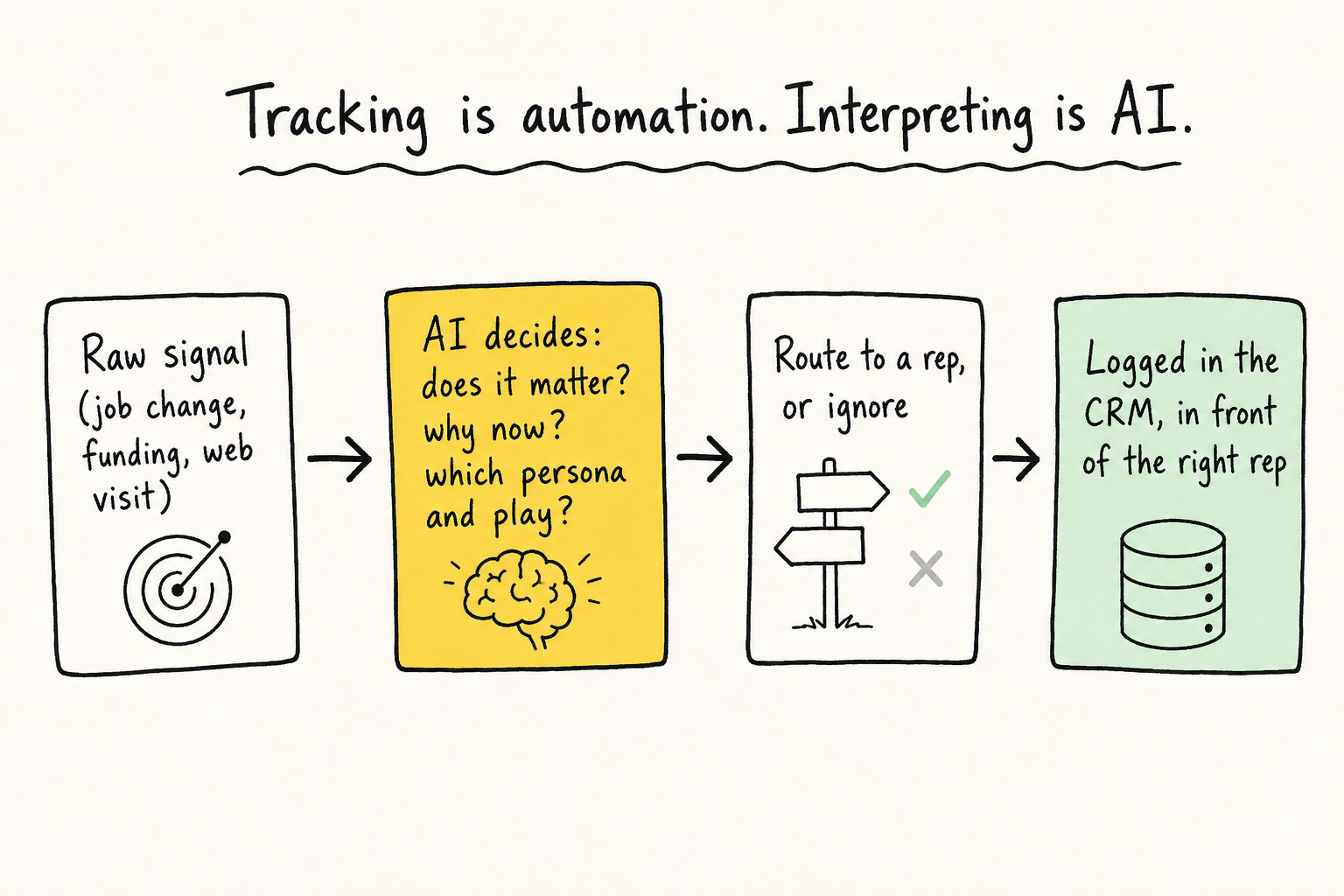
Job to be done: turn raw signals into “what should we do now?”
This is the timing layer: which accounts are worth a rep’s attention right now. The signal itself is usually not AI. Job changes, funding, hiring, website visits, PLG activity, compliance-page changes: those are just inputs. AI becomes useful when it decides whether the signal matters, what it means, which account or persona or play it maps to, and whether a human should act.
What’s inside
Raw signal → account fit check → why-now interpretation → persona mapping → play selection → route to AE / SDR / CS / ignore → store event history in CRM
ClickUp
AI monitors product usage on ClickUp’s PLG base. Usage spikes and paywall hits trigger a human touch, so reps stop watching dashboards.
Pocus reads the signals
A custom AI-SDR runs on Retool
Human XDRs take the calls
Result: human BDR meeting-booked rate 2.4%, inbound AI-SDR 28%
Tools: Pocus, Retool, Nooks, Outreach, Salesforce, ZoomInfo, Clari, Sales Nav, Gong.
Source: Kyle Coleman, LinkedIn
Pigment
AI turns unstructured inputs into clean GTM objects.
A job description becomes the tech stack, the competitors in use, and the seniority level
A LinkedIn profile becomes competitor usage and implementation history
Web content becomes buying-intent signals
Pigment weights each signal against its own value prop and stacks them into momentum models inside Palette, its own data warehouse built on BigQuery
Without this layer, real-time activation would not scale
Source: Growth Twins playbook
Writesonic
By Collin Chlarson, Head of Sales Development.
A weekly system that lives in Claude and hands every SDR their hottest accounts. Two parts.
First, it scores every account on nine criteria proven to lead to outbound meetings, and surfaces lookalikes of the accounts that hit
Second, it prioritizes each rep’s owned accounts and assigns the extra hot ones round-robin
Each rep gets a spreadsheet with their top accounts, suggested contacts, and a suggested pitch (10 to 20 new accounts max)
Plus a tab showing how much action they took on last week’s accounts
The score also writes back to HubSpot
Tools: Claude, HubSpot, spreadsheet.
Source: Collin Chlarson, shared this with me in the SDR Leaders of USA community.
2. Internal data synthesis / proprietary context
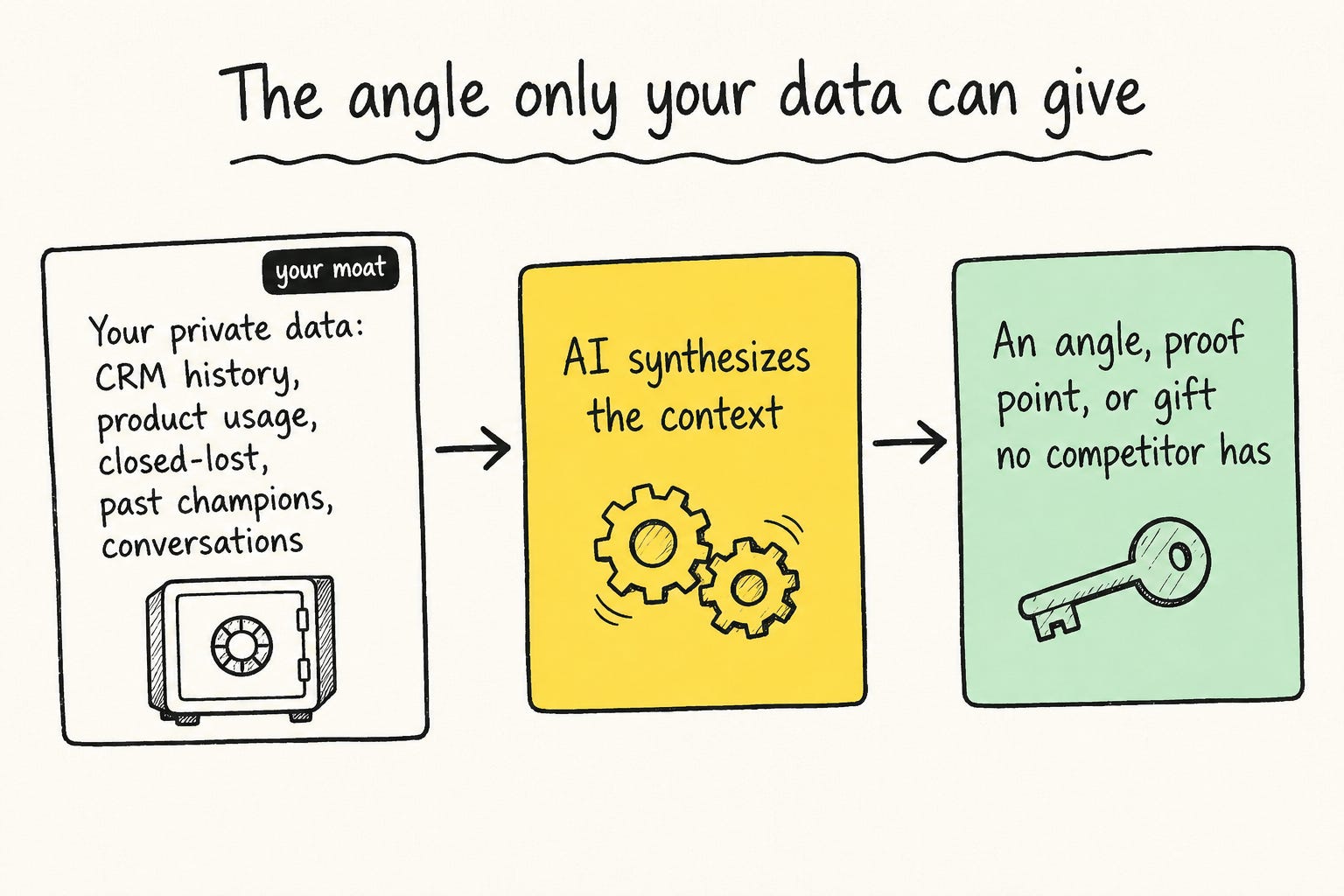
Job to be done: use private company data to create outbound angles competitors cannot copy.
This is the angle layer: the reason to reach out that no competitor can copy. Every vendor scrapes the same job-change and funding data. So do the 40 other vendors emailing your prospect. Your Salesforce history, product usage, closed-lost notes, and past champions are the part nobody else has. That is the moat, and it is what AI can turn into outreach.
What’s inside
CRM history + product usage + closed-lost data + previous champions + conversations + multi-threaded contacts → AI synthesizes context → AI suggests angle, proof point, gift, or next action
Sendoso
AI pulls from Snowflake product usage and Salesforce history to build email and gift angles only Sendoso can send.
The history it draws on: closed-lost opps, previous champions now at new companies, multi-threaded contacts
Result: those data-built angles took the BDR team from under 15% of pipeline to 30%+
Tools: UserGems/Gemmy, Snowflake, Salesforce, Claude, n8n, Orum, Qualified, Clay, Salesloft, Gong, Momentum.
Source: GTM AI Podcast
3. Account research / pre-call prep
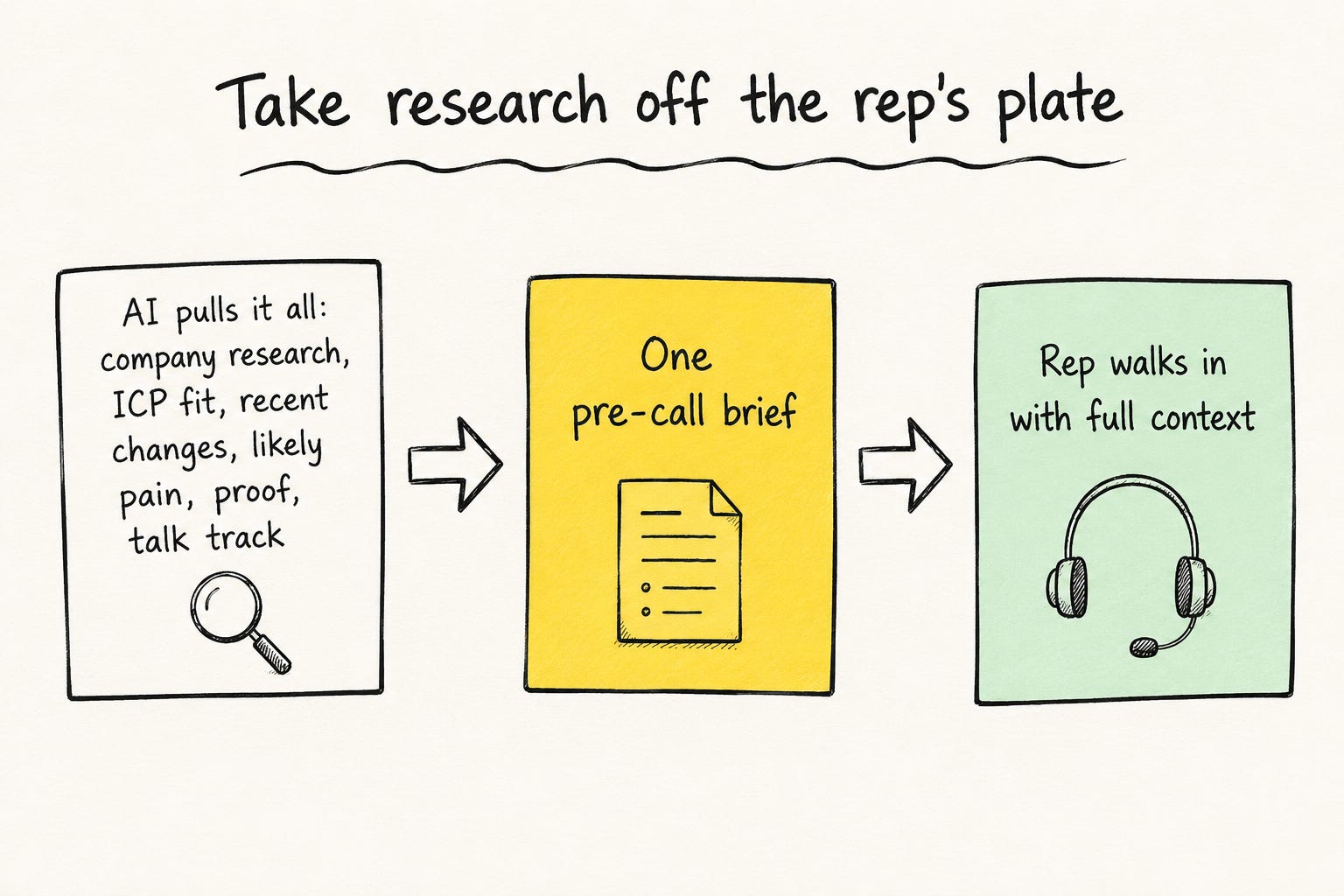
Job to be done: remove manual research from the rep’s workflow.
This is the prep layer: everything the rep needs in hand before the call. Not “AI writes better emails.” AI prepares the rep before the call: account context, likely pain, why-now, proof points, talk track. The freed hours go to selling.
What’s inside
Company research + ICP fit + recent changes + likely pain + relevant proof + account-specific talk track → pre-call brief → rep calls with context
Owner.com
Built its own AI pre-call research because restaurant context is proprietary.
A central data team owns list-building so BDRs make more calls
The thesis from CRO Kyle Norton: buy infrastructure, own your intelligence
Result: outbound revenue per BDR went from $72k to $120k a month (about $1.44M per rep a year)
Tools: internal AI PCR, Salesforce, Snowflake, Anthropic/OpenAI.
Source: How Owner.com’s AI SDR system hit $1.44M in outbound per rep
Glean
By Joey Lopez, Sales Development Manager, Strategic Accounts:
A Research and Contact Audit agent runs the full prospecting analysis on an account.
The initiatives they have that Glean solves for, with sources and quotes
The competitor’s version, a current customer to reference, and the key people leading those initiatives
How Glean has interacted with the company before
It audits which of those key people are missing from the CRM and writes up why they are worth a conversation
It drafts example emails at 80% done for the SDR to finish, creates the missing contacts, and adds them to the right sequence
Tools: Glean, CRM.
Source: Joey Lopez (Glean) shared this with me in the SDR Leaders of USA community.
ClickUp (Andy Cabasso, Growth Ops)
ClickUp’s reps run a parallel dialer (Nooks) at up to 150 calls a day. At that volume, when someone picks up you have zero seconds to find context. So Growth Ops built a workflow that loads it for them.
The moment a prospect enters a sequence, a Retool workflow pulls their CRM data, recent activity, and product usage
It fills the gaps with enrichment, then fires three AI models in parallel: Perplexity for recent company news, GPT to summarize the context, Gemini to write the talk track
All of it writes back to a CRM field that syncs to the dialer, so the rep sees the background and a talk track the second the call connects
Result: reps went from about 35 to 150 calls a day, and a top rep booked 200 meetings in a quarter, without losing quality
Tools: Retool, Nooks, Salesforce, Perplexity, OpenAI GPT, Gemini.
Source: ClickUp built this before scaling dials
4. Content becomes the rep’s script
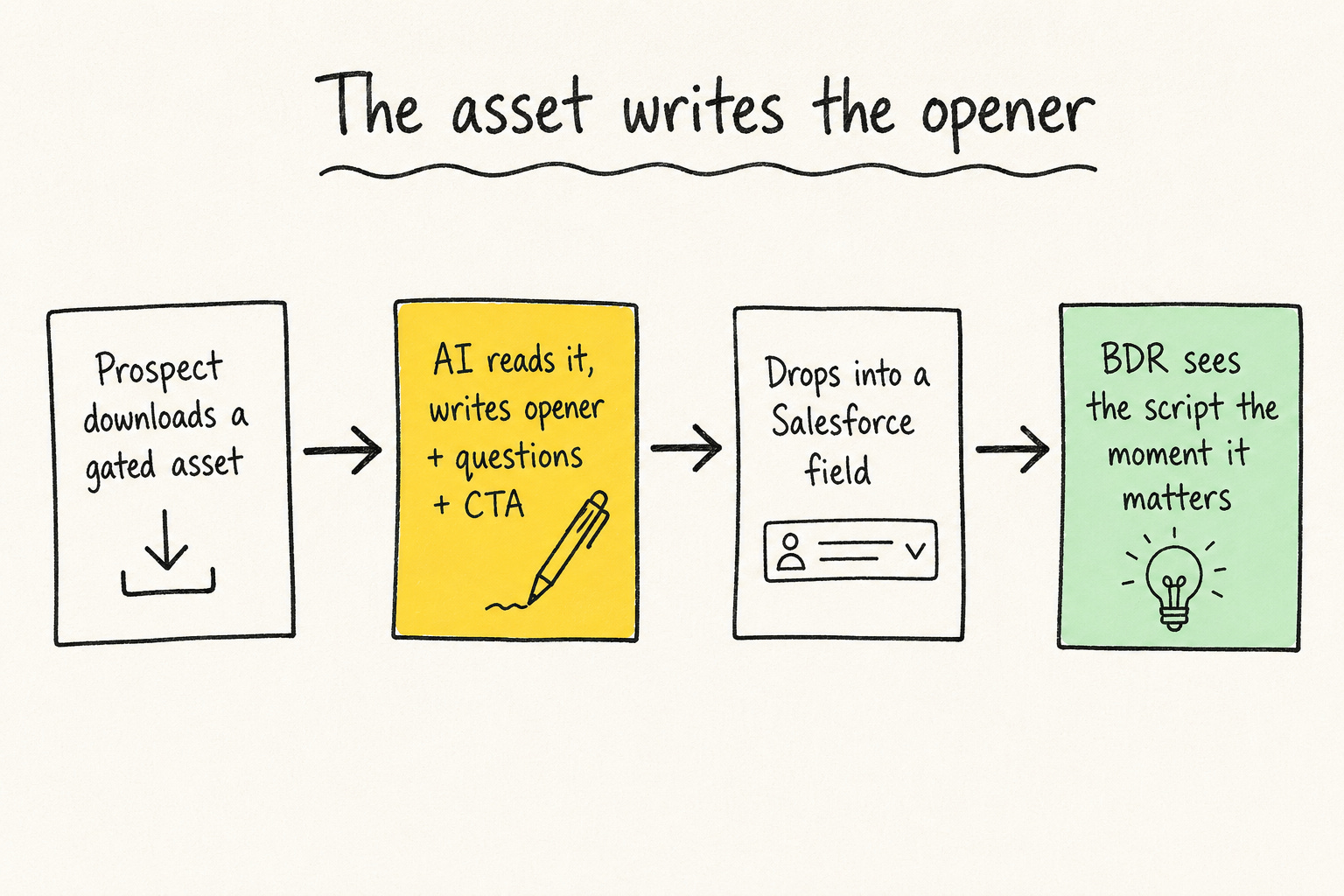
Job to be done: turn a marketing asset into a rep-ready opener at the moment of intent.
The asset already tells you what a lead cares about. AI turns it into the opener, the questions, and the CTA.
What’s inside
Prospect downloads gated asset → AI reads the asset → generates opener + questions + CTA → writes to a Salesforce field → BDR sees the relevant script
Rippling
A custom GPT: upload a gated asset and it writes an asset-specific opener, questions, and CTA straight into a Salesforce field.
Tools: custom GPT, Salesforce.
Sources: 95% Content podcast.
5. Personalized resources
Job to be done: hand a prospect something built for them specifically, so they see the value before they reply.
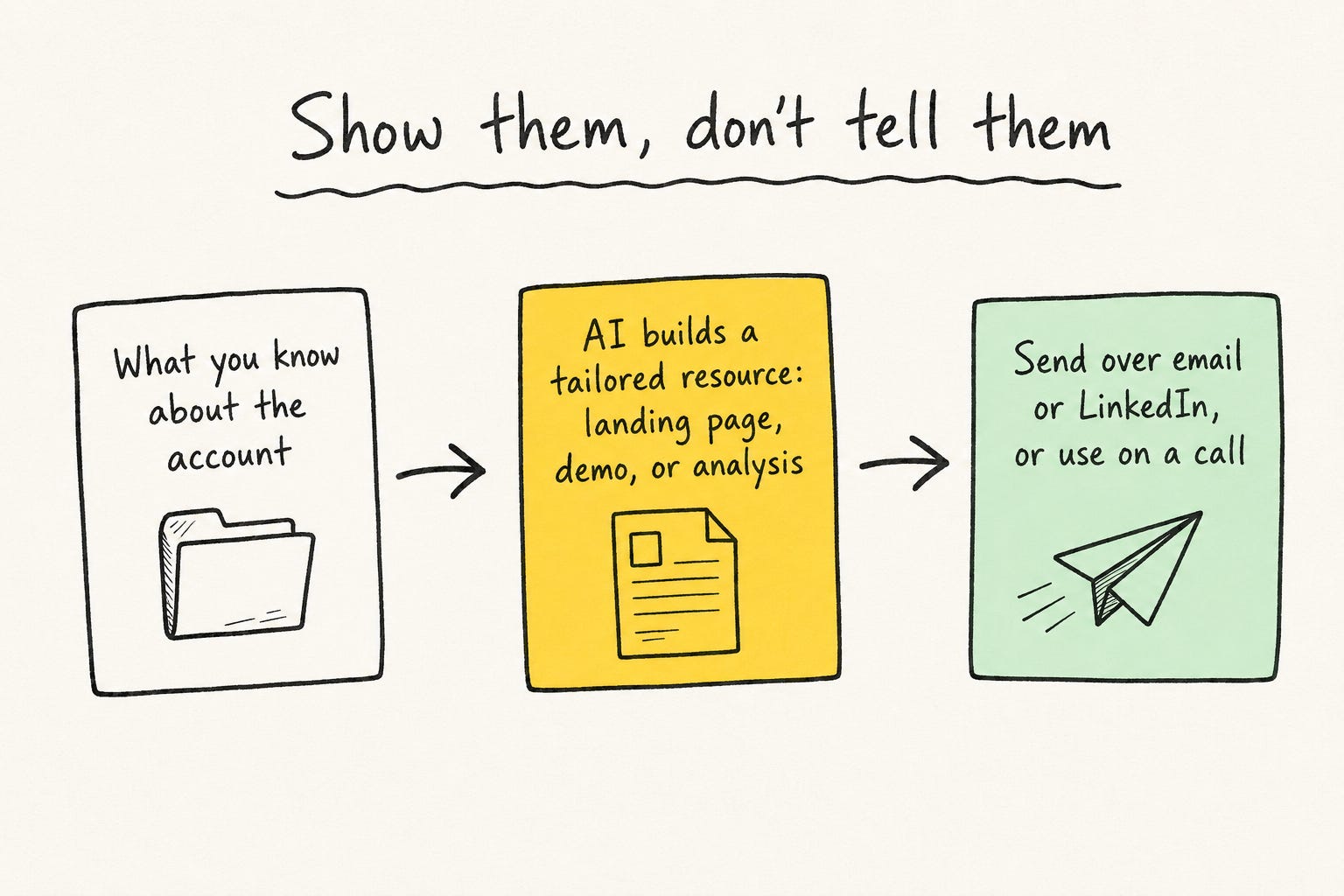
Instead of telling a prospect you can help, you show them. A page, a demo, or an analysis made for their account lands harder than any claim, and it is a prospecting touch in a medium they cannot ignore.
What’s inside
What you know about the account → AI builds a tailored resource (a landing page, a demo, or an analysis) → send it over email or LinkedIn, or use it on a call
Vercel (V0)
Reps built custom landing pages for prospects with V0, Vercel’s own AI app generator. The rep feeds in what they know about the account and V0 spins up the page.
Tools: V0.
Source: Ken Amar, Outbound Squad
Rippling (Ken Amar, Sr. Dir. Sales Development)
The same play, through a vendor.
The SDR inputs everything they know about the account and the ideal prospect
The tool builds a custom landing page with a tailored demo: here is what we know about your company, here are your areas of opportunity
It goes out over email and LinkedIn, an in-depth prospecting touch in a different medium
Tools: AI landing-page / demo generator.
Source: Ken Amar, Outbound Squad
Outbound Kitchen (the Chef’s Bite)
I do a version of this for my own prospects. Instead of telling them I can help, I send a personalized sample of the work, what I call the Chef’s Bite.
It might be a TAM analysis for one of their markets showing where the opportunity is
A list of in-market accounts giving off pain signals online, with the reasons they fit
A map of the business units inside a target account
An agent built in Claude Code or Clay learns their ICP and top customers, then builds the sample
They taste exactly what their reps would get, which beats any claim I could make
Tools: Claude Code, Clay.
6. Inbound qualification that frees outbound capacity
Job to be done: qualify inbound automatically so you can put more reps on outbound.
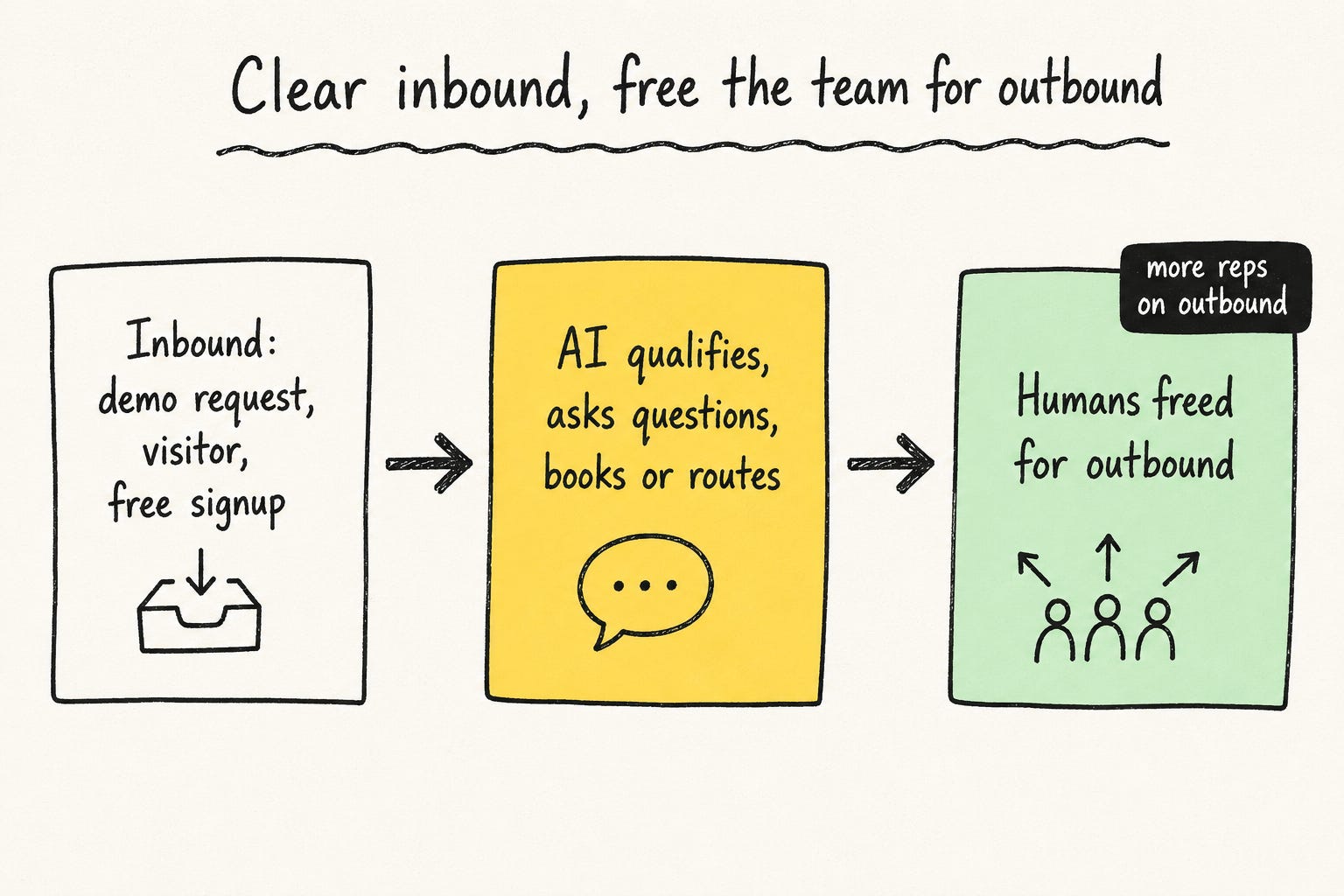
This one helps outbound indirectly. It is not an outbound play itself, but when AI handles the inbound, you free up people, and those people go do outbound. More humans on outbound is the win. (Reallocation, not cost-cutting.)
What’s inside
Demo request / website visitor / free signup → AI qualifies → AI asks questions → AI books or routes → human works higher-value outbound
Vercel
A form-to-enrich-to-qualify-to-Slack agent drafts the reply, a human reviews and sends.
Result: 10 inbound SDRs collapsed to 1 reviewer
32x ROI ($60K cost against $2M+ saved)
The 9 freed reps moved to outbound
Tools: internal AI lead agent, OpenAI Deep Research, Slack.
Source: drew.tech
ElevenLabs
An inbound AI SDR on its own Agents Platform.
78% of qualification decisions need no human
It handles about 50 calls a week (two FTE SDRs)
Across 38 countries, 24/7
Tools: ElevenLabs Agents Platform.
Source: ElevenLabs blog
Personio
Nia (by Qualified) books demos around the clock.
Result: 140 meetings booked in the first seven days (Lacor)
Roughly 80% of MQLs now route through it (Shantanu)
Tools: Qualified (Nia), Salesforce, Snowflake, Amazon Bedrock.
Source: SaaStr write-up
7. AI role-play
Job to be done: make reps practice against AI until they are ready, before a single live call.
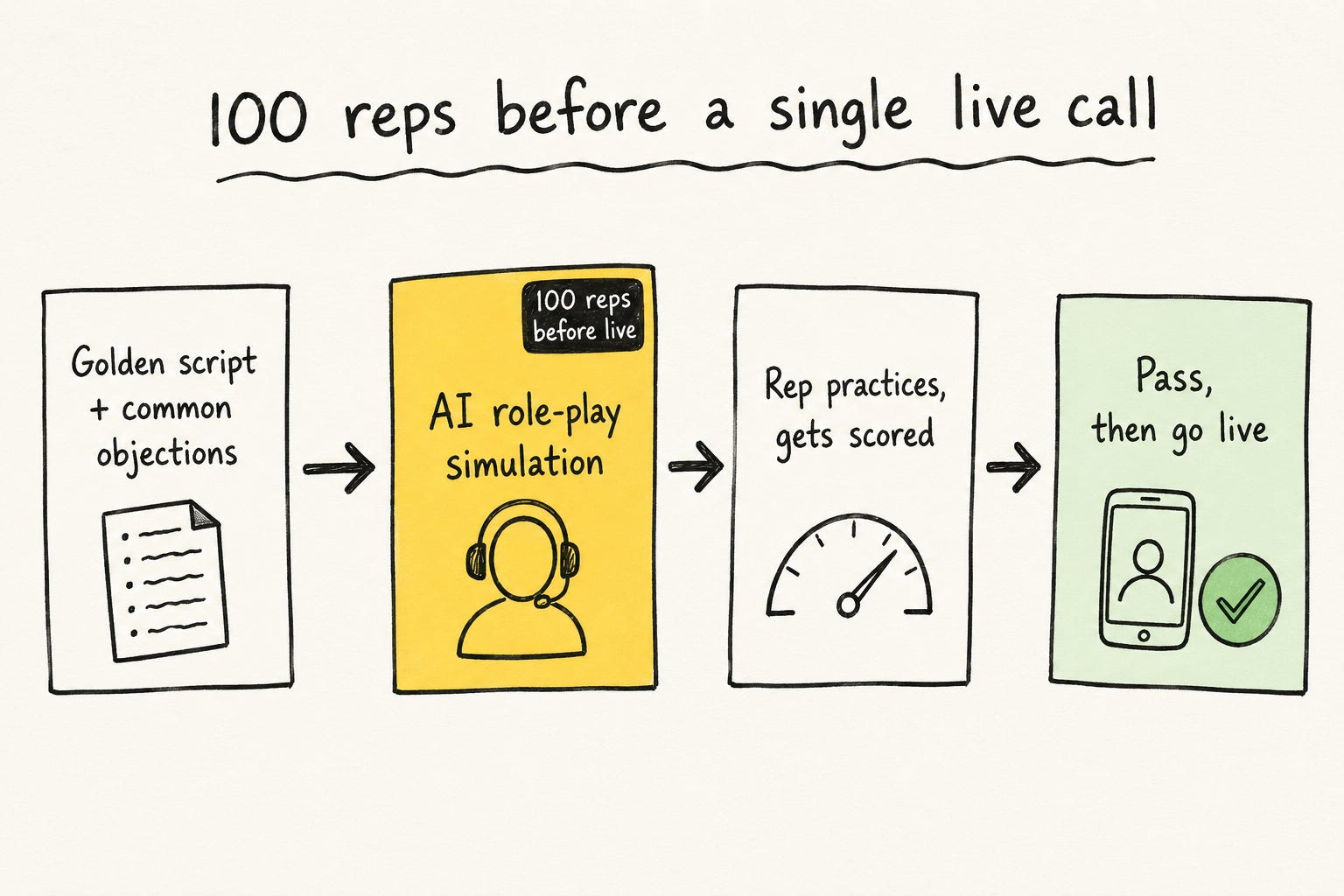
The common advice is to rush new reps onto the phone, day two if you can. Top teams do the opposite: they make every rep complete around 100 simulations before their first live call, to build phone confidence through repetition and cut ramp. Do not skip it. Practice happens off live deals, not on them.
What’s inside
Script + common objections → AI role-play simulation → rep practices and is scored → pass to go live
JumpCloud
Structured AI role-play (Hyperbound) in onboarding: 100 role plays before the first call made.
The four highest-practice reps averaged 143 role-play calls and reached first meeting in about 11 working days
Slow-ramp reps previously took up to 70
Tools: Hyperbound.
Sources: Hyperbound case study, Outbound Kitchen: 5 AI cold-call training scenarios
Owner.com (Rob Yuen, Head of Enablement)
Every BDR runs 100 simulations against AI avatars (Avarra) before they pick up the phone for real. The point is confidence built through reps, which is what shortens ramp.
The avatars include a crusty Brooklyn pizza-owner persona the team named Joe
The sims run onboarding and certification: enablement only signs off that a rep is ready once they pass
One cohort of 7 XDRs logged 168 hours practicing with avatars instead of live calls during ramp, and one rep alone did 37 hours in their first two weeks
The payoff: new reps catch up to experienced restaurant-tech hires fast, and rollouts that include an avatar piece see 30 to 40% higher adoption
How eagerly a rep engages the avatar even predicts their call volume and quota attainment
Tools: Avarra.
Source: Rob Yuen, Scaling Your GTM Playbooks Using Avatars.
8. Cold-call analysis
Job to be done: mine real call transcripts to find what works and what kills deals, then rebuild the script from it.
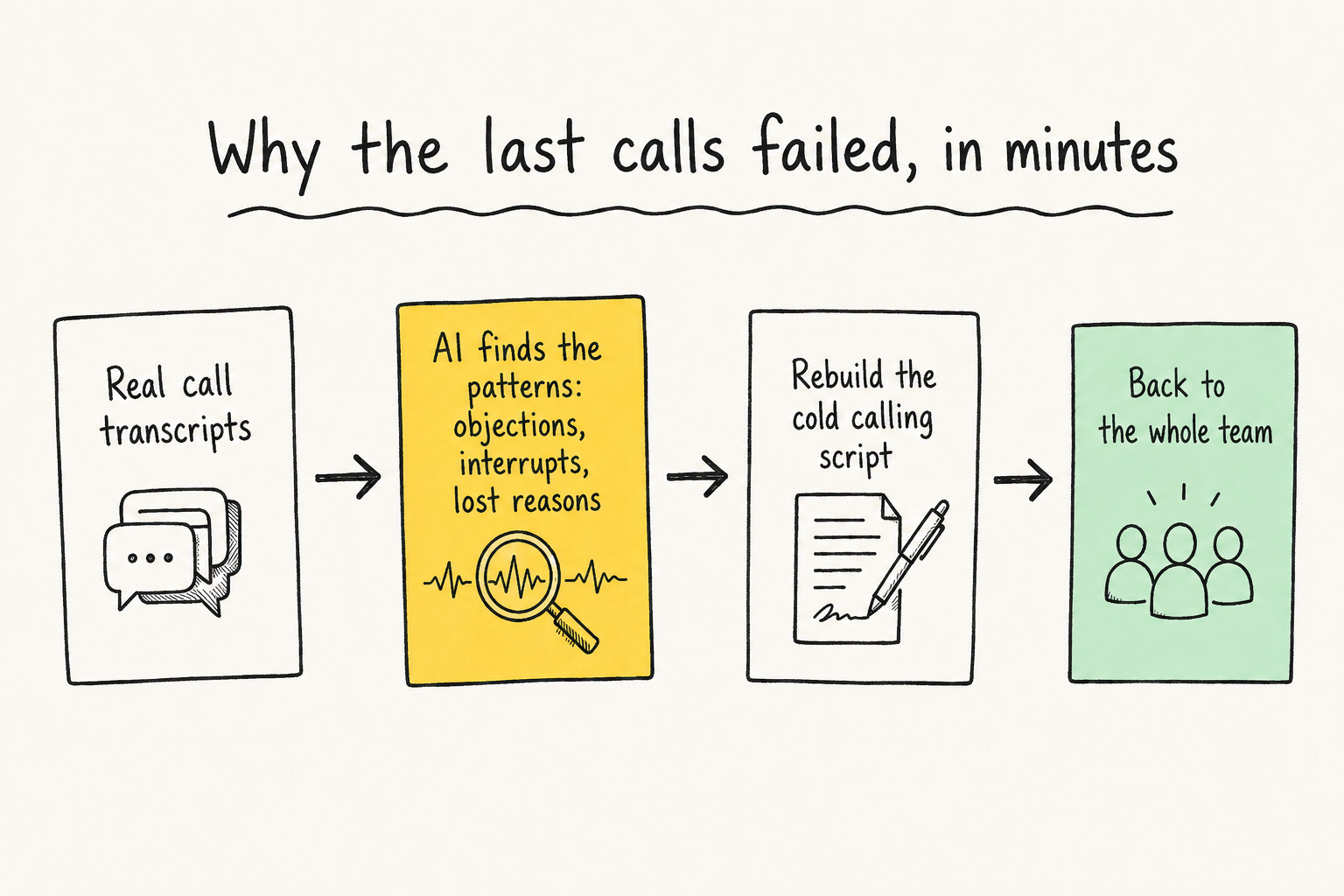
The best AI use case may not be writing the next email. It may be understanding why the last 212 calls failed, then fixing the script.
What’s inside
Calls → AI finds the patterns (objections, pattern interrupts, lost reasons) → rebuild the cold calling script → feed it back to the team
Mangomint
Analyzed 212 cold-call transcripts from Nooks in 3.5 minutes.
Nooks (their BDR dialer and sequencer) does not support bulk transcript export, so Claude’s browser extension scraped them all
Claude Code analyzed the patterns: top objections, the pattern interrupts that work, battlecard gaps, and regrettable vs non-regrettable losses
Tools: Nooks, Claude browser extension, Claude Code.
Source: GTM AI Academy interview
9. Build your own internal GTM app
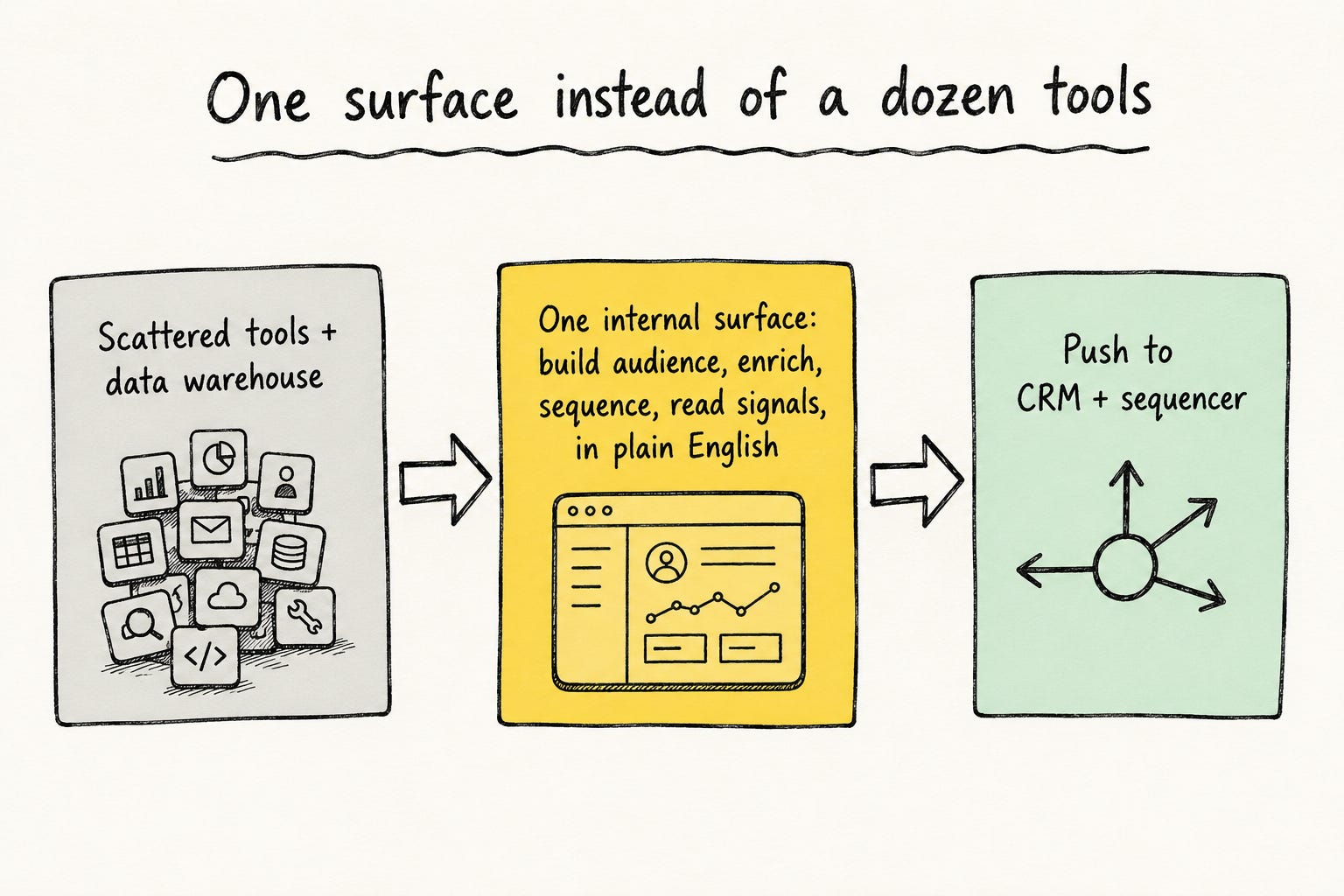
Job to be done: one internal surface, so reps stop switching between dozens of systems to figure out who to reach and what to say.
The most committed teams are not buying an AI SDR. They are building the surface their reps live in.
What’s inside
Tools + data warehouse → one internal surface → build audience / enrich / sequence / read signals in plain English → push to CRM and sequencer
Ramp
“Ramp Revenue,” an internal CDP processing millions of records a day plus a unified action layer with agents embedded in the workflow.
Self-reported: more than 80% of sales workflows now run on it
Tools: internal CDP, embedded agents, Salesforce.
Source: Parth Gujare, X
Pigment
Two internal tools on one warehouse.
Palette is the GTM brain, a BigQuery warehouse that models momentum and buying signals in real time, kept reliable by AI that continuously normalizes company names, standardizes roles, and de-dupes contacts (clean data is what makes the automation safe)
Newton sits on top: an AI account-planning engine that pulls CRM, Gong transcripts, past wins and losses, playbooks, and live market signals into one place
Instead of hunting across tools, a rep asks Newton what changed in an account, why it matters now, which narrative to use, and what similar deals looked like
80+ weekly active users (about 70% of the target AEs and BDRs), 12,000+ rep queries since June 2025
Tools: BigQuery (Palette), Newton, Gong, CRM.
Source: Growth Twins playbook
Vibe
An internal GTM co-pilot built by two GTM engineers in two months.
Build an audience in plain English, enrich in-app, push sequences to Smartlead, HeyReach, or Outreach
A layer called Sonar connects the app to Claude Code
Tools: Claude Code (Sonar), Smartlead, HeyReach, Outreach, Salesforce.
Source: Reza Mokdad (Vibe), from the upcoming Outbound Kitchen podcast episode.
10. Yes, AI can write cold emails
Job to be done: let AI write the cold email or message, and have it land.
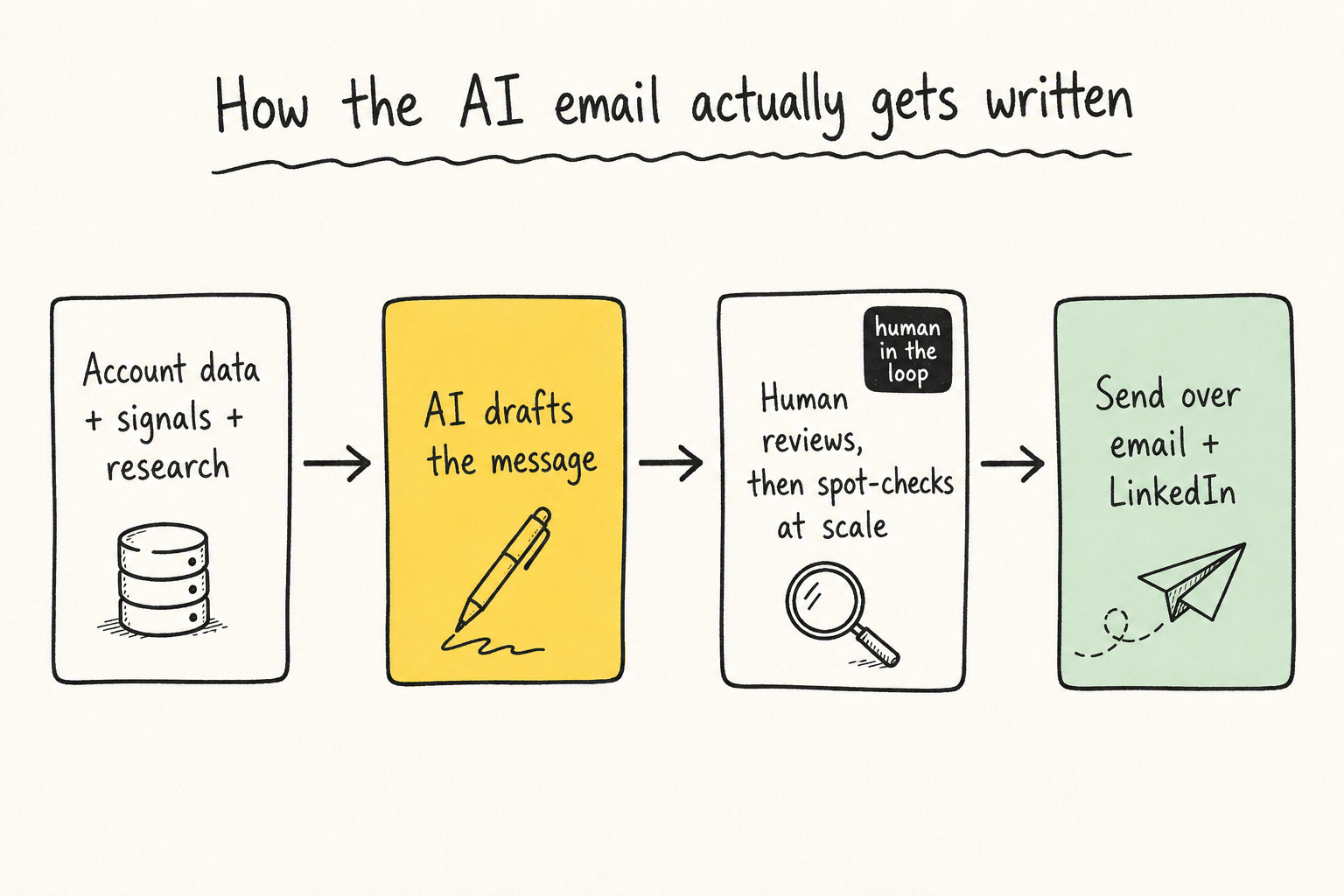
Half of LinkedIn will tell you AI cannot write a cold email. The teams getting results have the numbers to say otherwise. Here is what those takes miss: the email works because it is the last step of a workflow. The timing, the angle, and the prep from the layers above all feed it, so the AI is not staring at a blank “ChatGPT, write me an email.” And a human stays in the loop on quality. Wesley Baker at Nextiva calls the payoff “outbound that feels like inbound”: by the time a rep follows up, a personalized AI-written email has already landed.
What’s inside
Account data + signals + research → AI drafts the message → human reviews, then spot-checks at scale → send over email or LinkedIn
Snowflake (Jeff Long)
300-SDR org. When a rep adds a prospect to the Outreach cadence, a multi-step pipeline does the research, the summary, the search-term generation, and drafts the email on the rep’s behalf, then scores it and flags weak drafts to fix.
It takes the research, the drafting, and the sequence pick off the rep’s plate, and the rep stays in the loop inside Outreach
Result: reply rate 0.5% to 7.6% (over 15 times higher)
55,000 prospects, about 2,000 meetings booked
Tools: Outreach, internal scoring pipeline, Claude.
Source: Jeff Long, “How We Crush Prospecting at Scale Using AI”
Outbound Kitchen (what I built for different clients)
I built the same kind of chain for a client, end to end, across email and LinkedIn.
Clay and the Claude API research every account and rank the best-fit ones, the Claude API writes the messages, and Lemlist sends them
I stay on quality myself: I read the first ten or so by hand, and once I trust the output I spot-check about every hundredth one
No rep dialing, no manual research
Result: $1.6M in revenue generated in 2026 so far
Tools: Clay, Lemlist, Claude API.
Nextiva
By Wesley Baker, Sr. Director, Business Development and Automation:
The goal is end-to-end automation so SDRs spend time on calls, not prospecting admin.
Custom intent signals built on-site with their Outbound database flag high intent around Nextiva’s newest product (AI receptionist and AI voice)
Their outbound database builds those high-intent accounts, filters to the ICP buying group, and pulls 5 contacts per account
The accounts and contacts auto-create in CRM and route to the SDR team round-robin
Their Sales Engagement Platform research agent runs prompts tuned per industry (the restaurant agent looks for recent growth and reviews that complain about wait times or busy phones, anything the email can use)
A Prospect AI agent is embedded on the first email, and Wesley is experimenting with full automation: the SDR just has call tasks due, while a highly personalized first email to a high-intent ICP contact has already gone out on their behalf. That first step is automatic
The reps then power-dial, and because they can see the first email already sent for them, they lean on it in the conversation when they know they are calling cold intent outbound
Tools: ZoomInfo, Salesforce, Outreach, Nooks.
Source: Wesley Baker, Nextiva, shared this with me in the SDR Leaders of USA community.
11. AI reporting agents, a daily pulse on the team
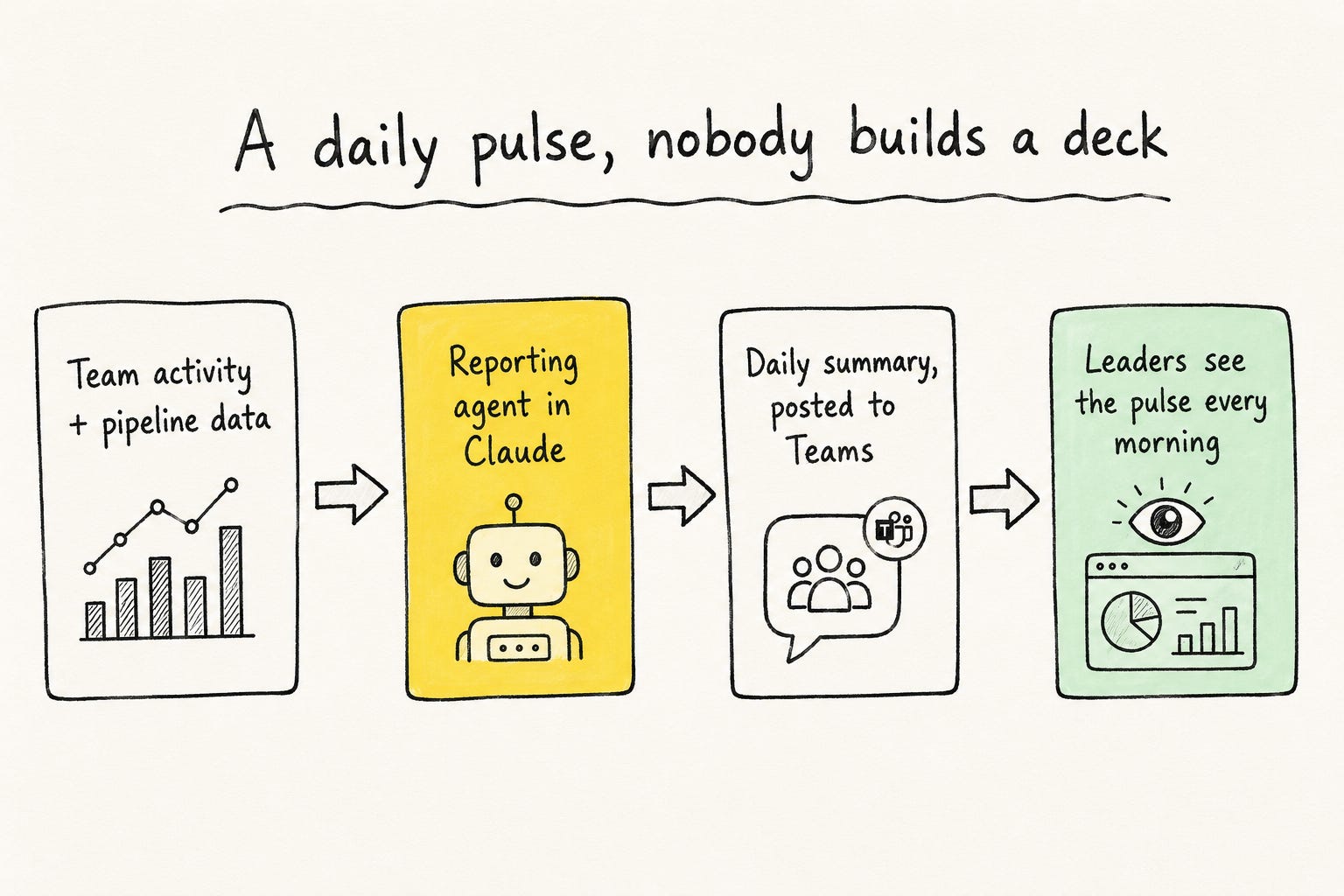
Job to be done: automate team reporting so leaders get a daily pulse, without anyone building a deck.
AI does not only run the prospecting. It can run the reporting layer on top of it, so the people leading the team see how it is pacing every day.
What’s inside
Team activity and pipeline data → reporting agent in Claude → daily summary → posted to a Teams channel → revenue leaders see how the XDR team is pacing
Nextiva
By Wesley Baker, Sr. Director, Business Development and Automation):
Built reporting agents that automate the team’s reporting and post it to a team channel, so revenue leaders get a daily pulse on how the XDR team is performing, allowing for further level of SDR execution inspection and highly customizable reporting that you cannot find with traditional reporting methods..
Tools: Claude (Cowork and Code), Microsoft Teams.
Source: Wesley Baker, Nextiva, shared this with me in the SDR Leaders of USA community.
12. Build the data and lists you can’t buy
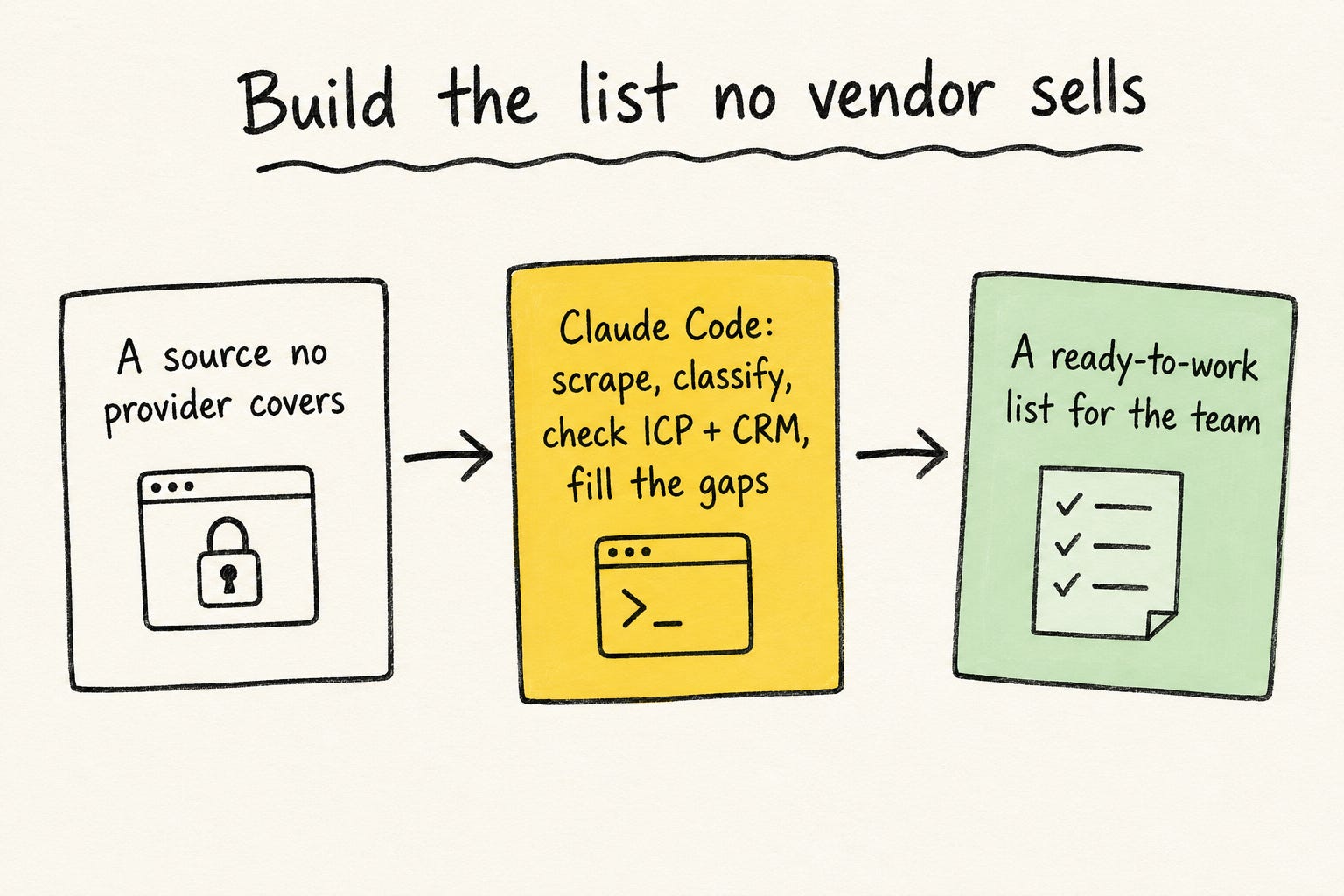
Job to be done: build the data or the list no provider sells, with AI, and hand the team something ready to work.
Sometimes the data or the list you need is not in Clay or any other provider. So you build it yourself, with Claude Code.
What’s inside
Find the source a vendor won’t sell you → point Claude Code at it → scrape and classify → check ICP fit and the CRM → fill the contact gaps → hand the team a ready-to-work list
Outbound Kitchen (custom buying signals)
When a client needs a buying signal that Clay and the other providers do not have, I build a custom scraper for the specific site that does, with Claude Code and Apify.
The unglamorous part is the workflow around it: scrape the source, dedupe, check whether the account is already in the CRM, then write the signal onto the records that matter
The client ends up with a signal nobody else can pull, sitting in their CRM, ready for the team to act on
Tools: Claude Code, Apify, CRM.
Outbound Kitchen (tradeshow attendee lists)
The same move, applied to events. I built this five times for clients in the past three months, and it replaced a seven-step manual slog across multiple Clay tables.
I point Claude Code at the event and it scrapes the exhibitors, sponsors, speakers, and attendees, sorts each into person or company, checks ICP fit, matches against the CRM, and finds contact info for anyone missing (Exa looks up each LinkedIn by name and company)
There are three ways in, depending on what the event exposes:
A public site, straight from the URL
A web-app attendee list, scraped or fed to Claude Code as raw HTML
A mobile-app-only list, where you screenshare your phone and let Claude Code read the screenshots
And when the official list is locked down, a fourth angle:
Claude Code plus the Serper API (not LinkedIn directly) finds the posts where people announce they are going, which works well for the big events
One event surfaced about 200 posts, and I reverse-engineered those into the right ICP contacts
The output is an ICP score for the event itself, plus a built list so the client’s reps can book meetings or invite people to the dinners they run
Tools: Claude Code, Exa, Serper API, Apify, Clay, CRM.
What’s next
This is a snapshot of what the best teams are building right now.
The hard part is turning any of it into something that makes money.
One ask:
If your team put AI use cases into outbound in a way that works, reply and tell me how. I am collecting the best ones for the next issue.
Hope that was helpful,
Elric
P.S. That is what I am building inside the new Outbound Kitchen membership:
the playbooks, the AI workflows, and the templates to install these systems yourself.