


This newsletter is sponsored by Default
Your reps act on every signal the second it lands
Default unifies signals from every tool you use, enriches each account with intent, and delivers it to your reps wherever they work: Claude Cowork, Slack, or any custom agent with MCP access. Teams like Owner.com, Perplexity, and Cortex already use it.
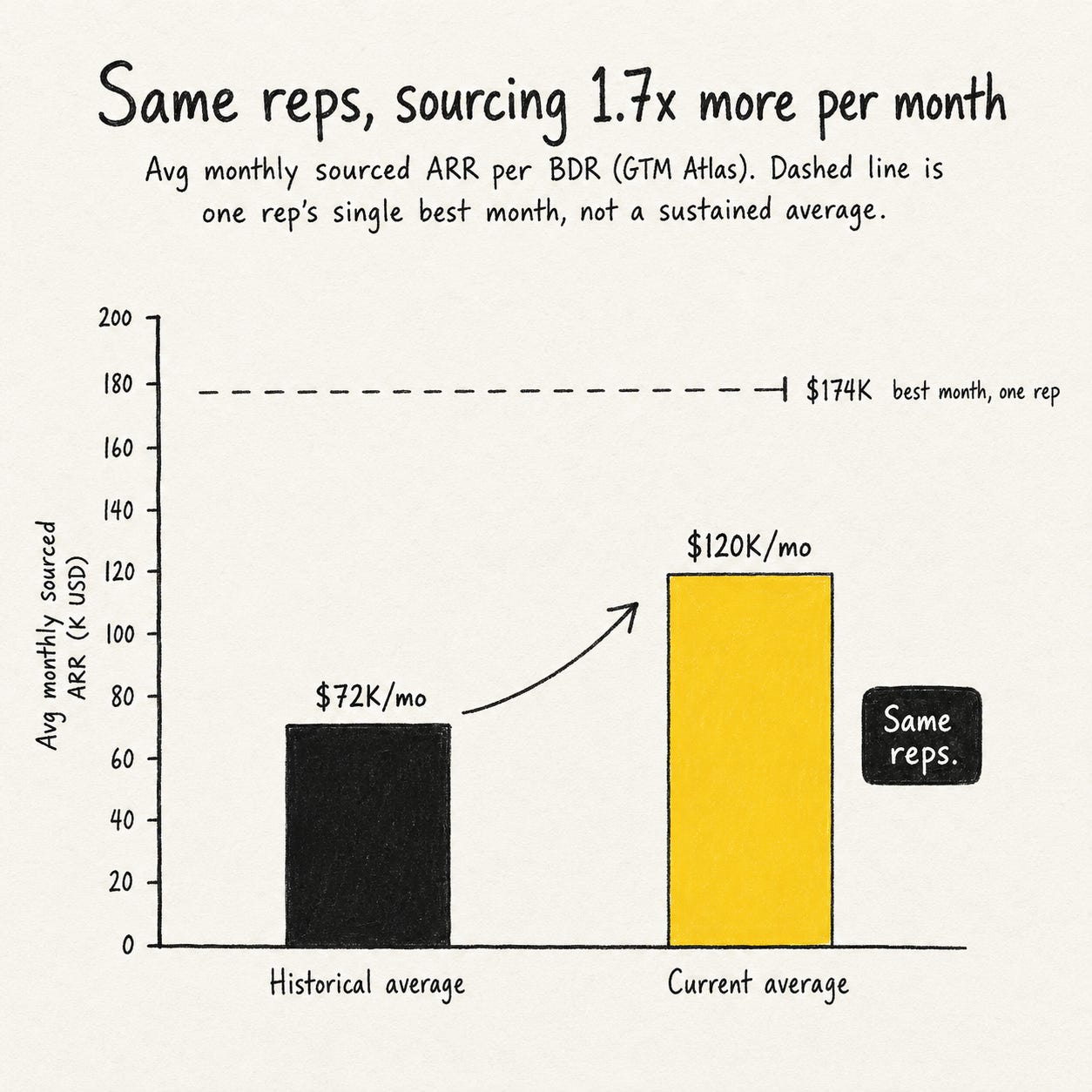
In 2026, Owner.com generates $120,000 in new ARR per BDR, per month.
So what’s the one thing they added to get there? There isn’t one.
The easy answer is they bought an AI SDR and the number went up. Plenty of teams bought the same AI SDRs in the same window, and their per-rep numbers didn’t move like this. If the tool were the cause, everyone who bought it would see the jump. They don’t.
What moved Owner’s number was who owned the AI, and the call on what to build versus what to buy.
Last year I broke down part 1: how Owner scaled outbound to $30M+ ARR. Back then each BDR was sourcing about $72,000 in new closed-won ARR every month.
Today it’s $120,000 on average. That’s $1.44M per BDR, per year (source: GTM Atlas). Their top performer hit $174,000 in closed-won in a single month.
Owner is redefining what an outbound team can produce in 2026. That’s why they’re worth studying. The lesson lives in how they think.
Today let’s unpack what changed.
P.S. If you missed part 1, read it here.
Who Owner is, in numbers
Restaurant software, SMB sales motion, ACV around $8K to $10K, in-office XDR team.
The scale tells you the rebuild is real: $50M ARR in September 2025 to about $100M ARR in May 2026. Headcount 258 to 357 (+38% past 12 months). Sales team 64 to 93 reps (+45% past 12 months). Their average AE closes $2M+ in ARR per year on a $150K OTE, and 4x CW ARR / AE / Month vs competitors.
That growth traces back to two structural decisions:
One team owns AI
Buy the commodity, build the differentiator
Decision 1: one team owns AI
Most companies do AI the decentralized way. Every rep and every manager goes off to figure out their own prompts, their own tools, their own workflows. It feels empowering. It produces a hundred mediocre half-built things, and it eats rep time. A rep using ChatGPT to research is a rep not on the phone. That’s why you see surveys where companies adopt AI everywhere and report zero impact.
Owner went the other way. One central team owns AI for the whole GTM function. In September 2025, they hired a GTM AI lead: YG Hong. A trained expert in this category gets closer to 20x the output of an amateur, not the 50% or 100% you’d assume. So the owner bought the expertise instead of asking each of their reps to become an amateur prompt engineer.
The ops and AI lead sit with the reps to find the bottleneck, build, measure it, and feed it back. Observe, build, measure, repeat.
Decision 2: buy the commodity, build the differentiator
The second layer. Owner buys infrastructure: Salesforce, Snowflake, Anthropic + OpenAI, Momentum, Salesloft, Datalane, Avarra, 1Mind.
They build the intelligence layer itself:
Pre-Call Research (PCR) agent,
ML lead scoring
Intelligent routing model,
Cerebro (Salesforce config in plain language),
The Gardener (master business-context file)
Churn review agent.
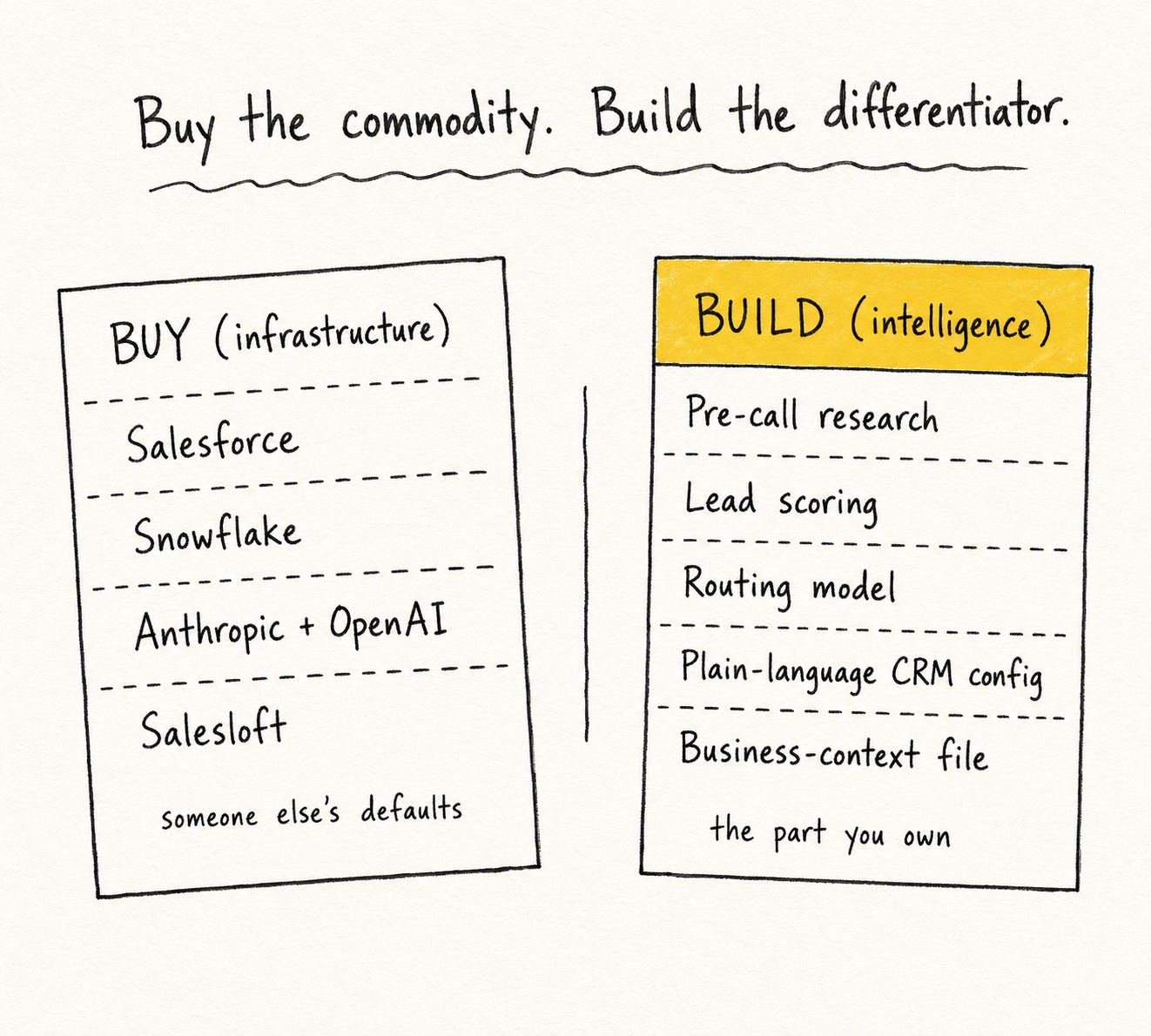
Their build test, and they only build when most of these are yes: it’s not uptime-critical, it’s custom to their ICP, the engineering ROI is big, they own the resulting intelligence, and no vendor will ever build it for their niche.
These two decisions are the whole story. Everything below only compounds because one team owns the loop.
Now let’s unpack what that loop produced at each stage of the funnel.
Stage 1: rebuild the BDR’s day
At most companies, only 30% of an SDR’s time is spent on prospecting, and 50-60% of their hours go to list-building and research.
That is the non-prospecting activities and time Owner went after first.
The central team shadowed outbound BDRs work and built one tool to absorb all of it. They call it AI PCR, pre-call research. It drops a personalized brief into Salesloft before every call: a website audit the prospect can see (a score out of 100, the revenue the problems are costing them, a problem list), plus the nearest high-performing Owner customer for local social proof.
The rep dials more, and each dial lands warmer, because the opener is built on something real about that specific restaurant. More connects, and better ones. Kyle Norton (Owner's CRO) frames it as a 5x improvement in decision-maker connects from where they started, now 20 to 30 a day on 150 to 200 dials.
The build cost: one engineer, two weeks. One team built it well, instead of fifteen reps building it badly fifteen times. Kyle calls AI PCR a large part of how the BDR team gets to $120,000+ in closed-won per month.
That lift only exists because one team owned the loop and pointed it at the boring 60%. That’s the first lift: more meetings into the funnel.
Stage 2: rebuild the AE’s day
AEs were spending to 30 minutes before every demo manually researching each prospect. That did two things: it cut the time they could spend with customers, and it slowed qualification, especially when a restaurant owner wanted a demo within hours.
The same pre-call research that warms the BDR’s dial also preps the AE’s demo. The Grader report audits the restaurant’s online presence before the call and hands the rep a personalized business case. Instead of “you need a better website,” the rep can show the specific problems likely costing this owner money. The buyer walks in already problem-aware.
The result: aes stopped burning 20 to 30 minutes per demo, freed that time for more customer conversations, were better prepared, and saw a close-rate lift on top.
If the AEs close more of the meetings the BDRs source, every sourced opportunity is suddenly worth more. That’s the second lift, stacking on the first: more meetings in, and each one worth more. The win-rate work below is the same loop, one stage downstream.
Stage 3: the talent system
Owner ran AI scoring across 150 of their sales calls to find what actually correlated with winning. The surprise: discovery barely moved the needle. Ten of the twelve highest-correlated skills were end-of-call mechanics. Discovery scored zero of twelve.
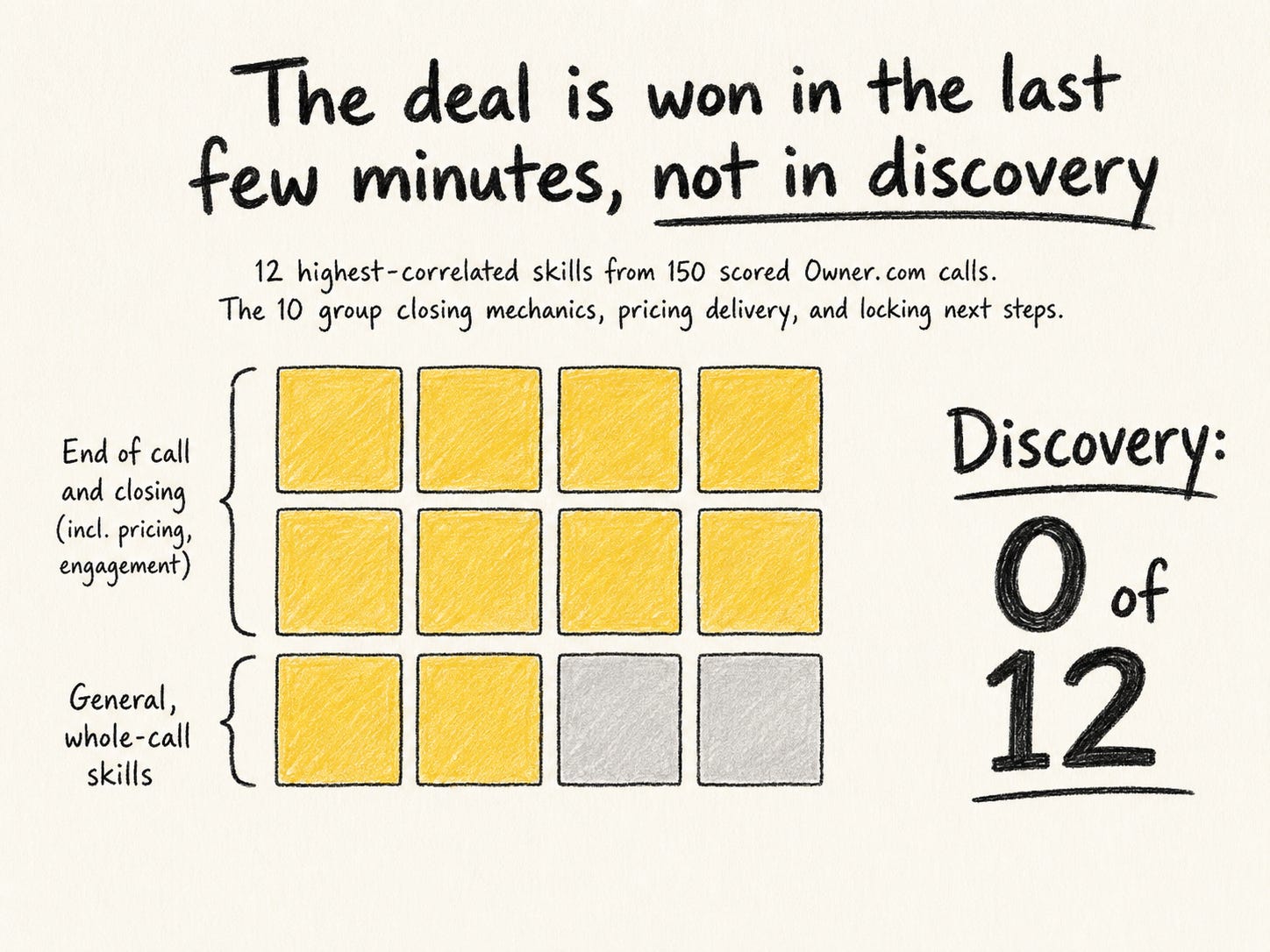
Here are the 12, grouped by where they happen on the call:
End of call (8 of 12):
Ask for the sale
Book the next call, even a placeholder
Help the prospect see the value of continuing
Agree on a real purpose for the next call
Gauge whether the prospect is leaning in
Ask for the next meeting to move the buying journey forward
Give next steps with clear reasons and value to the prospect
Make an assumptive close (fill out the form together)
Pricing (1 of 12): concise, transparent delivery that reiterates value.
Prospect engagement (1 of 12): the prospect leaves with a clear idea of next steps.
General (2 of 12): rep stays in control of the call, reads the room and simplifies language.
Discovery (0 of 12).
One caveat before you copy that. Owner sells to SMBs on a 1 to 6 day sales cycle, 1 or 2 calls to close. In that motion the deal is won or lost in the last few minutes of the call, which is why end-of-call mechanics topped their list. So don’t copy their answer. Copy their system: score your own calls and coach whatever separates your won deals from your lost ones.
Here’s what they do, in four steps.
Hire for DNA, then audit it. They hire raw, coachable people, often straight out of school, for drive, coachability, organization, and curiosity. Then every quarter they run a hiring autopsy: line up interview scores against actual attainment and re-fit the scorecard.
Manufacture the craft instead of buying it. An oversized enablement team installs skill faster than you could hire it, using a four-step loop borrowed from MMA coaching: introduce, isolate, integrate, inspect. Most enablement skips isolate and integrate and jumps straight from “here’s the skill” to “now go do it.” That gap is why training doesn’t stick.
Let the data tell you which craft to coach. The 150-skill analysis pointed at end-of-call mechanics, not discovery. So they ran three sequential modules on closing only, ten weeks, with calls scored daily, changing one thing at a time. Win rate moved from 38% to 52%.
Wire it into one signal system. The Skills Intelligence Center, an Owner build, marries the human read of a call with the machine read, and feeds both coaching and hiring off the same signal.
Talent and enablement compound together. Owner hires coachable people, then runs them through a real coaching machine. Raw talent without the machine stays raw. The machine without coachable people has nothing to work with. Put both on the BDRs and they book more, ramp faster, and stay longer. Put both on the AEs and they close more of what the BDRs source. Two stages lifted at once. That’s the compounding.
That explains another part of the $120K closed-won per BDR per month story. Owner got more precise about who could actually operate inside the machine, then made each of those people better.
Why it compounds instead of adds
The jump from $72,000 to $120,000 came in small lifts at each stage of the funnel, and the lifts multiply.
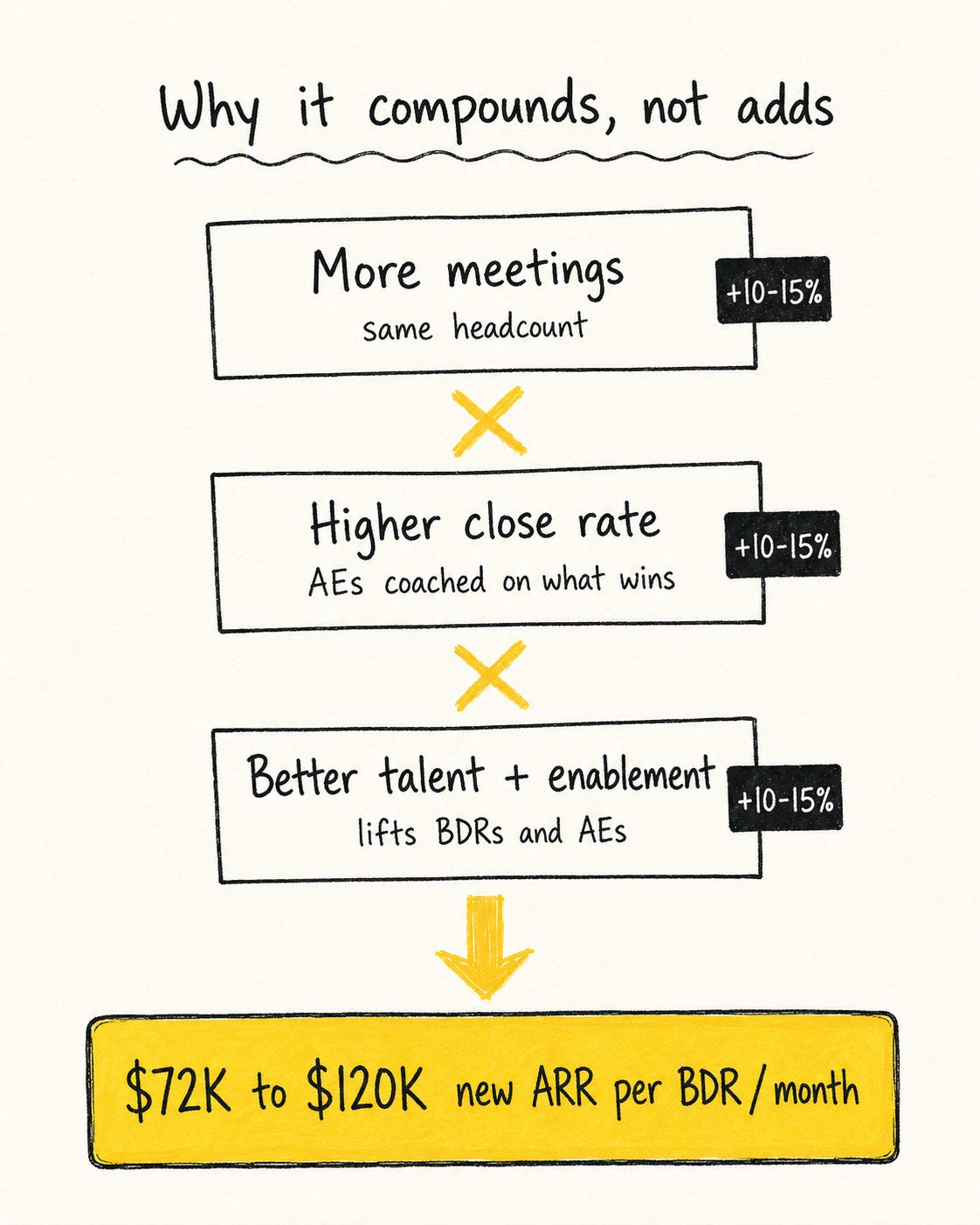
Hire the right people. Coach them on the skills that actually correlate with winning. Hand the research to AI so reps (XDRs + AEs) get selling time back, which means more conversations. The conversations are better prepared, so better conversion. More of those meetings close, because the AEs got better at closing. Reps ramp faster and stay longer.
Move four stages of the same funnel 10 to 15% each, and the gains multiply. $72,000 to $120,000 in closed-won per BDR per month. $1.44M a year, per rep.
With a team of 15 BDRs. At $72,000 each, that team sourced $1.08M in new closed-won ARR a month. At $120,000 each, it’s $1.8M. Same 15 reps, $720,000 more every month, about $8.6M more a year. That’s the lift from compounding alone, before they hire a single new rep.
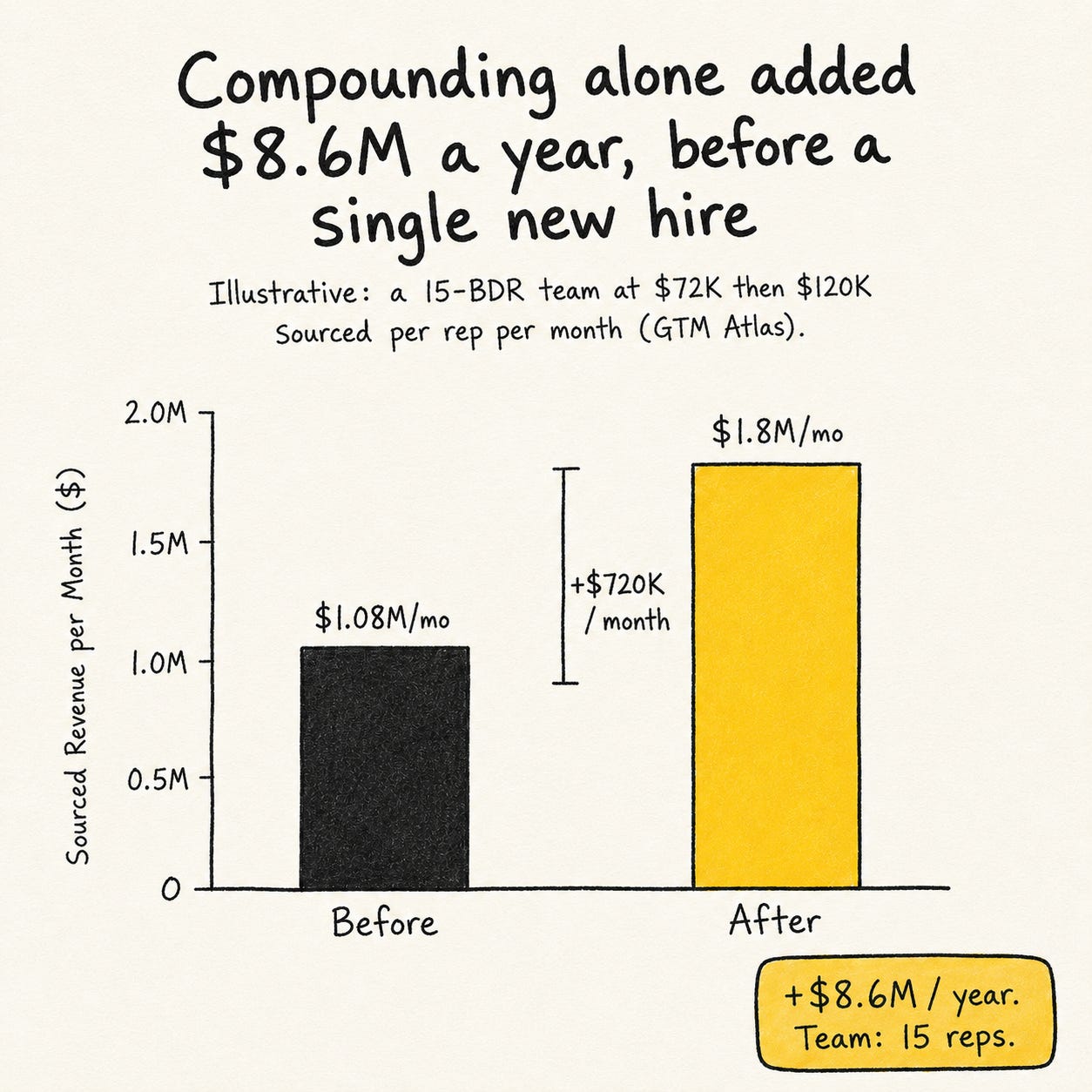
And they are hiring. Their sales team grew from 64 to 93 reps (past 12 months). So the two effects stack: each rep produces more, and there are more reps producing. Every new BDR now ramps into a $1.44M-a-year seat instead of an $864K one. The per-rep gain is the multiplier. Headcount is another multiplier on top.
This is the sub-two-hour marathon of outbound.
In April 2026, Sabastian Sawe won the London Marathon in 1:59:30, the first official sub-two-hour marathon in history, breaking a barrier the sport had called impossible for decades. Overnight it reset what every coach and runner believes a body can do.
Owner just did that for an SDR team. $1.44M sourced per BDR a year is the new proof of where the outbound ceiling sits in 2026.
What you can actually take from this
Even if you don’t have 100 reps. Or you don’t have an in-house GTM engineer building you AI pre-call research in two weeks.
Good news: the lesson doesn’t need any of that. The lesson is the order of operations.
First, give the structural decision its due. Pick one owner for AI and systems on your team, even if that owner is you for now. The compounding only starts when one person owns the loop instead of every rep building their own.
Then find the bottleneck. The manual work on your BDRs and AEs, the contacts added to a sequence by hand, the research before every call.
Then pick two compounding bets, not ten. Take the busywork off your reps so they sell more, and fix one stage of the funnel with depth, the way Owner fixed closing. Two stages moved on purpose beats ten tools bought in a panic.
This is the same equation I keep coming back to: strategy, leadership, talent, systems, enablement, and outbound process. Multiplied, not added.
So when someone asks what one thing Owner added, the honest answer is still: there isn’t one. They put AI under a central team, pointed it at the boring 60% of the job, coached the humans on the one skill that moved the number, and let it compound.
You can build a smaller version of that system this quarter.
Hope you enjoy this was helpful!
See you in the next newsletter.
Elric
P.S. Two things.
Building systems like this is what I do with clients right now. If you want help finding where your funnel leaks and fixing one stage with depth, reply and tell me what your motion looks like.
And I’m building something new (the Pantry) to upgrade the paid newsletter: a way to build these systems without me in the room. The frameworks I unpack in breakdowns like this one, plus the workflows to run them inside your own company.
Resources: