


👋 Hey chef, Elric here! Welcome to this week’s free edition of Outbound Kitchen. Each week I dive into reader questions about creating outbound systems for sustainable growth. Thinking about going paid? Here’s what you’ll unlock right away:
Instant access to 40+ paid newsletters, including:
My Outbound Chef Kit: 130+ resources (20+ email templates, cold call scripts, AI prompts, top tools, and more). Value: $1,000+
And the best part? You can try it free for 7 days. Cancel anytime.
But I think you’ll love it!
👉 Start your free trial today.
Two weeks left in 2025.
I spent a few hours this week reflecting on 2025, studying the top outbound teams, working with customers across early-stage to $50M ARR, and talking to GTM leaders and B2B founders about what’s actually working.
If you own outbound at your company, whether you’re a CRO, VP Sales, GTM leader, or SDR Manager, this is for you.
Everyone on LinkedIn is saying the same thing:
“SDR teams are getting cut. Outbound is dead. AI is replacing reps.”
I started tracking the data. Here’s what actually happened:
→ March 2025: 170,000 SDRs globally
→ December 2025: 190,000 SDRs globally
+20,000 SDRs in 9 months.
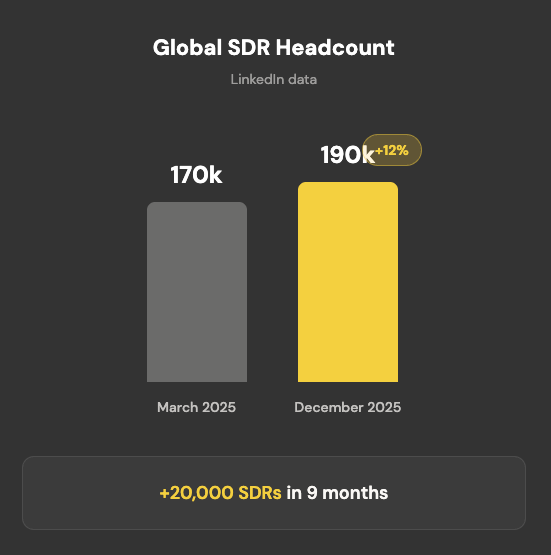
Outbound isn’t dead. Companies still need reps. But the playbook changed, and most teams didn’t adapt.
Here’s what I learned.
8 Things I Learned About Outbound in 2025
1. Outbound isn’t dead. It’s just harder, and most companies are still running the 2022 playbook.
I heard “outbound is dead” more times this year than I can count.
It’s not dead. But it is getting significantly harder—and the data proves it.
The numbers tell the story:
According to Jacco van der Kooij (CEO of Winning by Design), conversion rates have been plummeting:
2015: 100 cold emails = 1 opportunity (1% conversion rate)
2018: 200 outbound attempts = 1 opportunity (0.5% conversion rate)
2023: 1,000+ attempts = 1 opportunity (0.1% conversion rate)
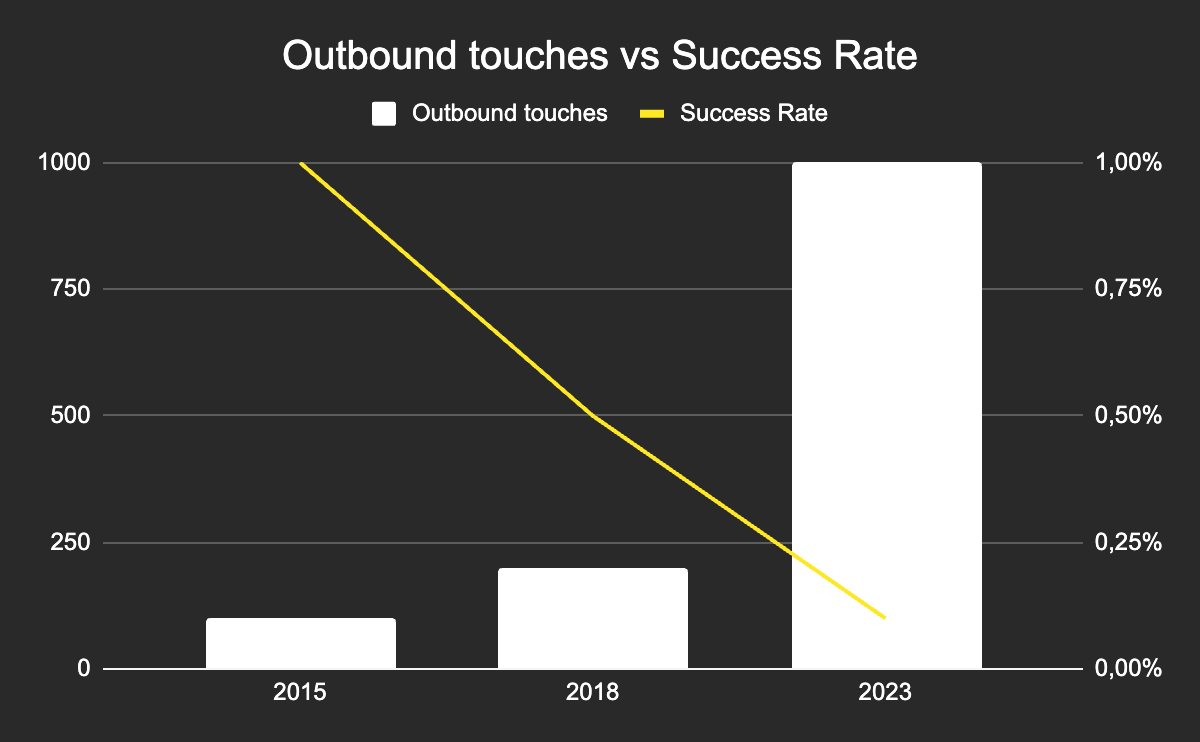
At the same time, SDR salaries nearly doubled, from $44K in 2015 to $85K by 2025.
Lower conversions + higher costs = drastically lower ROI.
Why is this happening?
Channel saturation. The same thing that happened with ads is happening with outbound.
You don’t read every ad on your phone anymore, you’ve learned to tune them out. Prospects are doing the same with outbound.
They’re getting more messages than ever. Some written by AI. Some written by reps. Most are bad. And AI has accelerated this problem, making it easier to send more volume, which creates more noise.
But here’s what most companies miss:
The companies saying “outbound is dead” are the same ones making the same mistakes:
Wrong execution
Wrong expectations
Hiring junior SDRs and hoping they figure it out
Junior reps used to be able to handle outbound at early-stage companies. Not anymore.
Outbound in 2025 requires experience. If you hire junior reps, you need a founder or head of sales deeply involved, training them, showing them what works, iterating with them.
You can’t hand someone a sequence and wait for results. The bar is too high now.
The takeaway:
Outbound is harder. That’s a fact. But it’s not dead.
The teams that are winning have adapted. They’ve invested in systems, hired the right people, and built processes that cut through the noise.
The teams that are losing are still running 2022 playbooks, high volume, low quality, hope-based prospecting.
If you don’t have the right people and the right systems, you’re not going to get results.
2. The top outbound teams do 100 things well, not one thing great.
I studied the best outbound programs this year. Snowflake. Ramp. ClickUp. Owner.com.
They don’t have a silver bullet. They invest heavily across the board:
Data infrastructure
AI and automation
Training and enablement
Hiring the right people
Think of it like a Michelin-star kitchen. Each person is specialized. Each part of the system is optimized. They don’t succeed because of one dish, they succeed because everything works together.
That’s what top outbound teams look like in 2025.
Most companies are still looking for the one tactic that will fix everything. It doesn’t exist.
3. AI is the productivity unlock, but only if you build systems, not just buy tools.
Snowflake 15x’d their reply rate using AI to write outbound messages.
One of my clients showed me what their team was writing versus what AI could produce. The AI output was better, faster, more relevant, better structure.
But here’s what most companies miss: AI doesn’t replace your team. It multiplies their output.
The best teams I worked with this year use AI for:
Data enrichment and cleaning
Automated research
Message writing
Spotting patterns (deal risk scoring, pipeline alerts)
Enablement and scorecards
Meanwhile, most companies bought ChatGPT seats and told their teams to use it manually.
That’s not a productivity unlock. That’s just adding another tool to the stack.
Here’s the real unlock: Build AI workflows that run in the background and push outputs directly into your CRM or sales engagement platform, where your team actually works.
But it’s not plug-and-play. AI needs training. Snowflake iterated 140+ times to get their prompts right. One of my clients took 30-40 iterations just to dial in messaging.
The business implication: Companies that invest in AI systems (not just seats) are generating the more pipeline with the same headcount. Companies that don’t are stuck scaling linearly, more reps, more cost, same results.
If you’re not willing to invest time in building and training your AI workflows, you won’t see results.
4. Productivity is the new competitive advantage, and most teams are leaving 2x on the table.
Owner.com has BDRs booking 40 meetings a month for their SMB motion.
Most teams are stuck at 10 meetings a month.
What’s the difference?
They optimized for productivity. They built systems that let their team spend maximum time on high-quality prospecting, not preparing to prospect.
Here’s the biggest mistake killing outbound ROI in 2025:
Your team is still doing work that should be automated.
If your reps are spending time on:
Manual research
Finding and cleaning data
Writing individual emails from scratch
Toggling between 5 different tools
You’re burning budget on low-value work.
Top teams automate in the backend, data, research, AI, and push the output directly into the tools where reps work.
The question to ask when evaluating your stack: Is this removing friction for my team, or adding it?
Most companies are still buying tools FOR their team to use. They should be buying tools that run IN THE BACKEND and make their team more productive without them touching it.
Here’s what this means for your business:
The old playbook: Hire 10 reps. Scale headcount. Generate pipeline.
The new playbook: Hire 5 reps who produce the output of 10.
The ROI:
Lower headcount cost (cheaper)
Higher rep productivity (more pipeline/revenue per rep)
Better rep retention (higher commissions, less burnout)
But it requires investment in systems, AI workflows, automation, data infrastructure that runs behind the scenes.
The litmus test: Can I 2x my team’s output with better systems? If not, you’re underinvesting in infrastructure.
Most GTM leaders are still focused on hiring and coaching. Not enough are focused on building the systems that make their teams 2x more productive.
Which brings me to the next learning.
5. Most GTM leaders are investing in the wrong layer of their outbound motion.
This is my most contrarian take.
I stopped listening to most outbound & SDR leadership content this year. Here’s why:
Everyone is focused on coaching. Enablement. How to ramp reps faster. How to run better 1-on-1s.
I’m not saying enablement and coaching aren't important.
They are.
But if you don’t have the right systems, coaching won’t save you.
There are 3 pillars to outbound success:
Talent – Do you have the right people?
Systems – Do you have the right tech stack, AI workflows, and data infrastructure to maximize productivity?
Enablement – Are you training and coaching your team so they can be successful and actually enjoy the role?
Most GTM leaders invest heavily in #1 and #3. They don’t invest enough in #2.
They buy 2-3 tools, run a training on those tools, and think they’re done.
They’re not building systems. They’re adding tools and hoping their team figures it out.
Here’s the reality:
Outbound is getting harder. Channel saturation is increasing. If you don’t have systems that maximize productivity, your coaching won’t matter.
You can train your team on messaging all day long. But if they’re spending 6 hours a week on manual research and data cleanup, you’re not going to 2x results.
The best GTM leaders in 2025 invest in systems first, then coach on top of that foundation.
6. You need to validate outbound before you scale outbound, and most early-stage companies skip this step.
Product-market fit is the first milestone for early-stage companies.
But there’s a second milestone most companies skip: validating your outbound motion.
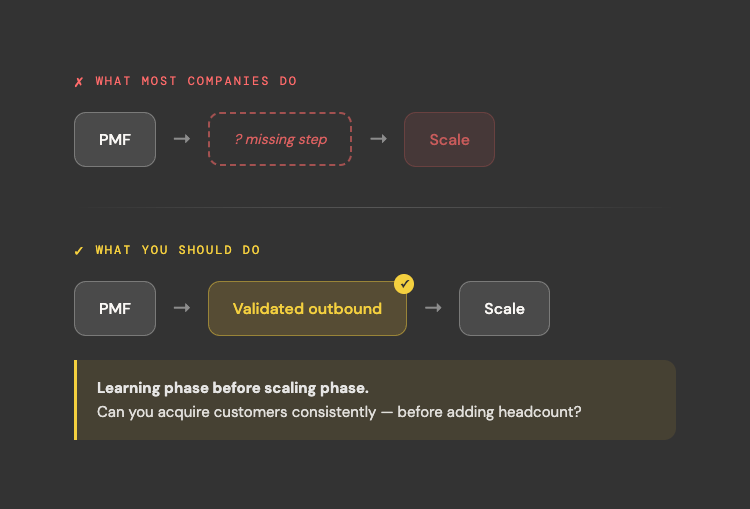
Here’s the mistake I saw over and over this year:
Companies hit product-market fit, then immediately try to scale outbound. They hire a team of SDRs, buy a stack of tools, and hope it works.
It doesn’t.
You can’t scale what you haven’t validated.
If you’re an early-stage company just getting started with outbound, your goal isn’t to scale. It’s to validate:
Is your ICP right?
Does your messaging resonate?
Are your channels working?
Can you get repeatable results?
Once you have that, once you’ve proven the motion works, then you can scale.
Skipping this step is why so many early-stage outbound motions fail. They go straight from zero to hiring 5 SDRs without ever proving the system works.
Don’t make that mistake.
7. In competitive markets, outbound creates timing, and most companies are leaving market share on the table.
Here’s a learning I didn’t expect:
I worked with a company this year selling into a traditional, competitive market. Their competitors weren’t doing outbound. They were creating content, going to conferences, waiting for inbound.
My client went proactive. They built an outbound motion and started reaching out to the right companies before their competitors even knew those companies were in-market.
The result: They’re gaining market share while their competitors wait around.
Here’s the insight:
Outbound doesn’t just generate demand. It manufactures timing.
If you’re in a competitive market and your competitors aren’t investing in outbound, that’s a massive opportunity.
Most companies think outbound is only for high-growth SaaS companies. That’s not true.
If you’re in a market where competitors are reactive, outbound is how you win.
8. Most companies that say “outbound is dead” are just bad at it, and they don’t even know what outbound actually is.
When I hear “outbound doesn’t work for us,” 99% of the time it’s bad execution.
Here’s what happened:
They hired 2 junior SDRs. Gave them a list. Told them to send 10,000 emails. Got no results. Declared outbound dead.
But the deeper problem isn’t just bad execution, it’s that they don’t know what outbound actually is.
Most companies think outbound = cold emails sent by SDRs.
That’s not outbound. That’s cold outreach.
Real outbound is a full-funnel, cross-functional motion:
SDRs prospect and book meetings
AEs close outbound deals, which requires different discovery, different process, different training than closing demo requests (AKA order takers)
CSMs and Account Managers proactively reach out for upsell and cross-sell opportunities, they don’t wait for customers to contact them
If you only invest in “SDRs sending cold emails,” you’re not doing outbound. You’re doing bad cold outreach.
And then you wonder why it doesn’t work.
Outbound is a system. It’s not a tactic. It’s not a top-of-funnel SDR function you can hire two people to figure out.
It’s a shift in how your entire GTM team operates.
What This Means for Your GTM Strategy in 2026
If you’re running outbound right now, here’s what you need to prioritize depending on where you are:
Early-stage companies:
Validate your outbound motion before you try to scale it. Prove your ICP, messaging, and channels work first.
Focus on the right 1,000 companies, not 40,000. Use AI to identify companies currently struggling with the problem you solve.
If you hire junior reps, make sure a founder or head of sales is deeply involved in training and iteration.
Track your champions moving to new companies. That’s your lowest-hanging fruit.
Companies with existing teams:
Strategic priority #1: Invest in systems that maximize team productivity. Automate research, data, and message writing in the backend.
Stop adding tools for your team to use. Add tools that run behind the scenes and push outputs into their workflow.
Ask yourself: Can I 2x the output of my current team with better systems? If not, you’re underinvesting in infrastructure.
Measure what matters: Track qualified pipeline and revenue generated by outbound, not just activity metrics.
B2B companies in competitive markets:
If your competitors aren’t doing outbound, you’re leaving market share on the table. Build a proactive motion and reach the right companies before they do.
Outbound isn’t just for high-growth SaaS, it’s for any market where you can manufacture timing and win deals before competitors know they’re available.
Outbound isn’t dead. But the playbook from 2022 is.
If you’re still running the old motion, manual research, junior reps, hope-based prospecting, tools stacked on top of tools, you’re going to keep struggling.
The teams winning in 2025 built systems. The teams that will win in 2026 will too.
What did you learn about outbound this year? Hit reply and let me know.
Let’s get cooking!
See you in the next newsletter.
Elric
Thinking about upgrading to the paid newsletter? Here’s what you’ll get:
Instant access to 40+ paid newsletters, including:
My Outbound Chef Kit: 130+ resources: 20+ email templates, cold call scripts, AI prompts, top outbound tools, and more, everything the best outbound teams use. Worth $1,000+
And the best part? You can try it free for 7 days. Cancel anytime.
But I think you’ll love it!
👉 Start your free trial today.
As soon as you’re ready, here’s how I can help:
Outbound Consulting Call: Need quick help? Book a 40-min session here.
Outbound Private Chef:
Part-time, I’ll build, optimize efficiency, and execute your outbound strategy.
Coaching/Advising: get tailored advice to fix your strategy, boost efficiency, and drive results.
Interested? Reply to this email or hit me up at bonjour@elriclegloire.com
Validating outbound is much like Mark Roberge's Go-To-Market fit. Once you have PMF, you need GMF. Knowing how to take your product to your customers.
Love this perspective, Elric! It's so interesting how the data counters all the LinkedIn chatter. Whats the biggest shift in the new outbound playbook?