


New podcast episode is up!
Watch on YouTube, listen on Spotify, listen on Apple Podcasts, or listen on Snipd.
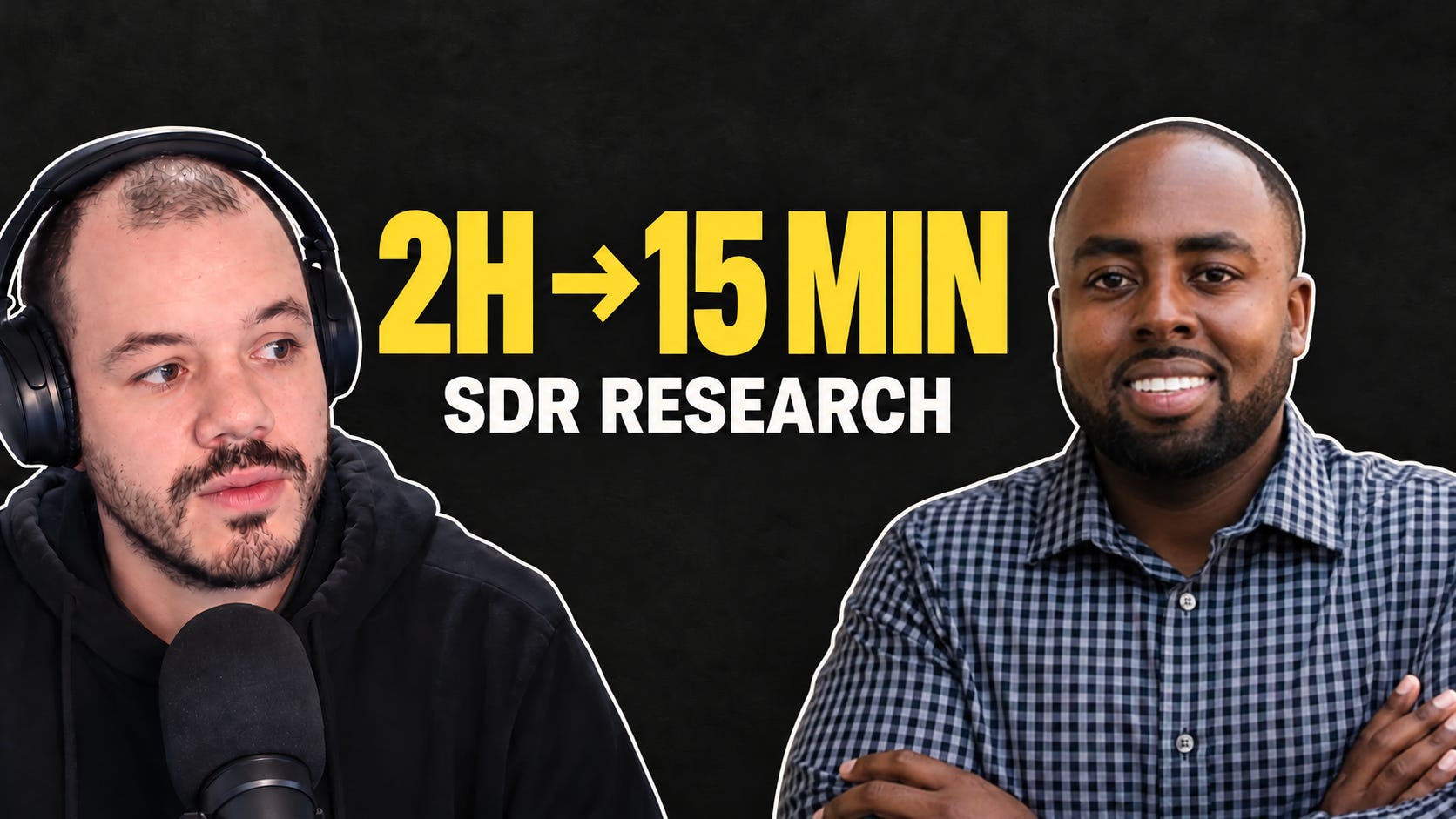
Morgan Williams is Director of Sales Development and GTM Engineering at Flexport. His team completed 14 straight months above quota while Flexport raised the target twice. The team reached 181.8% against the current quota in August.
We broke down the operating system supporting that performance: AI-powered research, account and contact scoring, signal-based prioritisation, coaching, and one end-to-end workflow for the rep.
Morgan says one of those workflows reduced account research from about two hours per SDR per day to roughly 15 minutes. That gives reps more time for conversations and coaching.
We discuss:
Measuring conversation quality through meetings booked per decision-maker connect
Removing non-revenue work before adding more activity
Reducing account research from about two hours to roughly 15 minutes
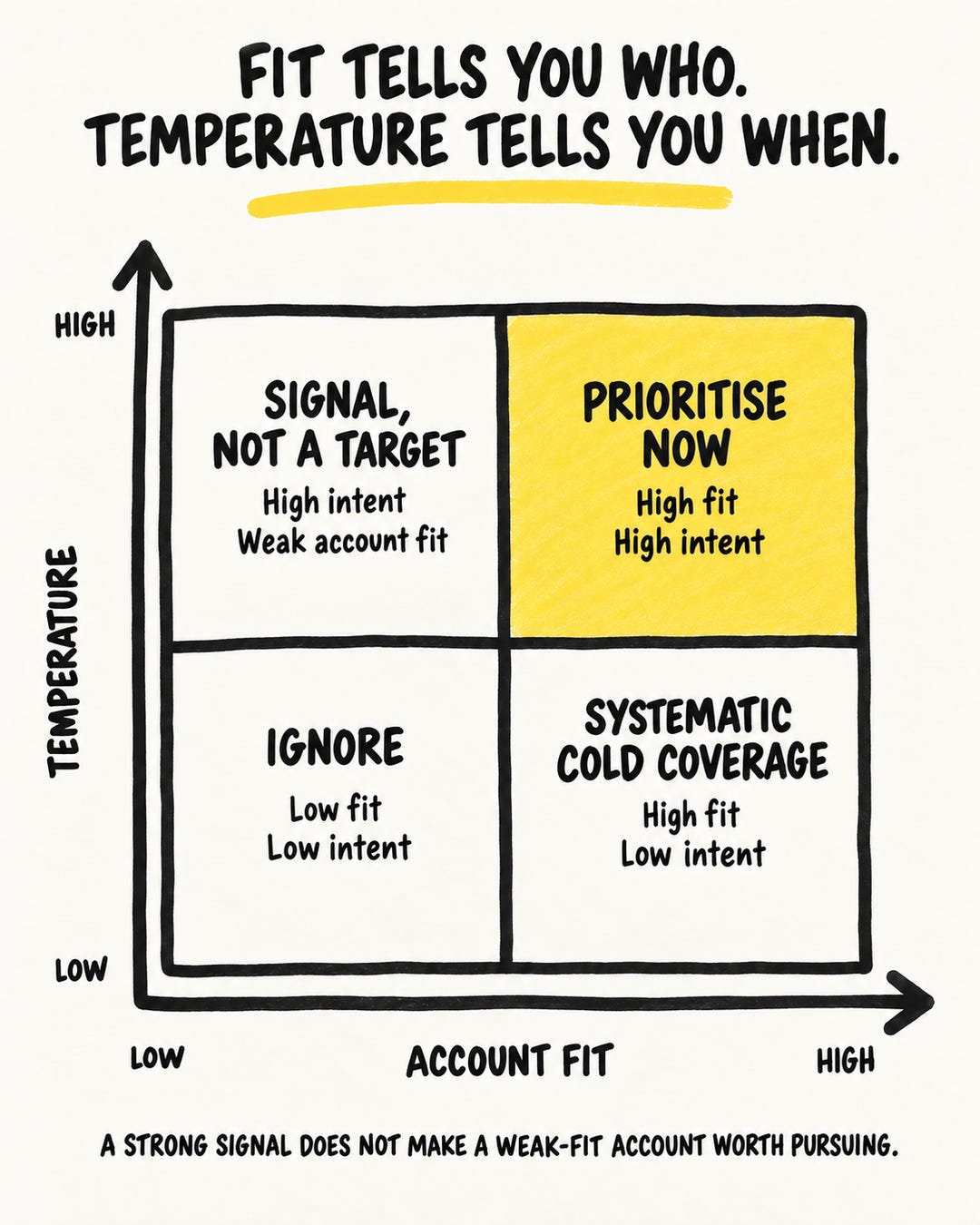
Separating account fit from account temperature
Combining high-volume cold outreach with high-signal precision
Using 62 account and contact features to predict pickup likelihood
Coaching reps according to prospect intent and familiarity
Building adoption through pilots, sources, feedback, and co-authorship
Referenced:
My biggest takeaways from this conversation:
Quick note before these. Morgan built this inside Flexport, with its data, systems, and market. The specifics are theirs. The thinking is what carries over. Read each play for the principle under it, then adapt it to your own team.
The Big Idea
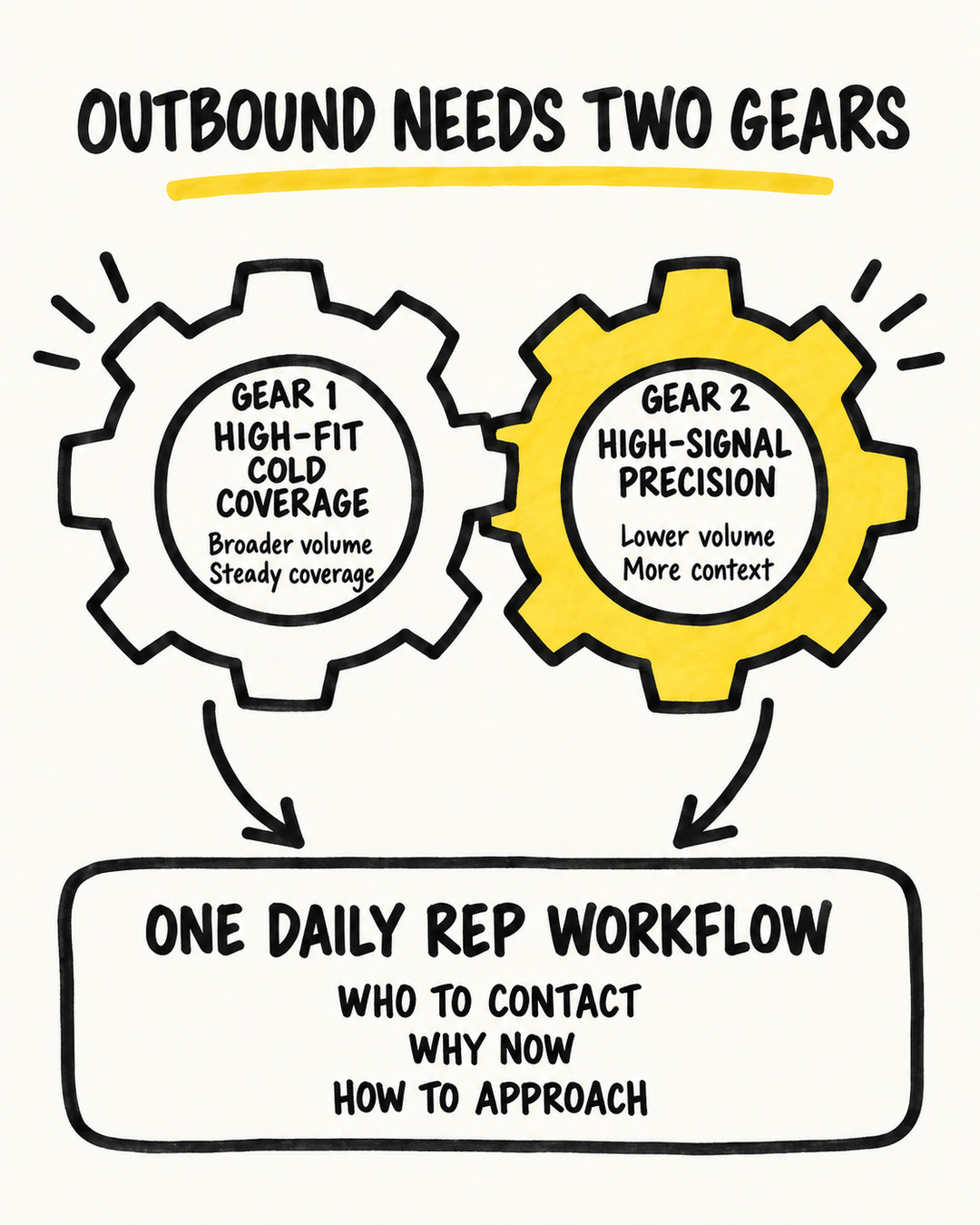
Put the complexity in the backend. Give reps one place to decide who to contact, why now, and how to approach the conversation.
Flexport’s operating system is made of several layers. A button in Salesforce sends an account through roughly 12 to 18 enrichments in Clay. The results return to fields inside Salesforce. Account and contact scores show fit. Temperature shows current engagement. A pickup-likelihood model adds another signal. A dashboard then turns those layers into a daily workflow.
The rep does not need to manage every tool behind it. They work mainly from Salesforce, then move contacts into Gong Engage or Trellus for outreach.
That distinction matters when people talk about consolidating the sales stack. The useful measure is how many tools a rep has to manage during the day. Your backend can stay sophisticated while the rep’s workflow stays simple.
Remove Non-Revenue Work First
When teams want more output, they usually start with activity: more calls, more emails, a power dialer, another automation tool.
Flexport started with a time study of the SDR day. Morgan found that reps were spending about two hours a day researching accounts and preparing before they could call. The first workflow turned that work into a button inside Salesforce and brought the research time closer to 15 minutes.
Only then did the team layer in power and parallel dialers.
The order matters. Faster dialing has limited value when the rep still spends a large part of the day deciding who to call and gathering the same information by hand. Remove the work that keeps them away from conversations, then use the recovered time for calls and coaching.
The two-hour-to-15-minute figure is Morgan’s estimate, rather than an independently audited measurement. The operating principle stands on its own: map the day, find the largest block of non-revenue work, and fix that before asking for more activity.
On Conversation Quality: Count Real Chances to Book
Morgan’s team measures meetings booked divided by decision-maker connects.
They keep gatekeepers, wrong numbers, and wrong contacts out of the denominator. The ratio answers a cleaner question: when a rep reached someone who could say yes or influence the decision, how often did the conversation turn into a meeting?
Meetings booked alone can hide weak targeting. A general connect rate can be diluted by calls that never had a chance to become a meeting. Morgan’s version isolates the conversations that matter, then lets the team look downstream at show rate and qualified pipeline.
This is replicable with one condition: the call dispositions have to be accurate enough to separate decision-maker connects from everything else.
On Prioritization: Keep Fit and Temperature Separate
One of my biggest takeaways was the separation between account score and account temperature.
The score answers: how well does this account match the ICP?
The temperature answers: who should I contact right now, based on engagement and intent signals?
Flexport calculates them independently and uses them together. Temperature refreshes four times a day, with first-party signals weighted more heavily than third-party signals.
This avoids a common signal-based outbound mistake. A company can show a strong trigger and still be a poor fit. A great-fit account can also be cold today and still deserve systematic outreach.
The workflow should preserve both decisions. First decide whether the account belongs in the market. Then decide how much urgency the current signals deserve.
On Coverage: Run Outbound in Two Gears
Signals cannot carry the whole motion. Flexport runs two gears:
Higher-volume cold outreach to high-fit accounts.
Lower-volume, higher-precision outreach to accounts and contacts showing stronger signals.
Both appear in the Salesforce dashboard through the nets, spears, and seeds model from Predictable Revenue.
Nets: the larger pool of high-fit accounts. Reps group them by segment or trigger and work them through the appropriate flows.
Spears: warmer accounts and contacts showing first-party or third-party signals. Reps start here and slow down enough to use the context.
Seeds: people who said “later.” The rep creates a Salesforce task, and the dashboard brings the follow-up back at the right time.
The two gears protect the team from overcorrecting toward signals. A team that only works visible intent can exhaust the small warm pool and let its cold-outreach skills weaken. High-fit cold coverage keeps the market moving while signals tell the rep where precision deserves more time.
On Calling: Use Your Own History to Improve the Next Dial
Flexport built a pickup-likelihood model from years of SDR call data already stored in its CRM.
The model looks at 62 account and contact features, then places contacts into four tiers: high, medium, low, or unlikely to pick up. It refreshes every night using new contacts and calling activity, then writes the result back to Salesforce.
The training signal matters. Flexport uses decision-maker connects as the successful outcome, so gatekeepers do not inflate the model’s definition of success.
The exact model is specific to Flexport’s data and technical capacity. The principle is available to more teams: review the outcome history already sitting in your CRM before buying another source of intent. Your own call data can tell you which patterns deserve another dial.
On Research: Give the Rep a Hypothesis
Automated research earns its place when it helps the rep start a better conversation.
For a cold account, the rep has only a few seconds to explain who they are and why the call is specific to that business. Flexport’s research gives them details they can connect to a problem the company may be facing.
Research should give the rep a hypothesis they can test. It should avoid claiming knowledge of what is happening inside the company. The rep can show the work, explain the business reason for calling, and let the prospect correct the hypothesis. Morgan said prospects often give you more time when they can see that you thought about their business.
Sources matter here. I have seen reps trust AI research more when the evidence link is attached to the output. They can check where the information came from before using it on a call.
On Coaching: Match the Conversation to Intent
A cold prospect and someone who registered for a webinar arrive with different levels of familiarity. Morgan coaches the team around that difference.
Cold calls require the rep to build familiarity quickly and lower the initial resistance. Research gives them a specific reason for reaching out. A warmer prospect already knows something about the company, so the rep can move more directly into the relevant context.
Flexport’s end-to-end dashboard helps managers see where each rep’s funnel needs attention, from dials through meetings booked. The coaching can then follow the actual gap. A rep with low pickup rates may need a better contact mix. A rep who reaches decision makers but books few meetings needs work on the conversation.
Signal-based outreach also creates a new coaching risk. Reps who spend most of their time with warmer prospects can lose some of their cold-outreach muscle. Morgan keeps both gears active and coaches the approach to the prospect’s level of intent.
On Adoption: Build With Reps Before You Roll Out
Morgan sees behavior change as the hardest part of the build.
Flexport pilots new workflows with a small group of reps. The team shows users how the system produces the output, collects their feedback, makes changes, and lets the results build trust over time. Reps still keep room to discover accounts and experiment on their own.
This is where co-authorship matters. A workflow imposed on the team asks for trust before the reps have seen it work. A pilot gives them a chance to test the data, point out failures, and influence what reaches the wider team.
The same principle applies to AI research. Include the source. Let the rep inspect the evidence. Make the feedback loop visible.
Morgan gave a useful adoption test near the end of the episode: once people start complaining that the system is broken, you know they depend on it. Praise can be passive. A repair request means the workflow has become part of the job.


