


This newsletter is sponsored by Influ2
[Live Webinar] Why account scores tell you too late
Account-level ABM waits for the score to spike. By then the buying group has decided and the wrong messages have already landed. Forrester’s Kelvin Gee joins Influ2 CEO Dmitri Lisitski to break down what orchestrating around individual buyers looks like instead. June 3, 12 PM ET.
In the past 2 weeks, I saw 4 GTM leaders (CRO and SDR leaders) asking about how to increase show rate. And I saw this on LinkedIn:
If you are using Calendly or Chili Piper and sending automated reminders, that's exactly why your show rate is sitting at 30 to 50 percent. Just remove the automation, run the handoff manually, and the show rate climbs.
Which I disagree with the framing that automation is the problem, I worked at Chili Piper. So I've seen our internal data and with customers.
So if you have 30-50% show rate, it’s a meeting quality problem.
The meeting was bad before it got booked.
P.S. For paid members, the full meeting-quality diagnosis scorecard with if-yes / if-no branches is at the end of the newsletter, including what to fix for your outbound team.
Show rate is a defect rate
Think of show rate the way a kitchen thinks about a plate sent back from the table.
When a dish comes back, you do not fix it by training the server to apologize faster. You walk back to the line. You find the station where the dish was made wrong. You fix the process there. The complaint at the table is just where you noticed the defect. The lever is upstream.
The meeting got booked. That part worked. But what got booked? A prospect who said yes to escape a cold call. An invite titled “Intro call” with no agenda and no reason to attend.
Reminders confirm a meeting the prospect already wants to attend. They do not create the reason to be on the call.
Show rate is the receipt at the end of a meeting-building process. Fix the process, not the receipt.
Bad meetings are created before the calendar invite is sent.
Once you accept that show rate is downstream, the question changes. The right question is: where in our process are we building meetings prospects don’t want to attend?
So if an outbound team has a 30–50% show rate, I’d first look at the sales process:
Is the account in ICP?
Show rate is the first place a bad account shows up, but it is not the last. The same account that no-shows the first meeting also tanks opportunity rate, deal size, and close rate downstream. If your SDRs are booking outside ICP to hit activity quota, you are building defects on purpose. Audit the booked accounts against your ICP definition before you audit anything else.
What is the channel used for booking the meeting?
Meetings booked via cold calling versus email or LinkedIn have a different show rate. Don’t expect the same show rate.
Did the prospect name a problem?
Curiosity is what got the prospect on the call. That is outbound’s job. But curiosity is not enough to make someone show up next week. A stated problem is. If the SDR cannot repeat one clear sentence the prospect said about their pain, the prospect was only interested. They were not committed. That meeting is weak.
How far out is the meeting booked?
The farther the meeting is, the weaker it gets. Same week is strong. 14 days out is risky. After 14 days, you are betting that the prospect will still care about the same problem. They probably won’t.
Did the prospect accept the invite live, on the call?
A live accept is the cheapest, strongest commitment device you have. If your reps are not asking for it, you are leaving show rate on the table.
Does the invite explain why you are meeting?
“Intro call” is not a reason. The prospect’s stated problem is a reason.
The data points upstream, not at the reminder
At Chili Piper, where I worked, we ran 80 to 90 percent show rate on outbound meetings, around 200 meetings per month. We had automated reminders, sure. We also had the meeting-building process I just described. The reminders were a layer. The meeting-building was the foundation.
Gong data, cited in Cold Calling Sucks, breaks it down by rep tier.
The average rep runs a 56.9 percent show rate on cold-call-set meetings.
The top quartile runs 72.5 percent. 1.3x the show rate.
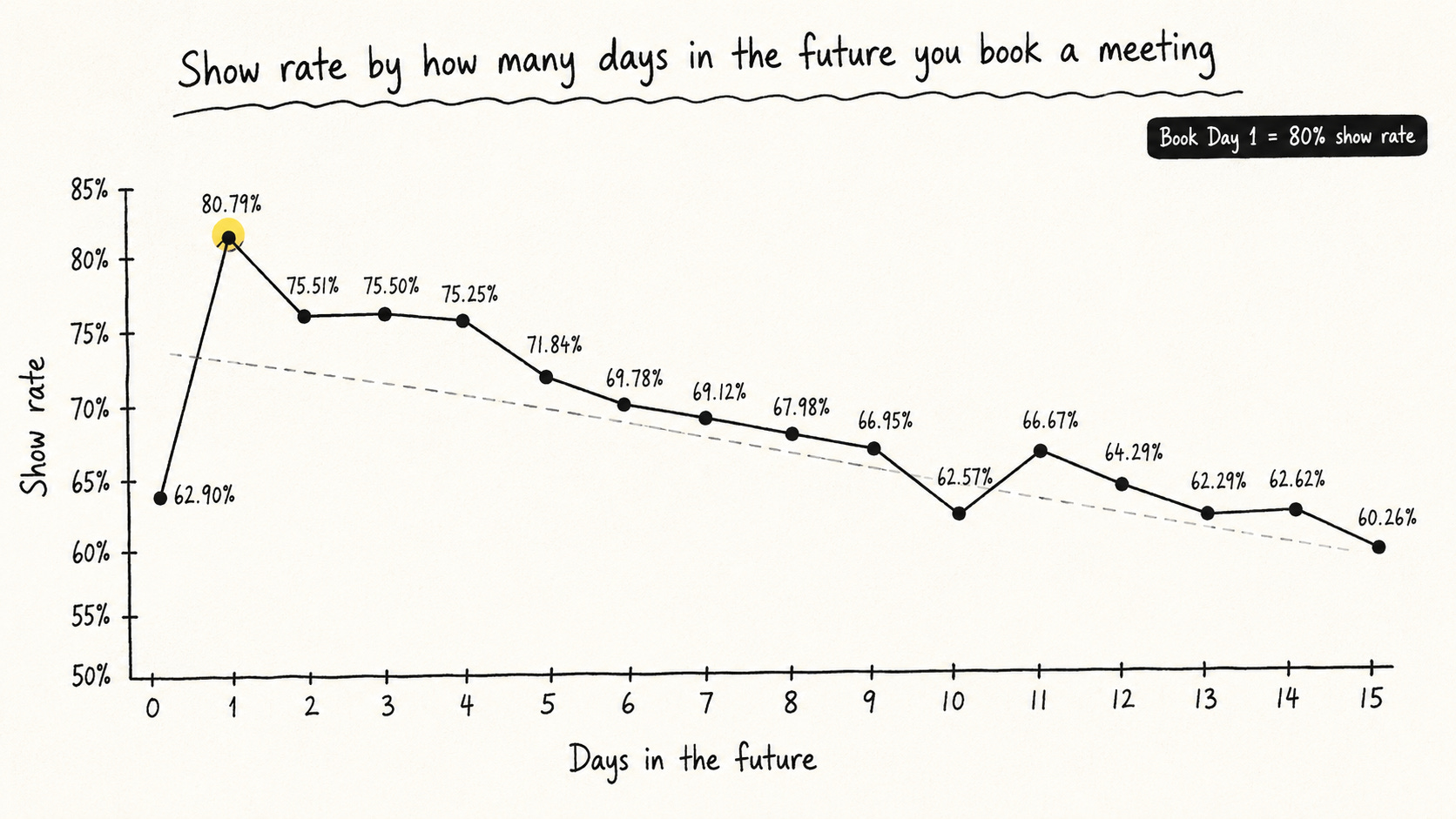
Tito Bohrt analyzed 6,414 meetings and found the same directional pattern on calendar distance. Same-week beats next-week beats two-weeks-out. The meeting was a stronger commitment at the time of booking.
Booking meetings 0-1 days out results in the highest show rate, peaking at 80.79% for day 1.
The show rate stays relatively strong for the first few days, around 75%, but starts to dip by day 5 and steadily declines to around 60% by day 14.
As always, compare apples to apples. If you sell to people on the ground, like restaurants, don’t expect to get 90 percent of show rate. Your show rate will look different from selling to office buyers who spend all day in their calendars.
So comparing show rates without segmenting by industry, persona, and channels can be misleading.
Show rate shows the result. Meeting quality is the lever.
Show rate is the metric you might check every Monday. Track it. If you want it higher, fix the meeting before you fix the reminders.
Outbound creates demand. We're here to give the best experience for prospects by creating curiosity on how we can help them fix their problems and change. If prospects won’t show up to the conversation, it was a politeness response on a cold call.
The fix is on the line.
That's it for today.
Hope this was helpful.
Elric
What’s coming
US Mobile data benchmark for 2026: Finally, wrapping this up, the benchmark will be sent this week.
For the paid newsletter
I’m still building The Pantry. It’s the next version of the paid newsletter.
I’ve been spending on how to design the next phase, don’t want to be just another “hub” just for content + templates like the paid newsletter. And working on the MVP.
Here’s what the membership will give you:
Self-assessments and trainings that work like a kitchen audit. You walk your line, find the station slowing the whole pass down, and fix it this week.
AI workflows, prompts, and skills you can run today. Example: scraping attendee lists from tradeshows and conferences.
The methodology, built in the open. You’re on the journey with me as I turn what I do with customers into SOPs and frameworks.
The system runs on any CRM, any SEP, any market. With AI you depend on tools less anyway. You build your own layer on top.
Trained on real reps. What I run with customers, what I test, what top teams do. It gets sharper every month.
New: Pricing when Pantry launches: $79/month or $499/year.
To everyone who supported the paid newsletter until now: thank you. You made this possible. That’s why your current rate stays, a small way to say thanks.
Already a paid subscriber? Nothing changes as long as you stay subscribed. (If you cancel and come back later, the new rate applies.)
On the fence? Subscribe before The Pantry goes live to lock in the current rate.
For Paid Members
Scorecard: The meeting-quality diagnosis
The full meeting-quality diagnosis scorecard with if-yes / if-no branches. Including what to fix.