


Brought to you by:

How ElevenLabs took outbound from 5% to 30% of pipeline
ElevenLabs moved its EMEA team off too many disconnected tools onto lemlist. One campaign hit 71% interaction and 25% replies. Jon, their SDR lead: ‘it has been built by people who really understand outbound.’

Last year I published a breakdown of how Ramp reached $1B in annual recurring revenue with outbound.
If you missed it, read the original Ramp breakdown.
This follow-up has three parts:
They shut down their Outbound Automation Team (OATs), their artificial intelligence (AI) sales development representative (SDR) program.
They expanded the infrastructure behind it into Ramp Revenue and an internal Model Context Protocol (MCP) layer called Growth MCP.
Two other takeaways around outbound and go-to-market (GTM): how they experiment with a 150+ person SDR org, and their outbound guardrails.
1. Ramp shut down OATs and reinvested in human reps
On December 2, 2025, Ramp co-founder Gene Lee announced that the company was shutting down Outbound Automation Team (OATs), their AI SDR Program.
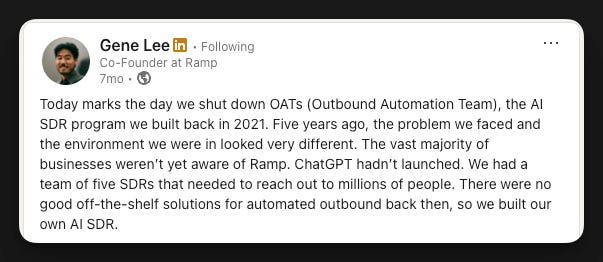
OATs had generated 30% of Ramp’s pipeline for years.
Ramp built OATs in 2021 because 5 SDRs needed to reach millions of businesses. Good AI SDR products did not exist, so Ramp built its own.
OATs drafted messages, classified replies, and organized inboxes.
Building it also meant creating a database of Ramp’s entire total addressable market (TAM) in Snowflake, enriched with technographic and firmographic data from dozens of sources.
At that time, Ramp split the market into two funnels:
Tier 1 accounts went to the human GTM team.
Tier 2 and Tier 3 ran through the automated funnel.
That setup made sense when Ramp had one main product, a large market, and a small sales team.
By 2025, dozens of automated-outbound products were available. Competitors could access similar data.
Ramp had several flagship products that required more complex sales conversations. Prospects were receiving more cold outreach.
The return on their automated funnel started to plateau.
In Clay’s June 2026 Future of GTM livestream, Ramp Growth Product Manager Keyan Sarrafzadeh added another reason.
Buyers of a complex financial product want human connection. They ask detailed questions and want to put a face to the name.
Ramp already employs “talented storytellers” who go into the market. Ramp chose to make those humans more targeted with who they go after and how.
Ramp shut down the program, merged the funnels, and reinvested the Growth Engineering team across the full GTM organization.
Gene described the decision:
“We’re raising both the floor and the ceiling by giving every person at Ramp the same advantages the OATs system had in a silo.”
He also named the areas where Ramp would continue building:
Group selling and orchestration
Multi-channel incentives and experimentation
Customer relationship management (CRM) foundations and integrations
Online and centralized customer data
A consolidated interface for reps
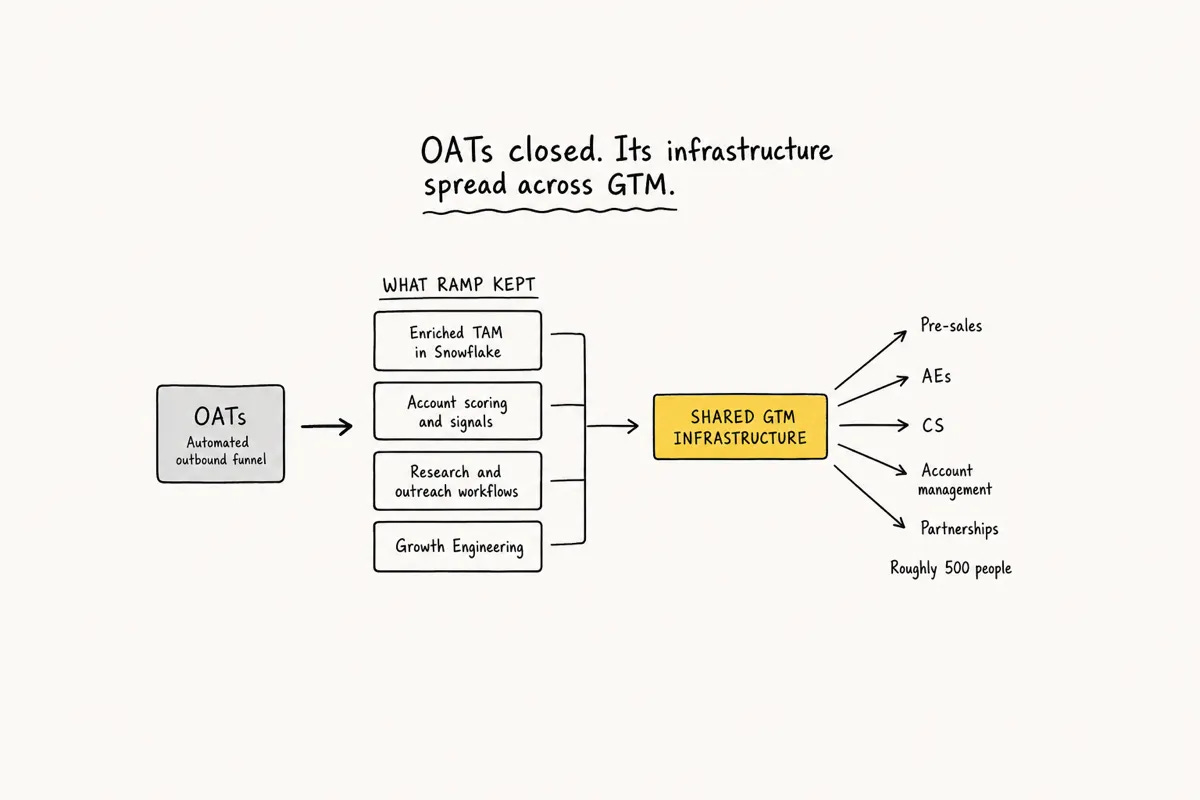
2. Ramp expanded OATs into a centralized engine with decentralized interfaces
A. The Growth Platform team owns Ramp’s GTM foundation
In my first Ramp breakdown, I found that they had engineers dedicated to supporting the outbound and sales teams.
Today that pod is called the Growth Platform team. It is a full product team with product managers, engineers and designers working alongside data scientists.
Its remit grew from the AI SDR program to the data platform behind Ramp’s go-to-market and tooling for the entire sales org.
It now serves:
SDRs
Account executives (AEs)
Customer success
Account management
The engineers and designers work full-time on the team. They are not borrowed from a central pool.
The team supports virtually all of outbound, from prospecting and copywriting to call scripts.
It even builds post-booking tools designed to increase the odds that a booked prospect shows up to the demo.
B. Each product layer was built on the previous one
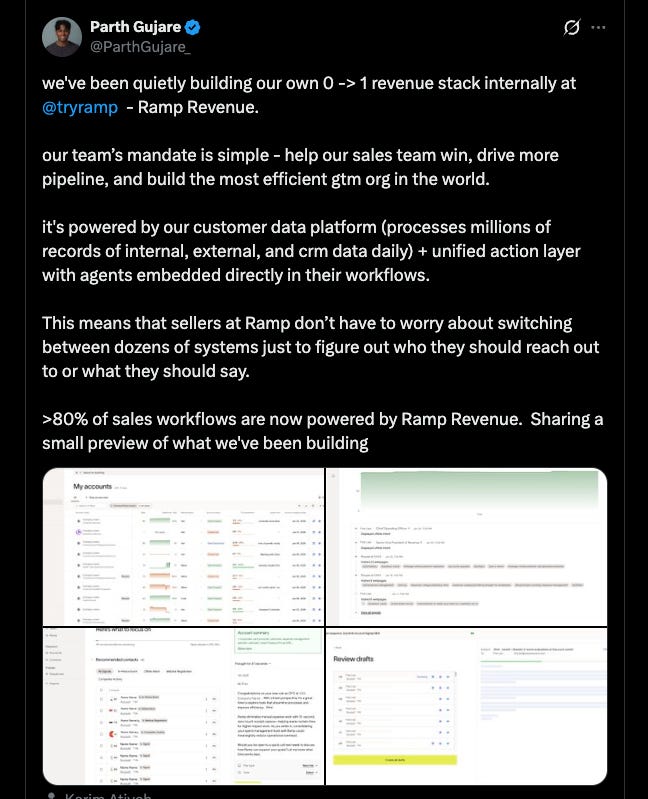
Two months after Gene’s shutdown post, Parth Gujare publicly shared Ramp Revenue on X.
He is Ramp’s Senior Product Manager for Acquisition, Activation, and Expansion.
Ramp Revenue is the internal product Ramp’s reps use to decide who to contact and understand the account, then draft outreach and complete follow-up work.
Three weeks after the Clay panel, Deepline published a second talk with Keyan: How Ramp let 400 reps build their own custom GTM tools.
In it, he walked through a four-to-five-year build sequence:
OATs
An enriched database of Ramp’s total addressable market
A customer data platform (CDP) app: an audience builder
Ramp Revenue
Growth MCP
C. Ramp Revenue gives reps one centralized application
Ramp Revenue covers a rep’s book of business, account signals and daily priorities.
It also handles drafted sequences, meeting preparation and call follow-ups.
Underneath it is Ramp’s customer data platform, which processes millions of records from internal, external and CRM sources every day.
A unified action layer connects those records to actions inside rep workflows.
An SDR opens the product in the morning and sees recommended contacts.
Signals include an in-person event, offsite intent or a webinar registration. Competitor activity can also trigger a recommendation.
The SDR can then open the account and see:
why the account is worth attention
an account summary
the source behind the recommendation
a first email draft
the option to refine that draft
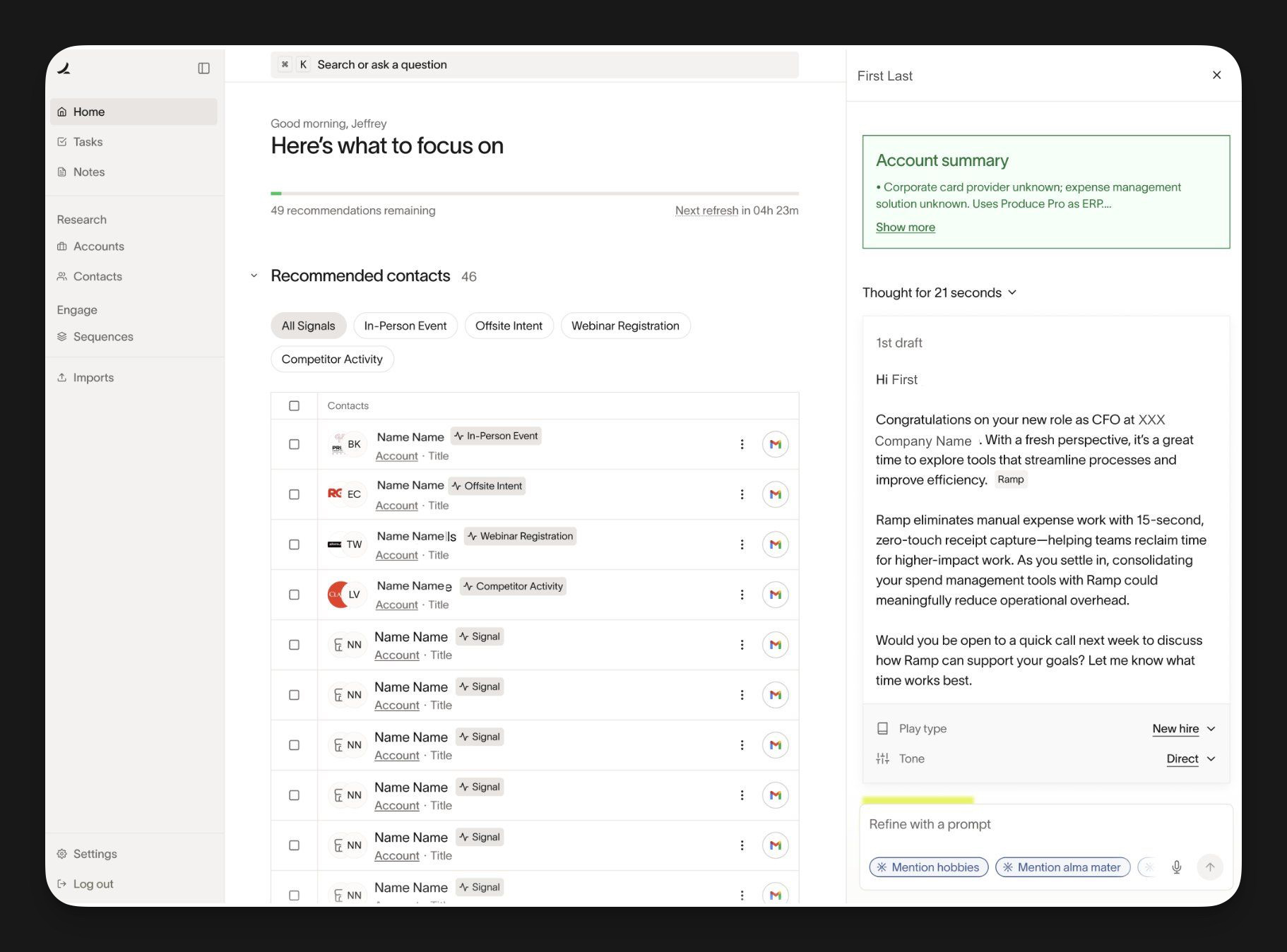
The SDR sees the work that needs attention without moving between an intent dashboard and the CRM.
For this workflow, the rep no longer needs a separate account-research tool or email writer.
The product is also used across pre-sales and post-sales teams. AEs, customer success, account management and partnerships all use it.
Keyan estimates that 99% of Ramp’s SDRs log into Ramp Revenue every week, if not every day.
That estimate applies to the SDR team, which had more than 150 people at the time of the Clay panel.
The broader Sales and GTM organization was approximately 500 people when Gene announced the OATs shutdown.
Ramp Revenue is the central GTM app. Growth MCP gives Claude, Codex, and internal apps controlled access to the same data and actions.
D. Growth MCP gives reps a decentralized access layer
One central product team could only build so many workflows.
Keyan says three to four hundred salespeople were already using Claude Code or Codex to make their own tools.
The vast majority queried Claude daily. A smaller group built workflows, and fewer built complete internal apps.
Those tools could not safely reach Ramp’s CRM or call recordings. They also could not reach customer data or sequencing systems.
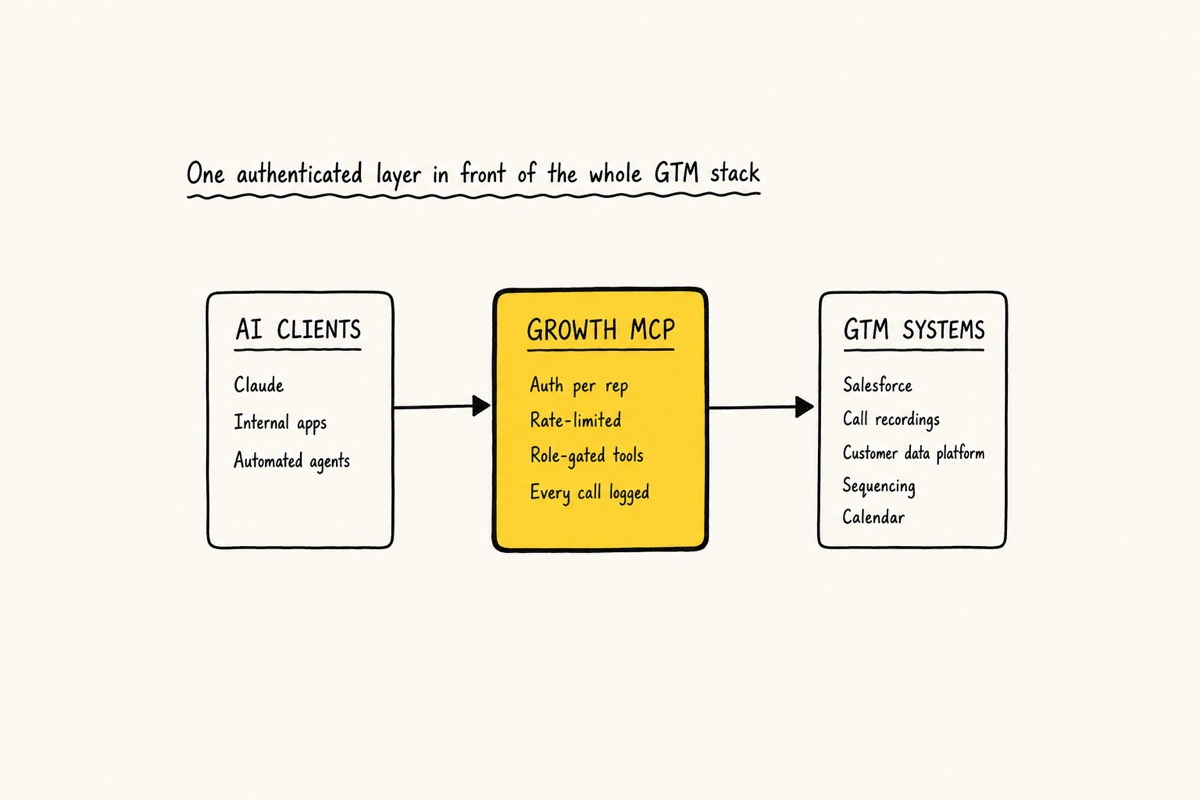
Growth MCP sits between those AI clients and Ramp’s GTM systems.
A rep using Claude or Codex can access the same approved data and actions available in Ramp Revenue.
It:
signs in as the individual rep
applies the permissions attached to that role
limits usage
logs each call
Same prospecting job, two interfaces.
Ramp Revenue gives the SDR a morning workspace with recommended contacts, signals, context, and a draft.
Growth MCP lets the rep run a customizable version from an AI client.
One example: a rep can ask, “What in my book got hot this week?” Growth MCP scans the rep’s accounts for buying signals, ranks and deduplicates the results, and filters out anyone already in a sequence.
It replaces a 20-minute Monday ritual of building a CRM report, checking intent, and cleaning the list.
E. The centralized model
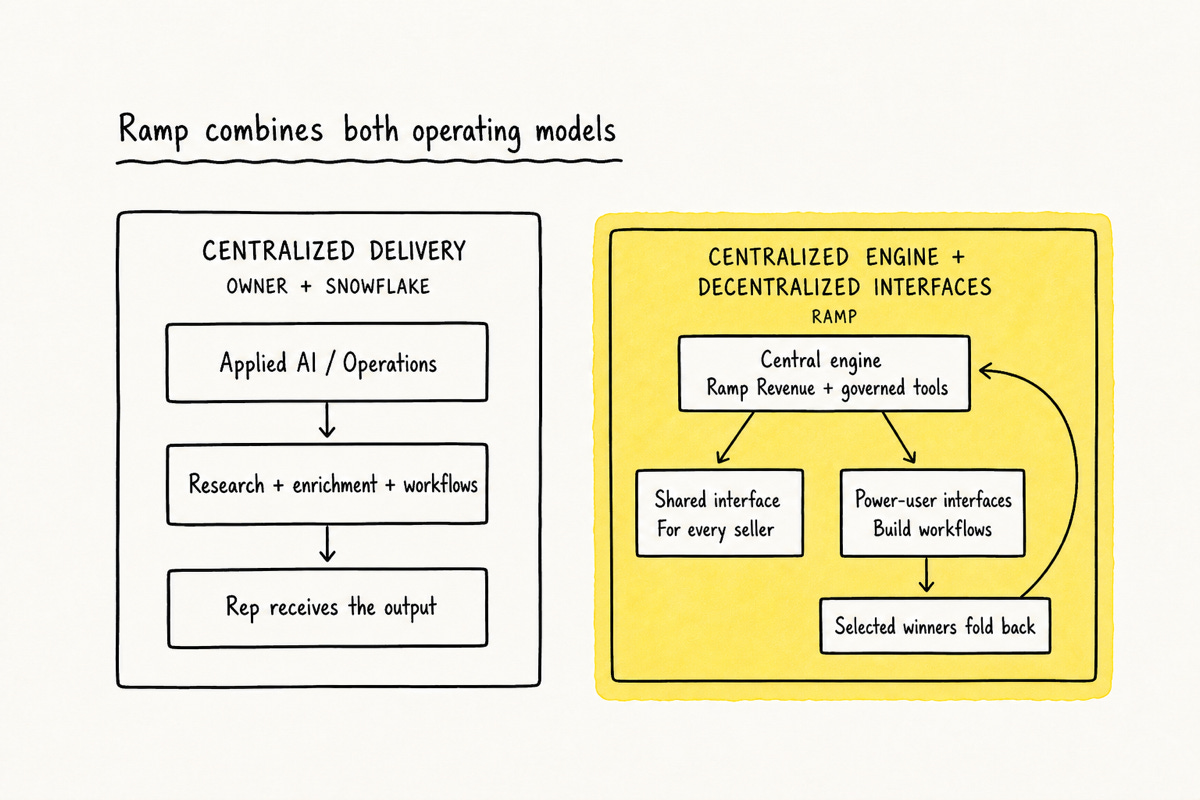
The data, permissions, and core rep product stay centralized.
Salespeople can use the same building blocks to create workflows in Claude, or Codex
This is the first company I have seen run both operating models together.
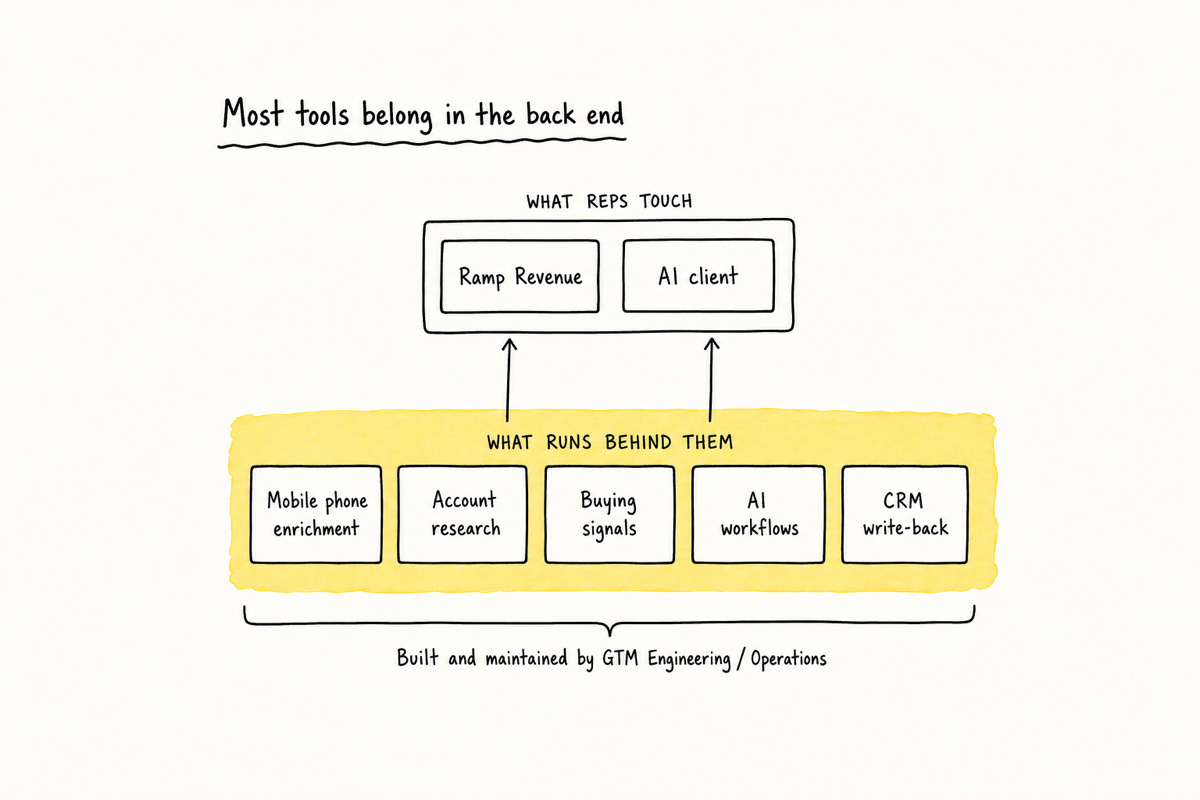
Owner and Snowflake both use the centralized model. Their ops and data teams run enrichment, account research, and other workflows behind the systems reps already use.
Owner shadow BDR to find this friction.
The goal of those shadowing sessions is to understand the work reps still do manually that could be automated through workflows or AI.
You can have 20 tools in your stack. The rep may only need to work from one or two.
GTM engineers or operations still have to build and maintain those back-end systems.
Ramp does that too. It also gives power users controlled access to build their own workflows.
F. Rep-built workflows become user research
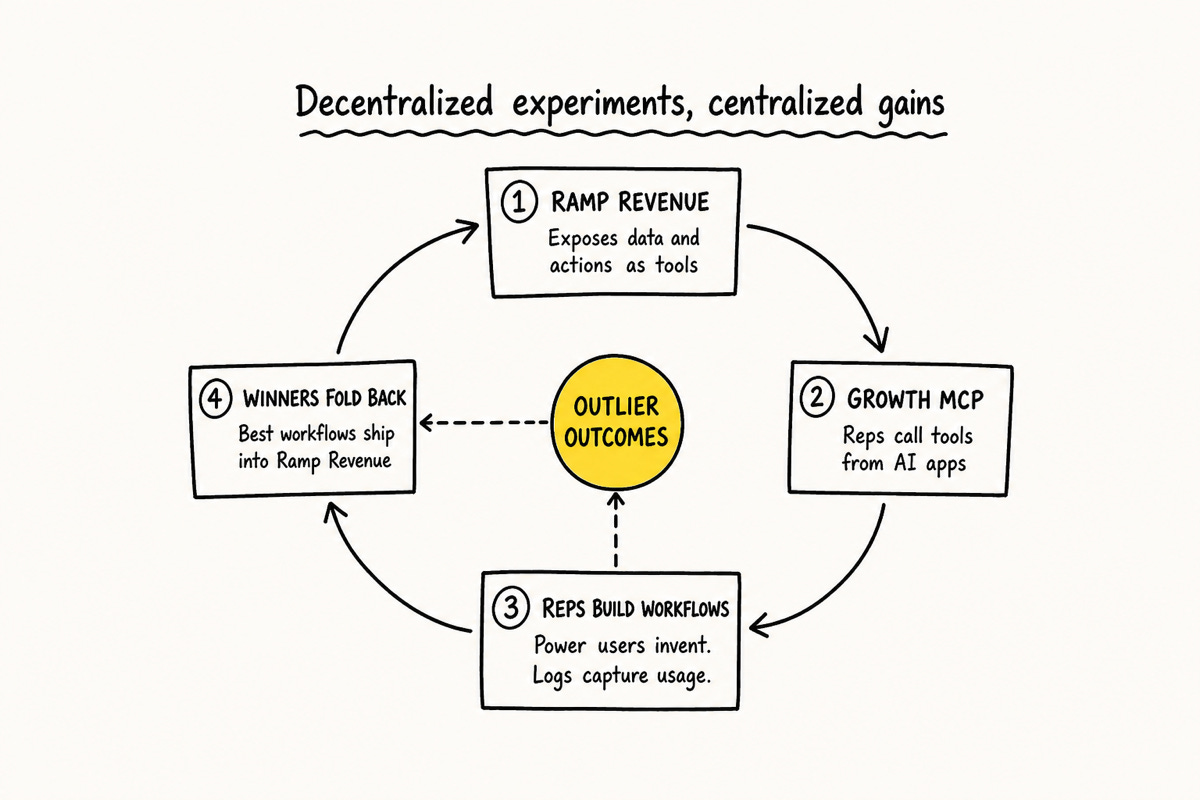
Ramp can see what people build.
Every tool call is logged, including the reason the AI called it. The Growth Platform team groups those reasons to understand what reps are trying to do.
The team then looks for workflows associated with unusually strong outcomes.
Those ideas can move into Ramp Revenue, where the full team can use them.
Keyan:
“Decentralized tooling is the highest-fidelity level of user research; the centralized product is where it scales to everyone.”
3. Ramp also tests with small groups and protects the outbound channel
In the earlier Clay conversation, Keyan also shared two practical details from Ramp’s outbound operation.
A. Ramp tests with small groups before rolling out
In the previous breakdown, I unpacked how they use Tiger Teams to roll out new tools across the GTM team.
Now they have shared more about how this works with their SDR team:
Validate small, then expand. Ramp tests every new play or tool with a small group first. It measures the result and expands only after validation.
Rollout depends on the tool.
If there is no human in the loop and minimal enablement is needed, ship to everyone.
If the tool asks more of the rep, such as a new AI copywriter, use a phased rollout.
Ramp measures its incremental effect on reply rates and conversion to a sales-qualified lead (SQL) before full production.
Prioritize by impact, probability, and effort.
Ramp considers expected impact and probability of success alongside effort.
It then stack-ranks the ideas.
The estimates are rough.
The point is to separate exciting ideas that may change nothing from less obvious ideas that could move an important conversion metric.
For long-horizon builds, the metric is field signal.
Salespeople are “the most rational people in the world” because they are paycheck-driven.
If reps come back with a firehose of feedback and ideas, you are onto something.
If they go quiet the day after you hand them a tool, it failed.
They treat internal tools like products: usage is the vote.
B. Ramp caps outbound and measures quality
Keyan shared two guardrails they use for outbound.
Volume caps, his top recommendation.
Ramp’s planning process sets specific monthly volume goals designed to avoid saturating the TAM.
Those goals include a cap on the percentage of TAM the team can contact in a given month.
The cap protects the channel and prevents the team from over-penetrating its market.
Because the team cannot compensate with more volume, reps have to get more creative with copy and strengthen relationships through email, phone, and in-person events.
Keyan says the limits have produced unusually creative work.
Leading quality indicators, with leaderboards.
Positive reply rate, when a prospect shows interest or asks product questions, is the early signal.
Ramp then tracks conversion to demo booked.
Targets and leaderboards on those metrics show reps where they stack up in the org.
The brand tailwind.
As Ramp’s brand grew, outbound performance on the same audience improved versus two years ago.
Keyan makes a point of relaying this to the brand marketing team, since its impact shows up in outbound numbers even though no dashboard attributes it to them.
That’s it for today. Hope this was useful or you could learn 1 or 2 things about Ramp.
Elric
P.S. Glad to be back after 2–3 weeks away from content. I was moving and getting settled into a new place.
I’m also making good progress on the new membership, the evolution of the paid newsletter. It should be ready in August.
It’s built around 3 pillars:
Custom experience: The first deliverable I’m working on is your custom roadmap, based on your context. The goal is to give you clarity on what to focus on right now, and why.
Resource hub: I’m repackaging all the current paid resources, plus the AI agents and workflows I’ve built in Claude Code.
Community: I’ll help match you with other members who are at a similar stage.
thanks for reposting @Sam Dvorchik🫡