


👋 Hey chef, Elric here! Welcome to this week’s free edition of Outbound Kitchen. Each week I dive into reader questions about creating outbound systems for sustainable growth. Thinking about going paid? Here’s what you’ll unlock right away:
Instant access to 40+ paid newsletters, including:
My Outbound Chef Kit: 130+ resources (20+ email templates, cold call scripts, AI prompts, top tools, and more). Value: $1,000+
And the best part? You can try it free for 7 days. Cancel anytime.
But I think you’ll love it!
👉 Start your free trial today.
If you only read LinkedIn, you’d think outbound is dead.
AI is replacing SDRs. Cold calling is dead. Email is dead. The SDR role is dead.
If you stopped there, you’d think outbound is in trouble.
Last year, I started tracking top teams to see what they’re actually doing. I also looked at global SDR numbers by country and company. I’ve been tracking 232 companies since March 2025.
I cross-referenced my research with data from Insight Partners, The Bridge Group, SaaStr, RepVue, and PeerSignal.
Here’s what the data shows for 2025:
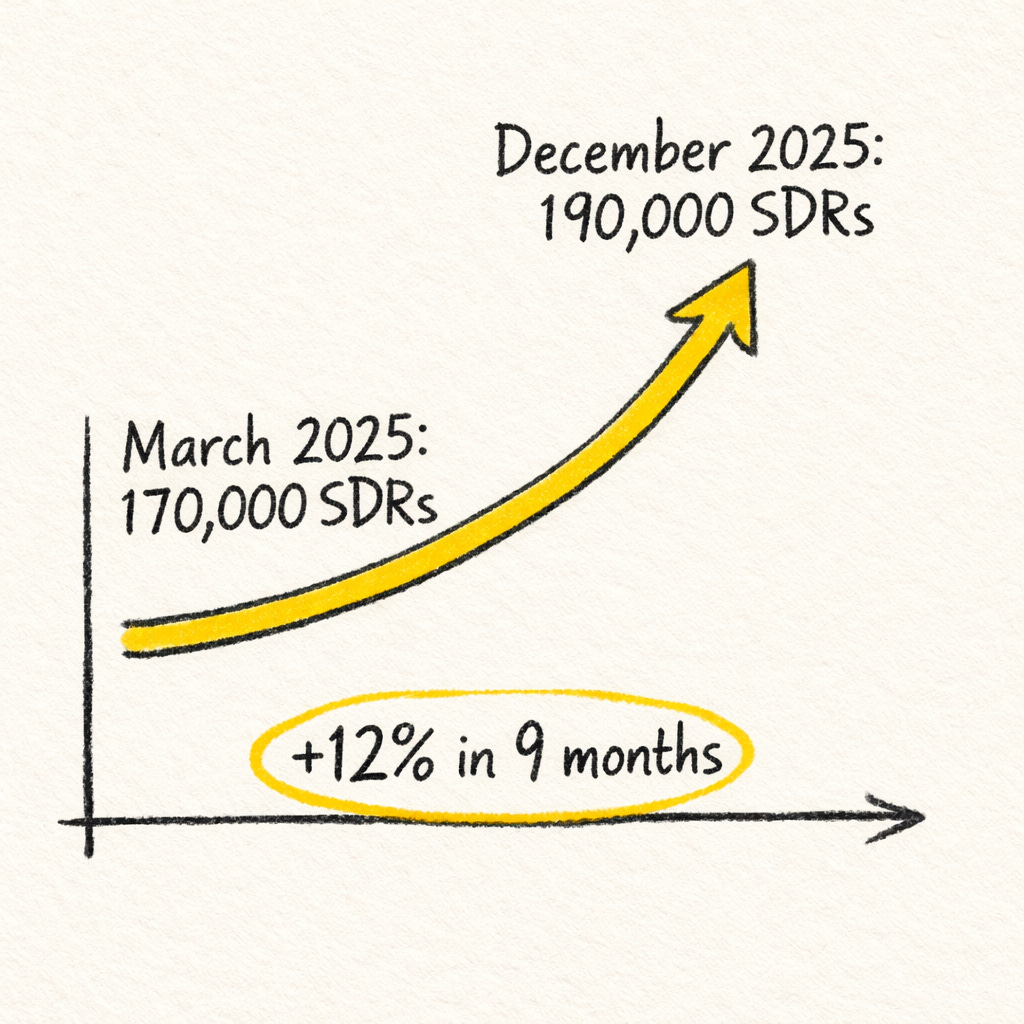
Global SDR headcount increased by 12%.
47% of the 232 companies grew their SDR teams in 2025.
Top GTM teams like Rippling, Ramp, Vanta, and Owner.com expanded their outbound teams.
AI companies are investing in SDR teams (OpenAI, Anthropic, ElevenLabs, Clay).
Traditional industries, not just tech, are investing in SDRs too: logistics, banking, paint, marketing agencies, and more.
1. The market split into three tiers.
Global SDR headcount:
170,000 in March 2025.
190,000 by December, 2025.
That’s 20,000 new SDR roles in nine months.
And the hiring isn’t slowing down.
In December 2025, there were 11,259 open SDR roles globally, across 4,944. companies. By February 2026, that number hit 14,135 postings across 6,248 companies.

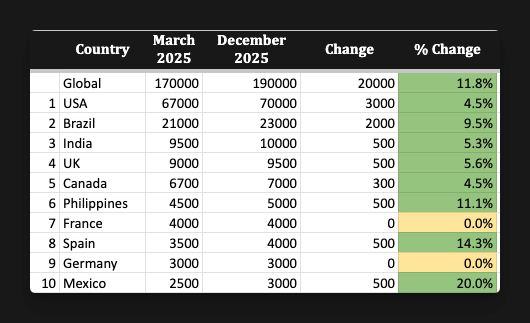
By Country (top 10)
The US holds 37% of global SDRs, but the growth is happening everywhere. Mexico grew 20%. South Africa grew 33%. Ireland grew 33%. The Philippines has 5,000 SDRs and grew 11%.
I have 213 companies with full March-to-December 2025 data. Here’s what I found:
Here’s what I found:
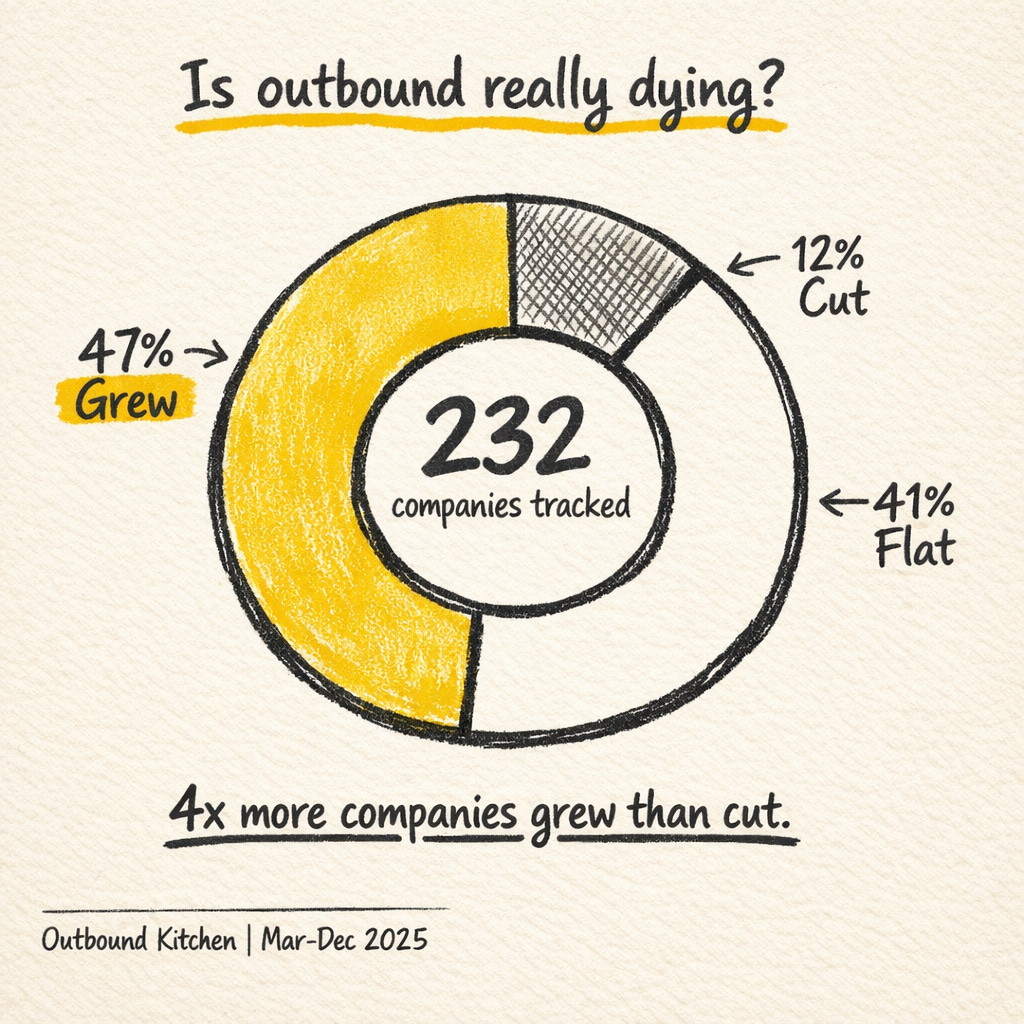

47% of companies grew their SDR teams. 12% cut. And 41% did neither, they added a head here, lost one there, averaging +1.5 SDRs per company across the full year.
And 41% did neither, they added a head here, lost one there, averaging +1.5 SDRs per company across the full year.
Aggregate Stats
Net SDRs added across the 213 companies: +2,772
Growers added +3,171 headcount (avg +32 per company)
Decliners lost -532 headcount (avg -20 per company)
Flat band: +133 across 87 companies (effectively flat)
Median company grew +8.9% (+8 heads)
Mean growth was +19.8% (pulled up by explosive growers)
The market is splitting into movers vs. the stuck middle.
By Broad Category

By Funding Status

54% of VC-backed companies meaningfully grew, but 13% meaningfully declined. No other funding category has this spread.
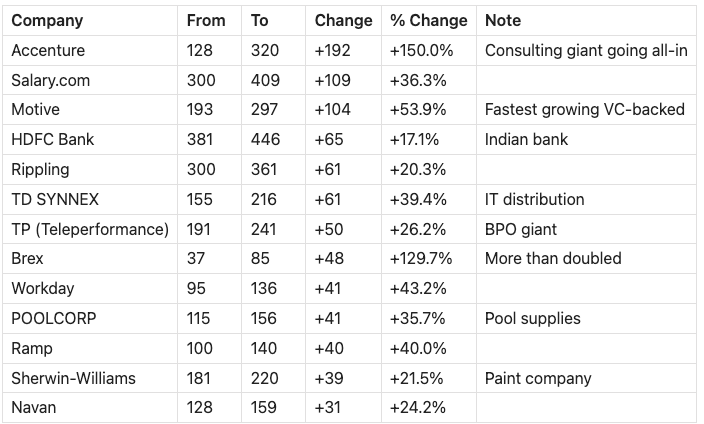
Biggest Growth Stories (Absolute Gains, March-Dec 2025)
The movers:
Cybersecurity went all-in. ThreatLocker (+60%), KnowBe4 (+52%), CrowdStrike (+12%). Six out of eight cyber companies in my data grew SDR teams. The security buyer is hard to reach, outbound is the play.
CrowdStrike 280 (+12%)
Fortinet 141 (+11.9%)
Palo Alto Networks 113 (-1.7%),
SentinelOne 113 (+27%)
ThreatLocker 83 (+59.6%)
Zscaler 42
Rapid7 80 (+23.1%)
Traditional industries
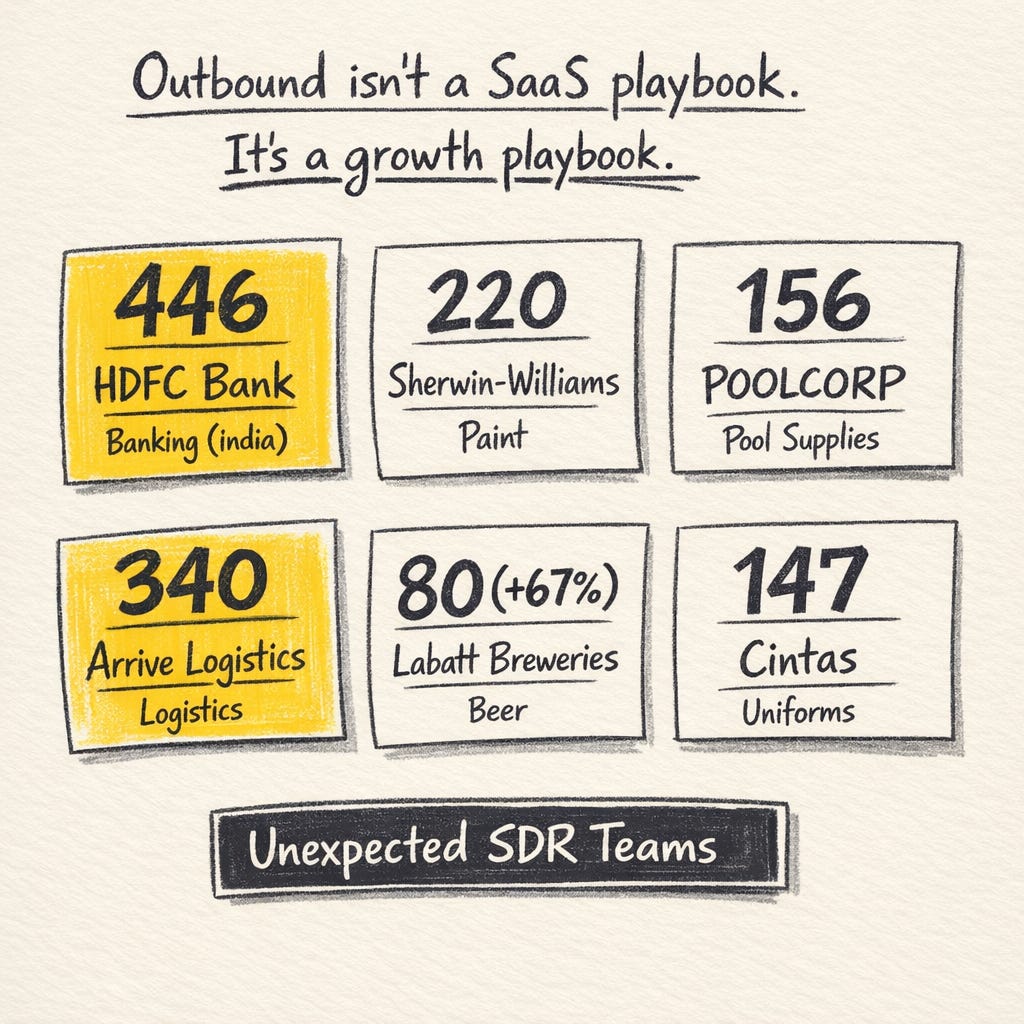
Another thing I learned from this research: Traditional industries are also investing in SDR teams, not just SaaS companies anymore.
HDFC Bank in India has 446 SDRs.
Sherwin-Williams, a paint company, has 220.
POOLCORP, which sells pool supplies, has 156.
Labatt Breweries grew its SDR team by 67%.
Accenture: 320 SDRs
TP (Teleperformance), BPO/Outsourcing: 241 SDRs
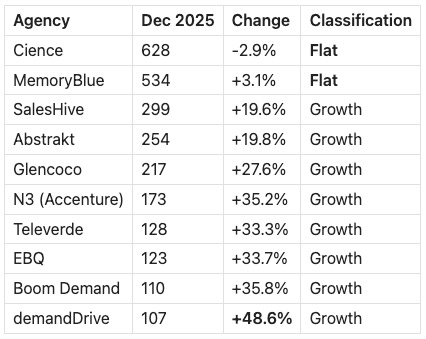
The outsourcing market: 92% of SDR agencies in my dataset grew. Mid-tier agencies grew 20-49%. Companies want outbound, many just don’t want to build it in-house.
SaaStr and Emergence Capital surveyed 560+ companies and found 36% of B2B software companies cut SDR headcount in 2025. SDRs had the highest reduction rate among all sales roles.
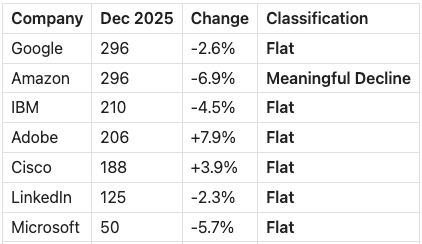
Big Tech: Flat, Not Pulling Back
They’re maintaining, which for companies this size means they’ve decided the current headcount is roughly right. Amazon (AWS) is the exception worth watching.
Why the growth? My hypothesis:
More companies entering more markets means more sellers competing for the same buyers. Inbound alone can’t sustain growth when your category has 47 competitors instead of 12. Outbound is how companies create demand when demand doesn’t come to them.
If outbound were dying, the numbers would be going the other direction.
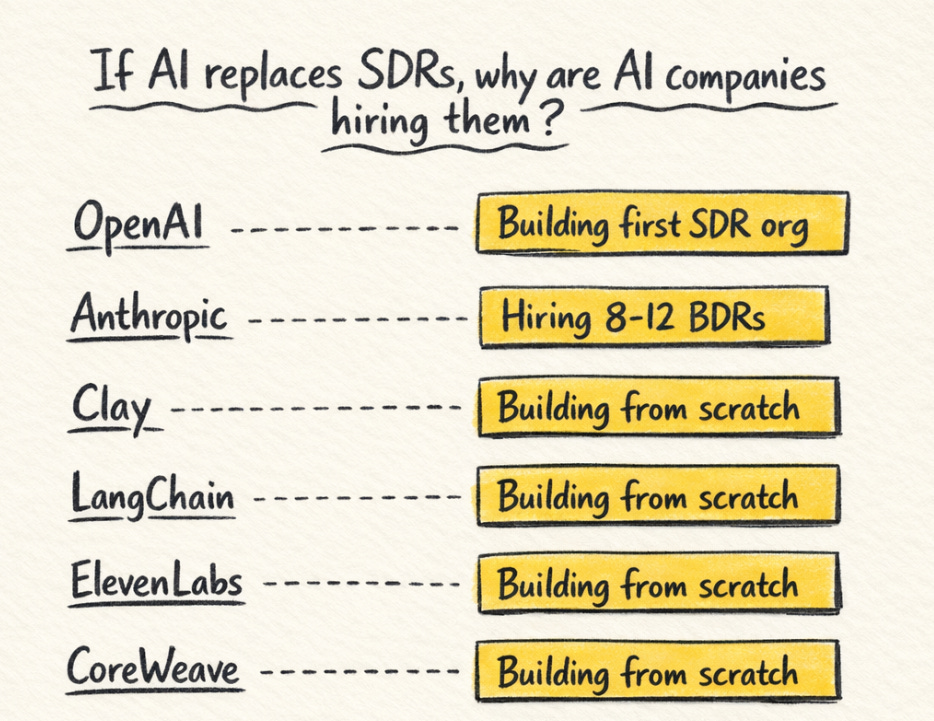
2. AI companies are hiring SDRs
39% of top AI companies with open GTM roles are actively hiring SDRs, data from Adam Schoenfeld at PeerSignal.
OpenAI is building its first SDR organization. Anthropic is hiring an 8-12 person BDR team. Clay, LangChain, ElevenLabs, and CoreWeave are all building SDR functions from scratch.
These are the companies building the AI tools that are supposedly replacing SDRs. And they are hiring SDRs.
There are currently 2x more Enterprise AE roles than SDR roles posted at AI companies, which means SDR hiring is coming, because those AEs need pipeline.
If AI were going to replace the SDR role, the AI companies would know first. Instead, they are investing in it.
3. What the winners built (and what the cutters got wrong).
Insight Partners surveyed 150 companies: top performers were 1.6x more likely to expand SDR teams. Only 2.9% of the best GTM teams eliminated their SDR function -- versus 9.8% of the broader market.
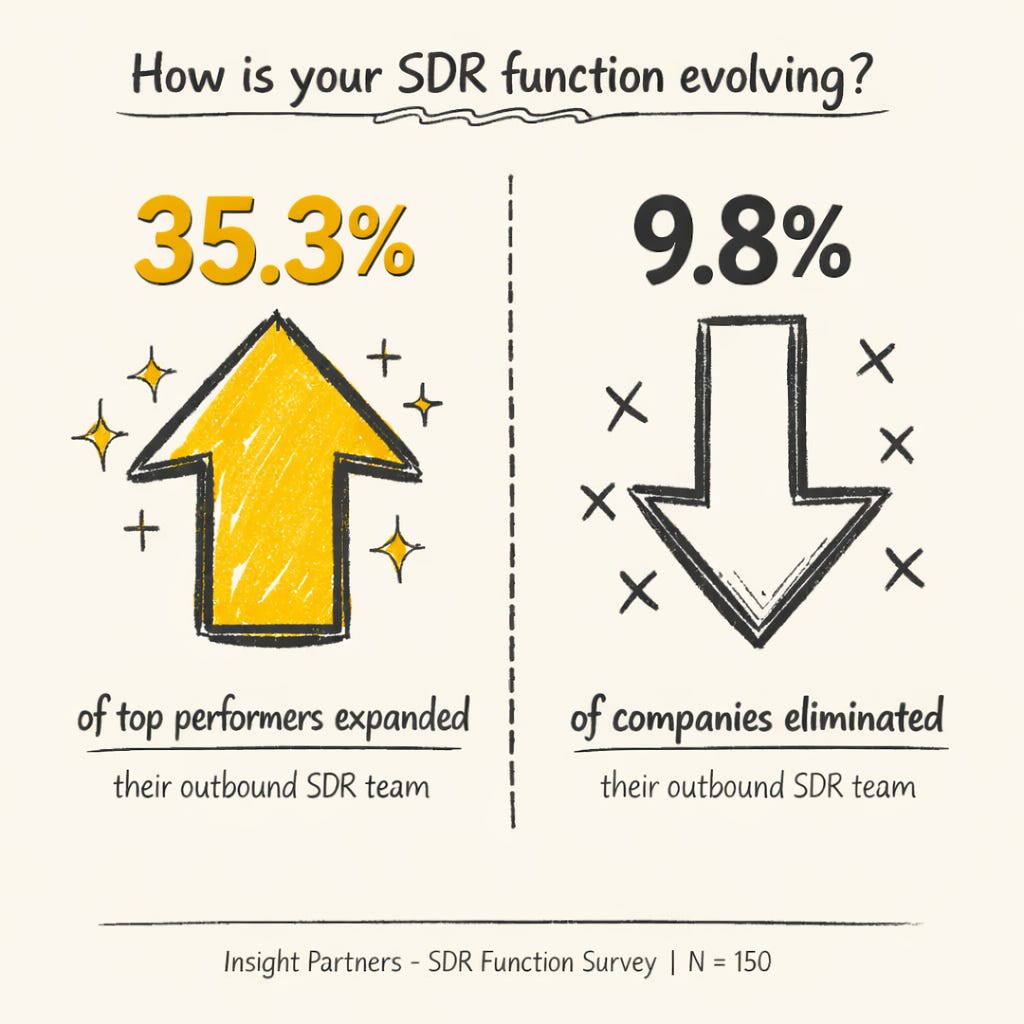
What I found in my dataset is similar to the data from Insight Partners.
The best GTM teams are investing more in SDRs.
Rippling: 300 to 360+ SDRs (+20%)
Ramp: 100 to 140+ (+40%)
Vanta: 64 to 82 (+28%)
Gong: 61 to 84 (+37%)
Owner.com: 20 to 30 (+50%)
Since 2024, I study the best outbound teams:
Snowflake. Ramp. ClickUp. Owner.com. Rippling.
They don’t have a silver bullet. They invest heavily across the board:
Systems: data infrastructure. AI and automation.
Enablement.
Talent: Hiring the right people.
Think of it like a Michelin-star kitchen. Each person is specialized. Each part of the system is optimized. They succeed because everything works together.
That’s what top outbound teams look like right now. Most companies are still looking for the one tactic that will fix everything. It doesn’t exist.
And the output tells the story.
Owner.com and Ramp generate 3–4× more pipeline per rep than their competitors.
ClickUp has shared publicly that they generate 3× more pipeline with the same number of SDRs.
Verkada built a system where their MDRs (SDRs) are 4–6× more productive than traditional SDRs.
What’s the difference?
Productivity.
They built systems that let their team spend maximum time on high-quality prospecting, not preparing to prospect. If your reps are spending time on manual research, finding and cleaning data, writing individual emails from scratch, toggling between five tools, you’re burning budget on low-value work.
Top teams build backend systems that push data into tools reps already use.
AI
The best teams are using AI:
Snowflake’s 15x’d their reply rate using AI to write outbound messages. They iterated 140+ times to get their prompts right.
Gorgias cut 200 sequences down to 10 modular sequences and uses prompts to write targeted emails at scale.
Ramp had a fully automated AI outbound motion and killed it a few months ago,they hit a ceiling. Now they’re investing more in the team, not automated outbound.
But here’s what most companies miss: most bought ChatGPT seats and told their teams to use it manually. That’s just adding another tool to the stack.
The real unlock: build AI workflows that run in the background and push outputs directly into your CRM or sales engagement platform, where your team actually works.
The cutters were cutting bad outbound.
Companies that cut treated SDR as a cost line. Hired bodies. Measured activity. Called it outbound. Companies that expanded treated SDR as a system. Invested in enablement. Measured outcomes. When the cost experiment got expensive, they cut. When the system produced returns, they scaled.
Most only had headcount.
Salesloft, a sales engagement platform, now has zero SDRs. They cut their SDR team. They’re PE-backed and focused more on efficiency than growth.
Outreach and Apollo also cut their SDR teams in 2024/2025 and in 2025 started rebuilding them from scratch.
I know three companies that tried cutting SDR teams entirely to replace them with AI. One early-stage company eliminated the team in 2024. By 2025, they hired a Head of BDR and eight BDRs on the floor. Two years without outbound pipeline, then a rebuild from scratch, because AI couldn’t replace the conversations that generate pipeline.
The other two, both around 1,000 employees, are in the same cycle. Cut. Trying to automate.
The SDR role is harder. That doesn’t mean it’s dead.
The role is evolving.
Manager spans are shrinking, 6.4 reps per frontline lead, down from 8. That’s more coaching time per rep, not less.
Ramp time hit 3.0 months, the fastest ever, down from 5.7 in 2020.
Tenure rebounded to 1.9 years from a low of 1.4 in 2022. 97% of orgs now advertise advancement tracks.
GTM engineer
The GTM Engineer role is forming around it.
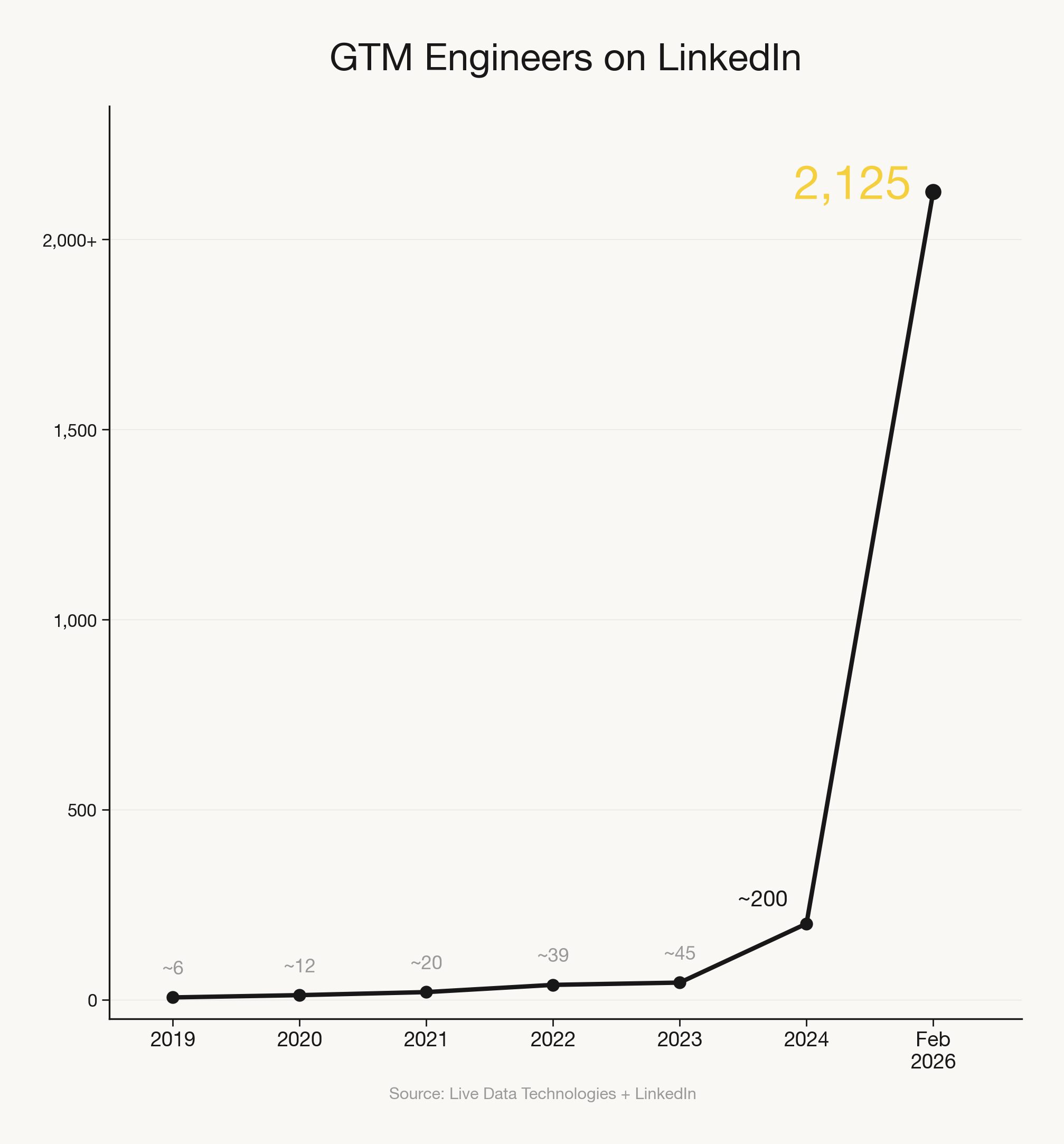
In November 2024, Brendan Short counted roughly 200 GTM Engineers globally, technical operators who build the infrastructure around SDRs (data pipelines, enrichment workflows, tool integrations) and other GTM teams.
He asked in one of his newsletters: The Rise of the GTM Engineer.
“Will this number be higher or lower this time next year? My bet: it will be much, much higher.”
Indeed, 15 months later:
2,125 people hold the title on LinkedIn.
67% got it in the last 12 months.
One in four works at an agency.

4. The economics changed. The bar is higher.
The cost of outbound is rising from every direction.
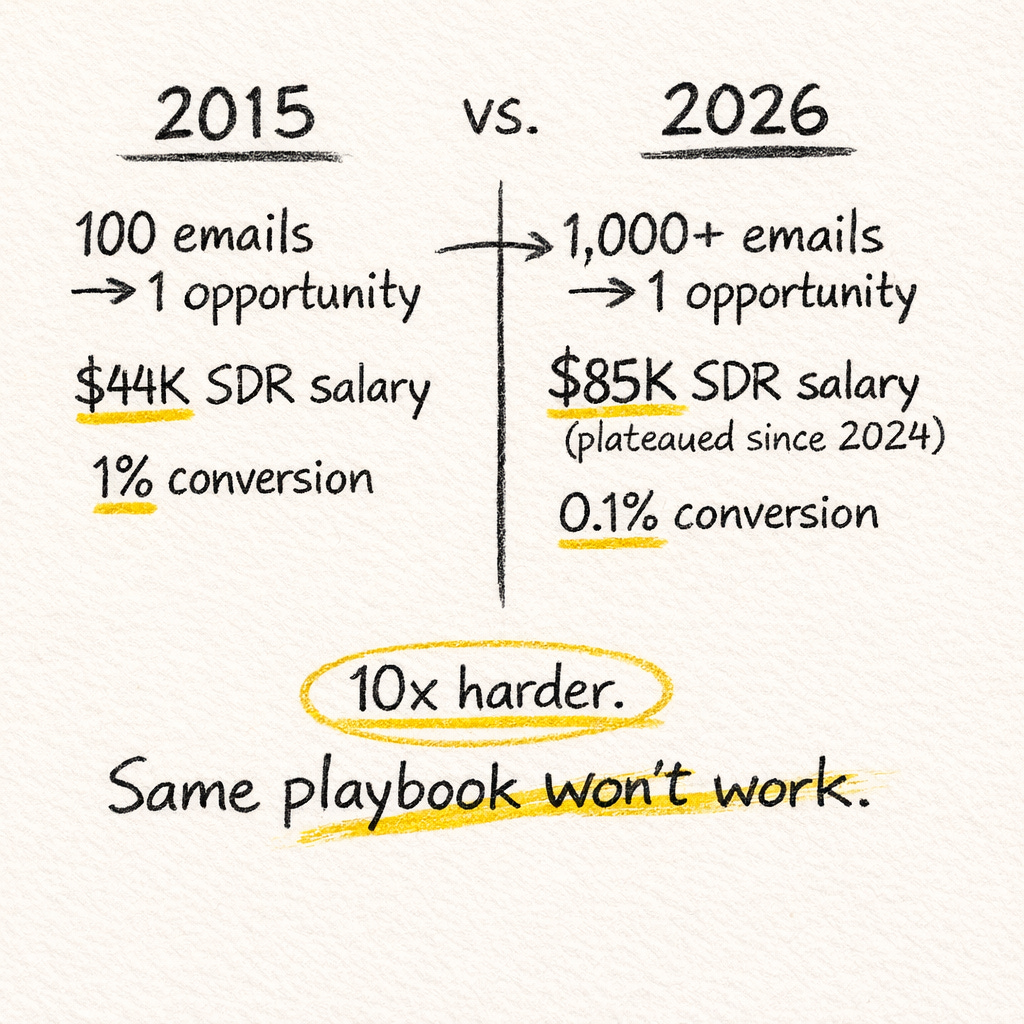
Winning by Design documented a 10x conversion decline over 8 years: in 2015, 100 cold emails generated one opportunity. By 2018, it took 200. By 2023, it takes 1,000+. The volume required per opportunity has grown tenfold. And it keeps climbing.
Insight Partners advises 500+ B2B SaaS companies. Jeremy Donovan, their EVP of Sales, puts the breakeven at $40-50K ACV: below that, human outbound doesn’t pencil out. That threshold keeps rising. Companies with $20K ACV are redeploying SDR budget into inbound and channel partners.
The exception is extreme velocity, Owner.com runs 8-10K ACV with a 2-call, 6-day sales cycle and generates $70K/month per BDR in closed-won.
But that’s the exception, not the model.
SDR salaries
Base was flat at $55K for three years, then jumped to $60K in 2026. OTE stepped up from $80K to $85K in 2025 and held. Top performer ceiling peaked in 2024 ($131K) and has slightly declined since.

More attempts per opportunity. Higher cost per SDR (2015 → 2026). The economics of outbound have fundamentally shifted.
And yet the best teams are beating those economics. Bridge Group found pipeline per SDR up 26%, from $3M to $3.78M annually. Phone-centric teams generate 1.4x more qualified conversations than email-first teams. Insight Partners’ portfolio data puts it even starker: 70% of meetings are booked by phone. Not email. Not LinkedIn.
The gap between the top and the average is widening, not because of talent, but because of infrastructure & enablement.
You can’t outspend bad systems. You have to build better ones.
What this means for you
Someone posts “SDRs are dead” and it gets 500 likes. A survey says 36% of SaaS companies cut SDR teams. A vendor promises their AI tool can replace your whole team. And suddenly you’re in a board meeting defending the existence of your SDR org.
It depends who you’re learning from.
If you’re taking strategy cues from people who say outbound doesn’t work, you’ll make decisions based on that narrative. If you look at what Rippling, Ramp, Owner.com, and ClickUp are actually doing, building, expanding, investing in systems, the picture is different.
Being bad at outbound doesn’t mean outbound doesn’t work. It means you were bad at it.
Outbound works. Even in 2026.
And in competitive markets, it does something inbound can’t, it manufactures timing. While your competitors wait for hand-raisers, outbound lets you reach the right companies before anyone else knows they’re in-market.
Audit your system. Data infrastructure. AI workflows. Training and enablement. The right people. The winners aren’t doing one of these well, they’re doing all of them. If your system has gaps, fix those before adding headcount.
In March, I’ll share the full dataset (SDR headcount, salaries, GTM Engineer role, and more).
Until next time!
Elric
Sources:
Original research via LinkedIn Sales Navigator (190K SDR headcount, 232 companies, 119 countries, March-December 2025).
2025 SDR Metrics and Trends Report: Bridge Group (SDR metrics, 351 companies)
Adam Schoenfeld/PeerSignal (AI company hiring)
Winning by Design/Revenue Architecture (conversion trends)
Jeremy Donovan/Insight Partners (Revenue Leadership Podcast E61)
As soon as you’re ready, here’s how I can help:
Outbound Consulting Call: Need quick help? Book a 40-min session here.
Outbound Private Chef:
Part-time, I’ll build, optimize efficiency, and execute your outbound systems.
Coaching/Advising: get tailored advice to fix your strategy, boost efficiency, and drive results.
Interested? Reply to this email or hit me up at bonjour@elriclegloire.com
@Kyle Norton thanks for reposting!