


The full benchmark lives on Outbound Kitchen website, with an interactive dashboard you can filter to your own segment and the raw dataset to download: outbound.kitchen/research/mobile-data-benchmark-2026.
I ran the same 1,400 US contacts through all 10 B2B mobile data providers. Then I checked every number twice. Once for whether it is a real mobile. Once for whether it belongs to your prospect. I paid $2,521, because no vendor will hand you these numbers.
I ran it because of how teams actually pick a provider. They go on opinion. The one a rep used last job, the one a founder saw at a conference, the answer to “what’s your favorite data provider?” in a Slack thread. Almost no one tests. So I did.
No single tool is enough. The real question is not which provider is best, but which cover the right people for who you call.
What I measured, the same way for all 10: coverage, valid-mobile rate, right-person match, predicted reachability, and cost per right-person number.
The short version
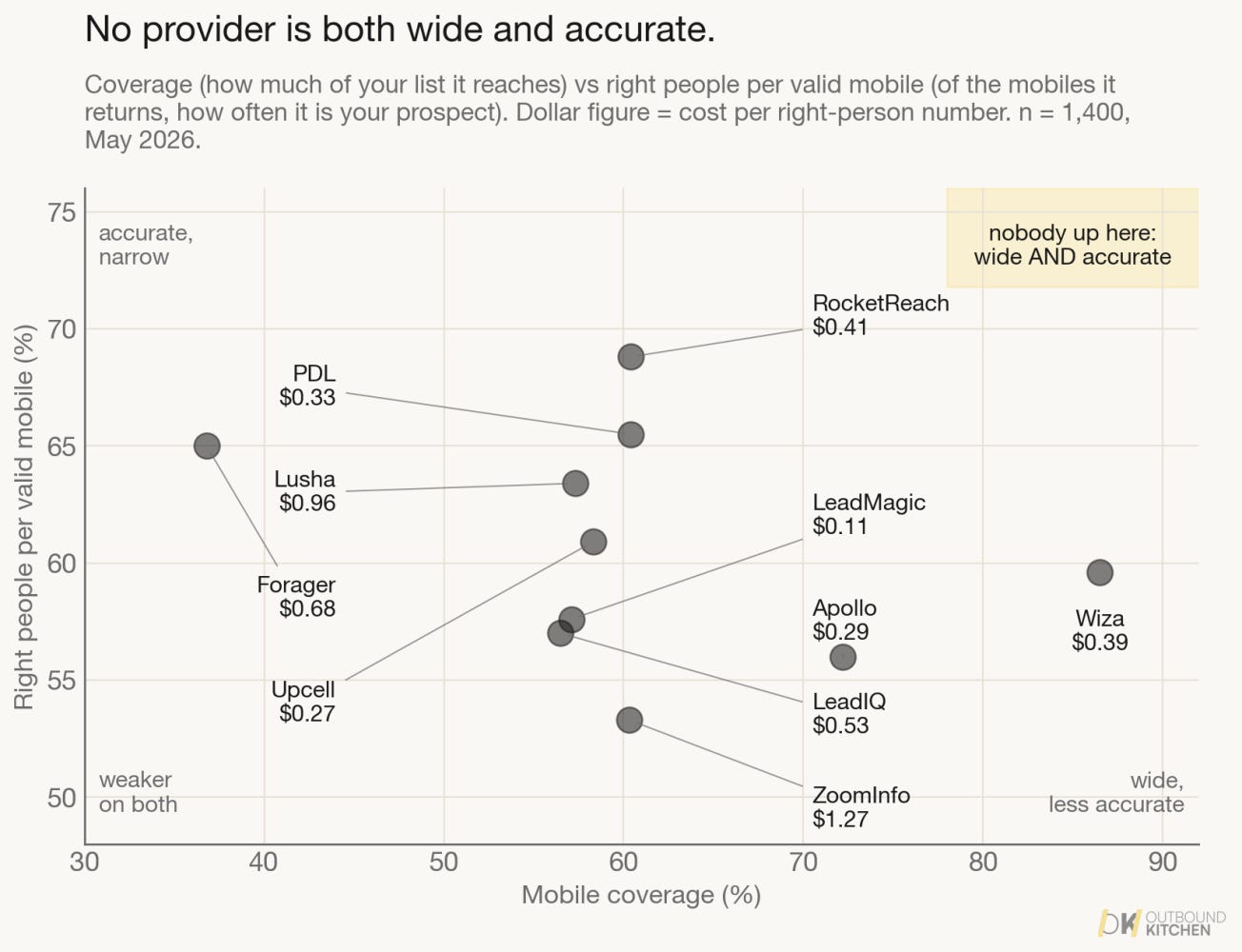
No provider is both wide and accurate, and 1 in 4 of the mobiles you get back is the wrong person. So you do not pick one, you stack two: lead with Wiza for reach, add the one provider that fits who you call, and validate the line and the name before you dial (about $0.10 a number). The rest of this page shows you which second provider fits your persona.
The 4 numbers that matter
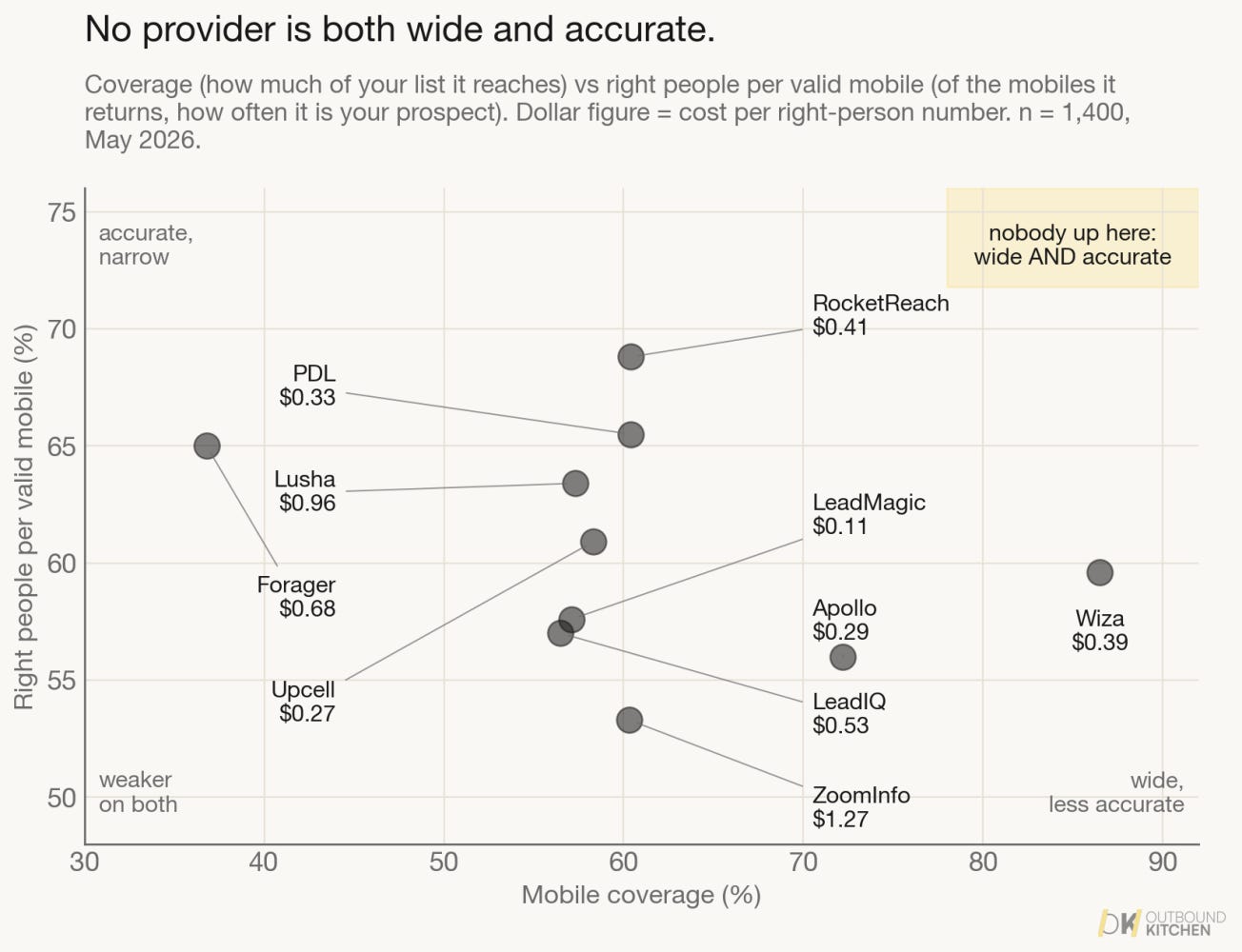
The widest and the most accurate are never the same provider. The widest returns a valid mobile for 1,211 of 1,400, or 87%; the most accurate is the right person 69% of the time and reaches far fewer people. The top-right corner of the chart is empty.
One in four mobiles is the wrong person. Of every valid mobile, 60% are the right person, 25% belong to someone else, and 15% cannot be confirmed without a call.
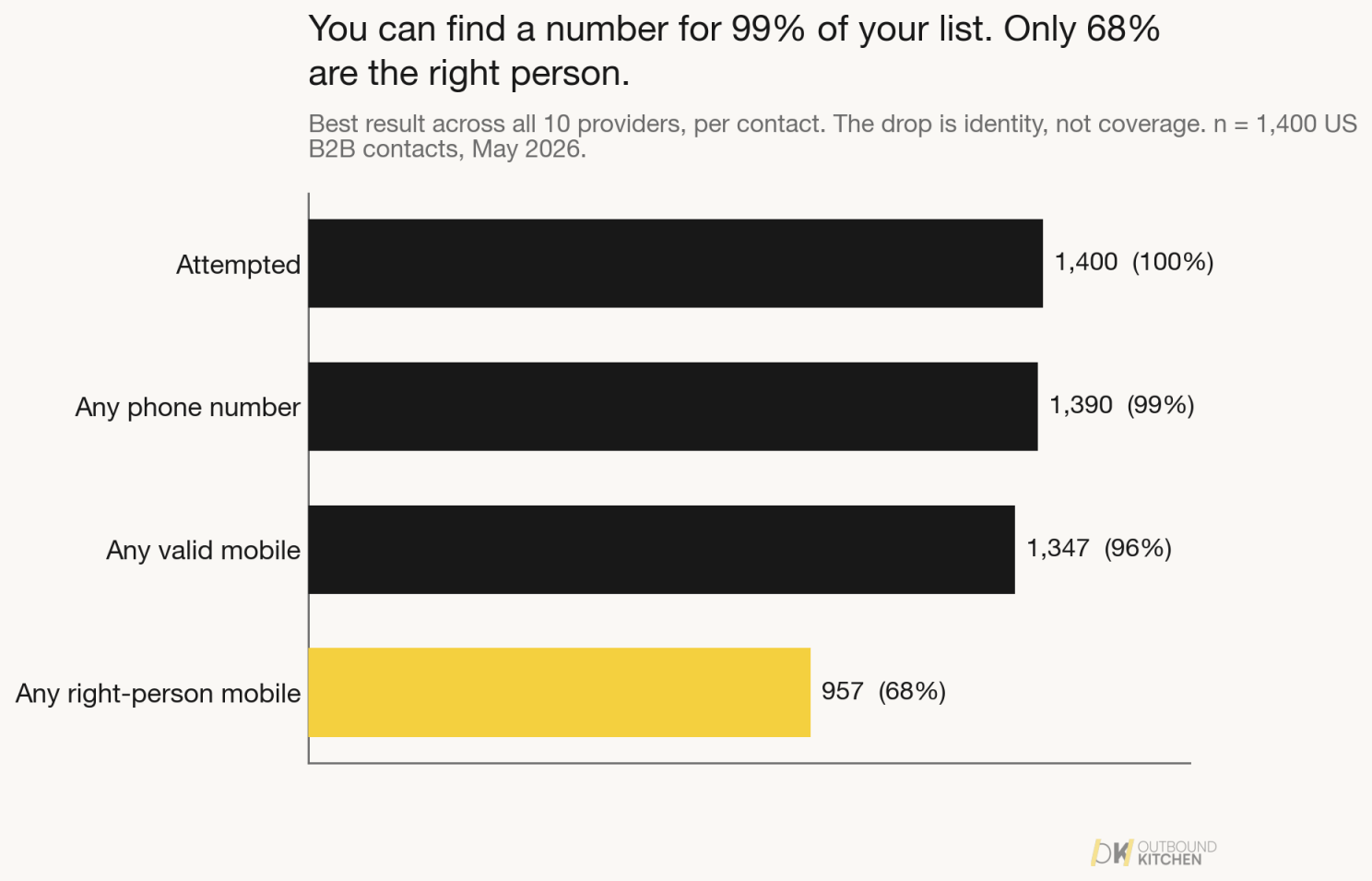
High coverage, low right-person coverage. You can find a number for 1,390 of 1,400 (99%), but a right-person mobile for only 957 (68%).
Bad data costs a 10-rep team about $53k a year. 50 dials a day, 1 in 4 on the wrong person, at an $85k wage, before dead numbers.
That empty corner is the whole story. Finding a number is the easy part. Reaching the right person on a working mobile is the hard part, and it is the only part that books meetings.
What this benchmark is. A head-to-head test of 10 B2B mobile data providers that sell phone numbers for cold calling and outbound:
Apollo
ZoomInfo
Lusha
LeadIQ
LeadMagic
Upcell
Wiza
Forager
People Data Labs
RocketReach
The same 1,400 US contacts, run through every provider at the same point in time. Together they handed back 3,446 distinct phone numbers, an average of 2.46 per contact. The sample is balanced across:
7 leader personas: security, engineering and product, finance, HR, ops, sales, and marketing.
Seniority levels: C-level, VP, and Head-of.
2 company sizes: mid-market (50 to 1,000 employees) and enterprise (1,000-plus).
100 contacts in each persona-by-size cell.
I put every number through the same two checks. First the line type: using Trestle, a service that labels each number a real mobile, a landline, or a VOIP line. Then the name on it, using IPQS, a fraud-and-identity tool that returns the name actually tied to a phone number, which I matched against the prospect. That is what makes these results measured rather than claimed. People Data Labs is shortened to PDL throughout.
Why me, and why you can trust the numbers. I help GTM leaders build and scale outbound teams, I do not sell a data product, and no provider here paid me. I paid for the test myself, about $2,521, because the vendors will not hand you these facts. They do not publish coverage, and the one thing they do claim, that the number is a mobile, is wrong a meaningful share of the time.
Who this is for. Outbound to US B2B contacts you can find on LinkedIn. If you sell into a market where your buyers are not on LinkedIn, like local businesses or restaurants, these providers cover far less of your list and this benchmark will not match what you see. Vertical and SMB data is a different problem and out of scope here.
What bad data actually costs you
You already validate emails before you send them, because spraying un-verified addresses wastes sends and burns your domain. Phone data is the same. Dial an un-validated list and about 1 in 4 of your calls lands on the wrong person, on top of the dead and non-mobile lines. That is the quiet SDR tax: reps spending their day on numbers you could have dropped before they ever lifted the phone.
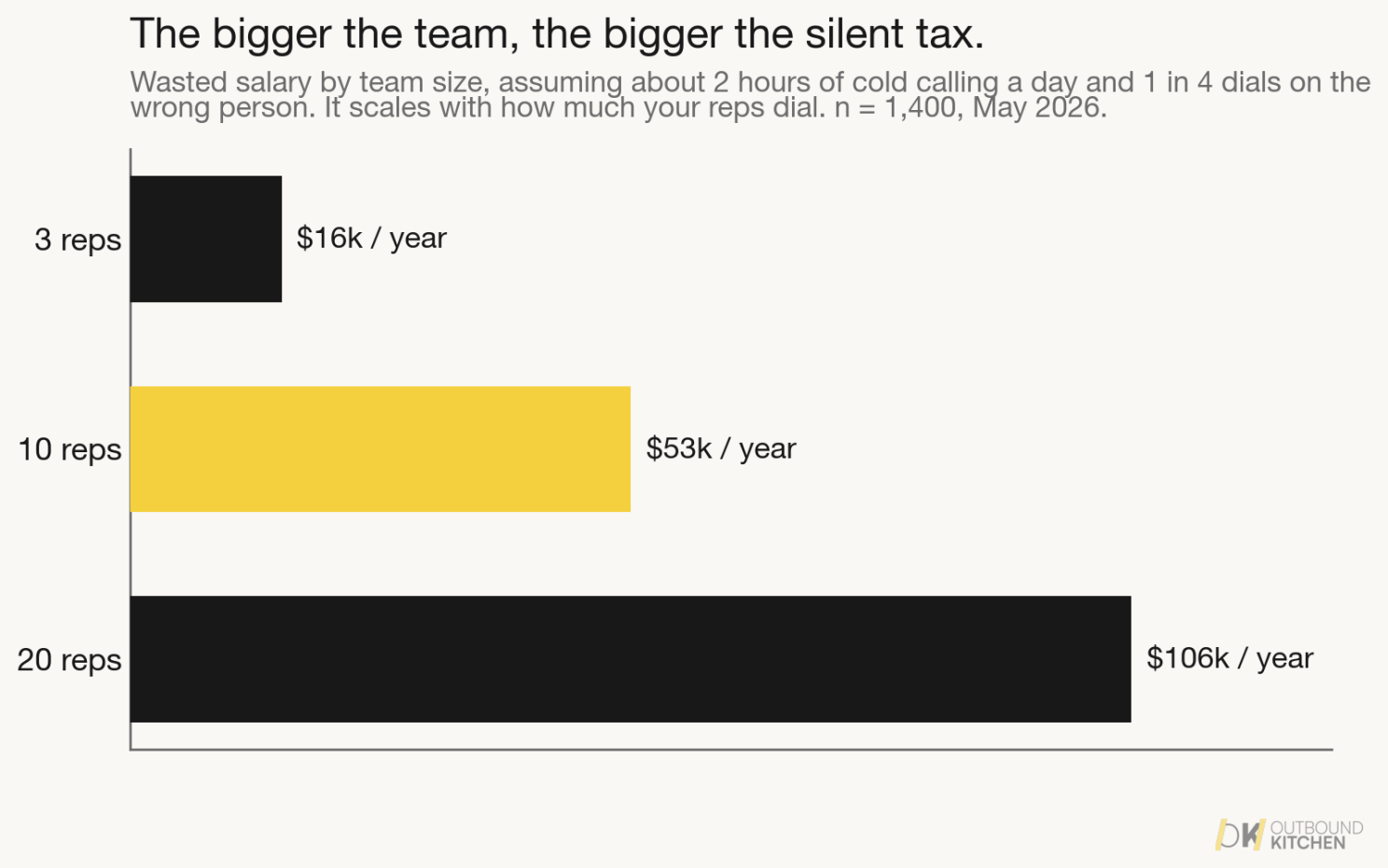
The math, scoped to what an SDR actually does, because they are not on the phones all day. Say two hours of cold calling, around 50 dials. One in four lands on the wrong person, so about 12 of those dials, roughly half an hour of selling time, are wasted every day, per rep, before you count the dead numbers. Across a 10-rep team that is five hours of selling gone daily. In salary, at an $85k on-target wage, that is about $5k a year per rep at two hours of calling: roughly $16k for 3 reps, $53k for 10, $106k for 20. Dial more and it climbs, dial less and it shrinks. None of it shows up as a line item, it shows up as reps who are not booking enough. More reps will not fix it. The fix is to validate the line type and the name before you dial, about $0.10 a number, so reps only ever call numbers that are real and likely the right person.
And the wasted salary is the smaller half. The bigger cost is the pipeline you never build: every dial spent on a stranger is a conversation that did not happen with a real prospect. A quarter of your team’s calling capacity going to wrong numbers is a quarter less pipeline, and that is lost revenue, not just lost payroll.
Why coverage numbers lie
Every provider advertises coverage: how often it returns a number. That is the widest, weakest layer, and it is the only one they talk about. A real number gets four questions, not one, and each one is harder than the last. The rest of this benchmark walks down them in order.
Coverage: did a number come back at all. Almost always yes, 99% of your list.
Valid mobile: is it actually a mobile line, not a landline or VOIP your dialer treats differently.
Right person: does that mobile belong to your prospect, or to a stranger.
Reachable: will the right person even pick up.
Coverage rate is how much of your list a provider matches, and it is the easy layer everyone passes. The other three are where providers separate. Measure all four, or you are measuring the easy one.
Layer 1 · Did a number come back?
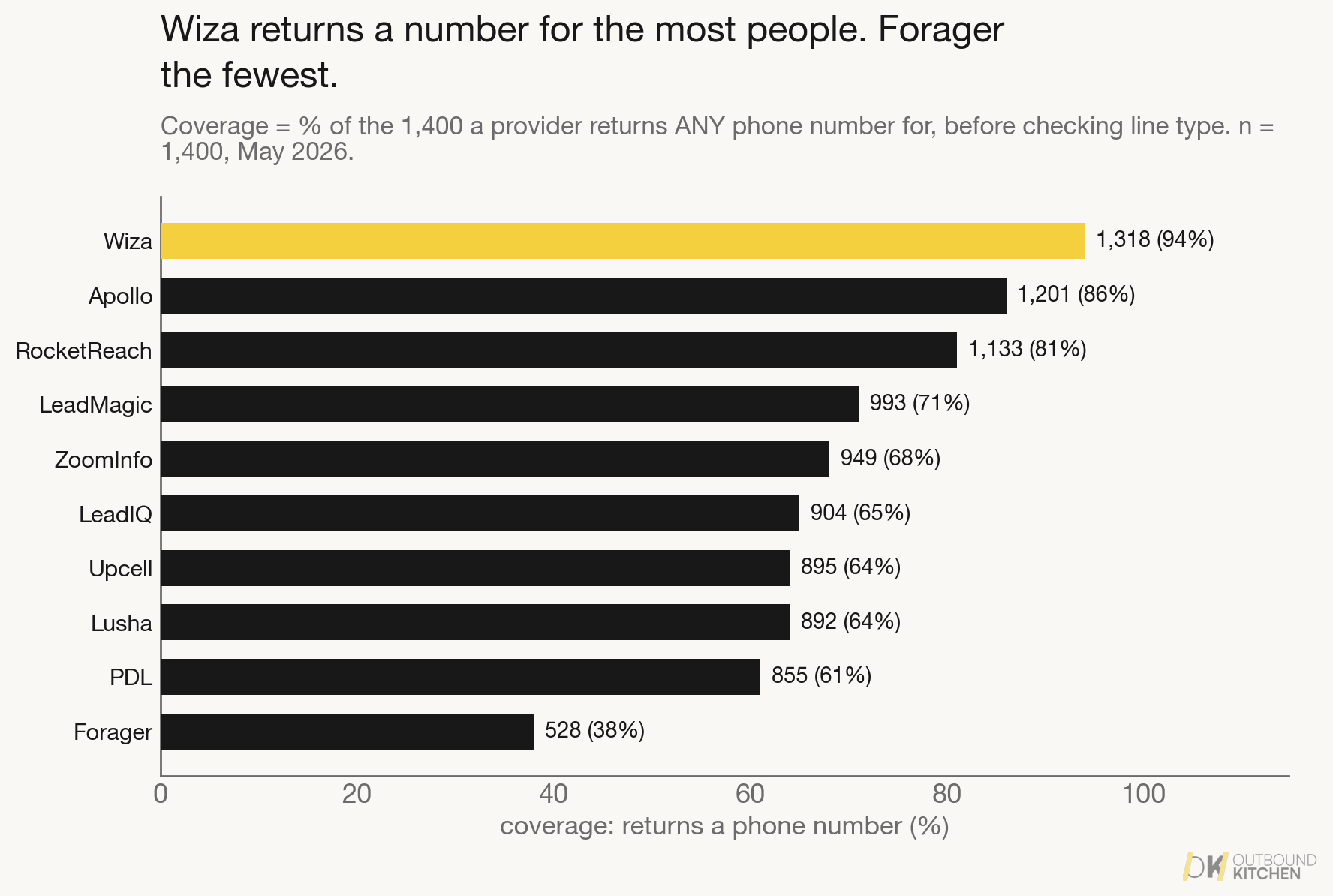
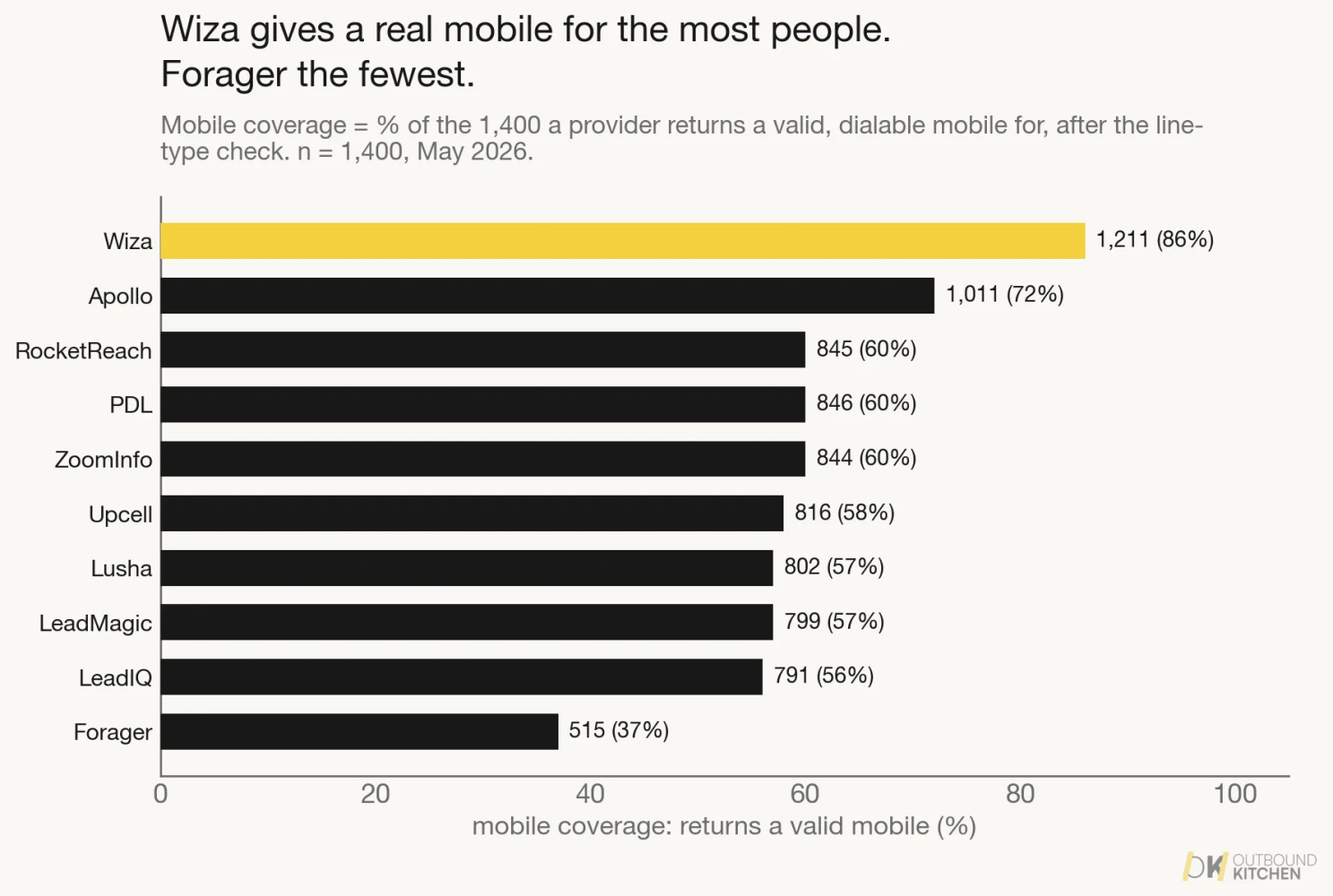
Wiza returns a number for the most people. Forager the fewest.
Coverage is the easy layer, but it is not flat. Wiza returns a phone number for 94% of a list; Forager for 38%. This is before any check on whether it is a mobile or the right person, just “did a number come back.”
Layer 2 · Is it a valid mobile?
Not every number labeled “mobile” is one.
The one claim providers make is that the number is a mobile. It is the only checkable claim, and it fails often. A share of what gets labeled “mobile” is a landline or a VOIP line that no dialer will reach the way you expect. RocketReach is the worst offender: one in four of the numbers it returns is not a valid mobile.
Strip out the landlines and VOIP and you are left with the coverage that actually matters: the share of your list you get a real, dialable mobile for. RocketReach shows the fall clearest, a number for 81% of your list but a real mobile for only 845 (60%). Wiza, cleaner, holds 1,211 (87%). This is the coverage the rest of the page runs on, the hero chart at the top and the scorecard both use it.
Layer 3 · Is it the right person?
One in four mobiles belongs to a stranger.
Once you have a working mobile, the question that decides everything: does it belong to your prospect, or to a stranger? This is the hard layer, the one no vendor reports, and the one that separates the providers.
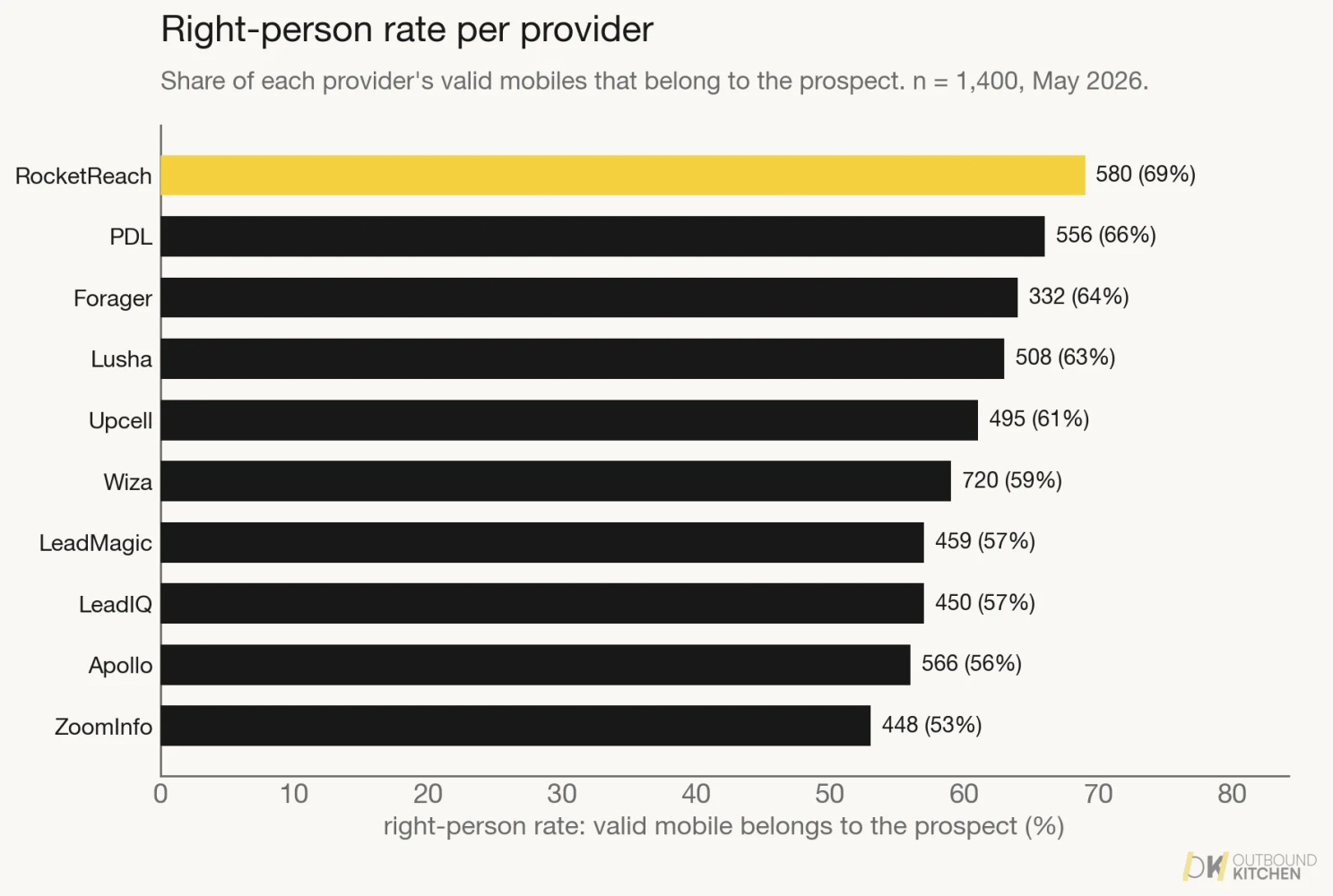
The leaderboard flips here. Wiza is the widest on coverage but sits mid-pack on accuracy at 59%, and RocketReach is the reverse, narrow coverage but the highest right-person rate. No provider tops both, which is the whole finding. Pool every provider together and the aggregate tells the same story from the other side.
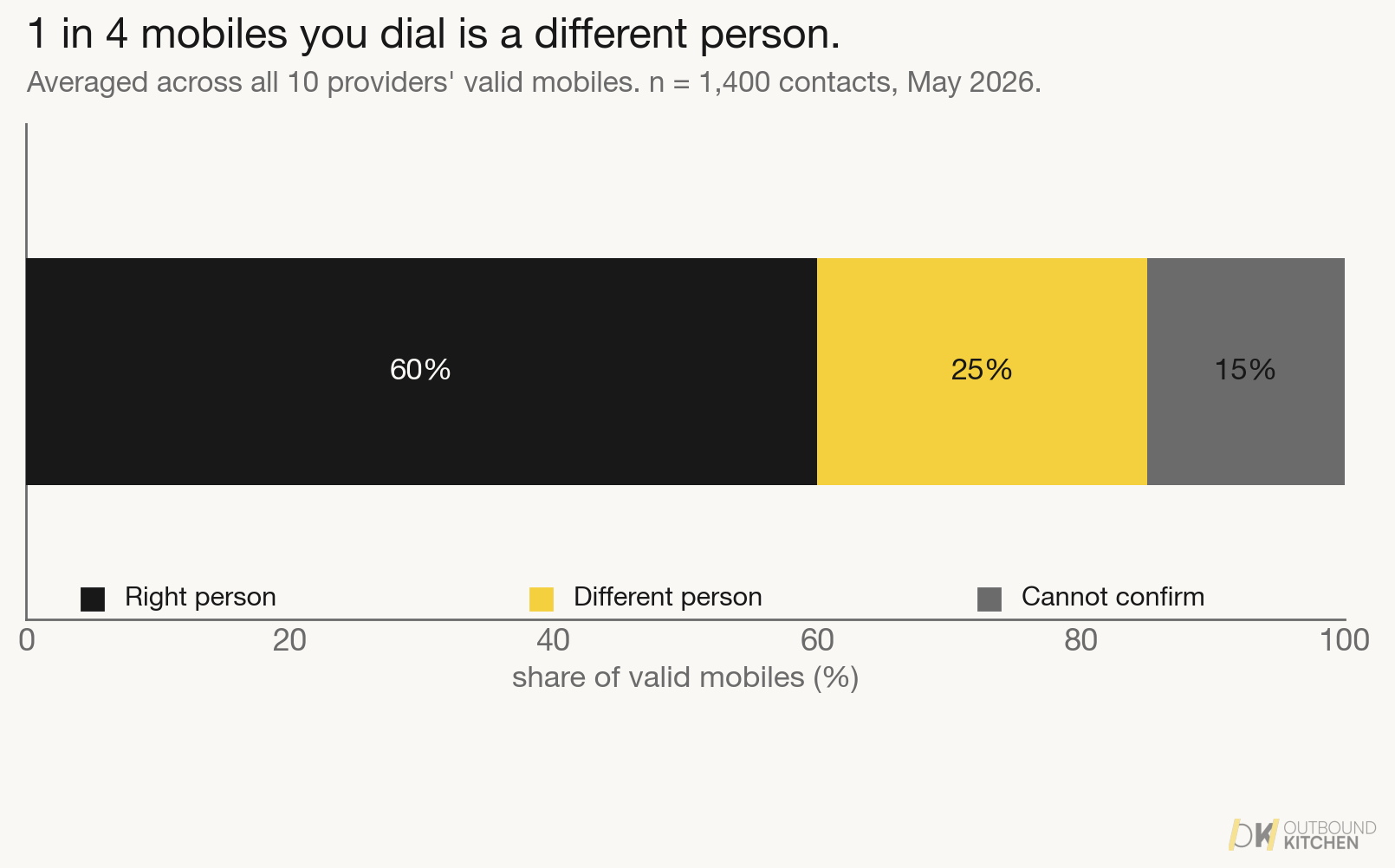
I checked the name on every valid mobile in the test (via IPQS). 60% were the right person. 25% belonged to someone else, a wasted dial and a polluted CRM. 15% I could not confirm without a live call. The best provider money can buy still hands you a stranger one time in four. And the honest limit, mine included: no data check confirms the number is still your prospect’s. People change jobs and numbers. Only the call confirms it, which is exactly why the right-person rate is the number to buy on.
Layer 4 · Will they pick up?
Pickup is the same for everyone.
The last layer, once you have the right person’s mobile: will they even pick up? This is the one you cannot buy your way out of. You cannot raise the pickup rate, because it is capped by buyer behavior, not data. TitanX, across hundreds of millions of dials, finds only about 20% of any B2B market ever answers a cold call, no matter how many times you try. And whichever provider’s number you dial, the predicted reachability is the same.
You can see it in SureConnect’s prediction. It forecasts a reachability tier for each number without ever dialing it, unlike TitanX, which scores from a team making real calls. Only about 3% are a predicted live answer (P1), about a third voicemail (P2), and over half predicted unreachable (P3). Both reachable tiers, the live answer and the voicemail, sit at the same rate for every provider. There is no provider whose numbers answer more.
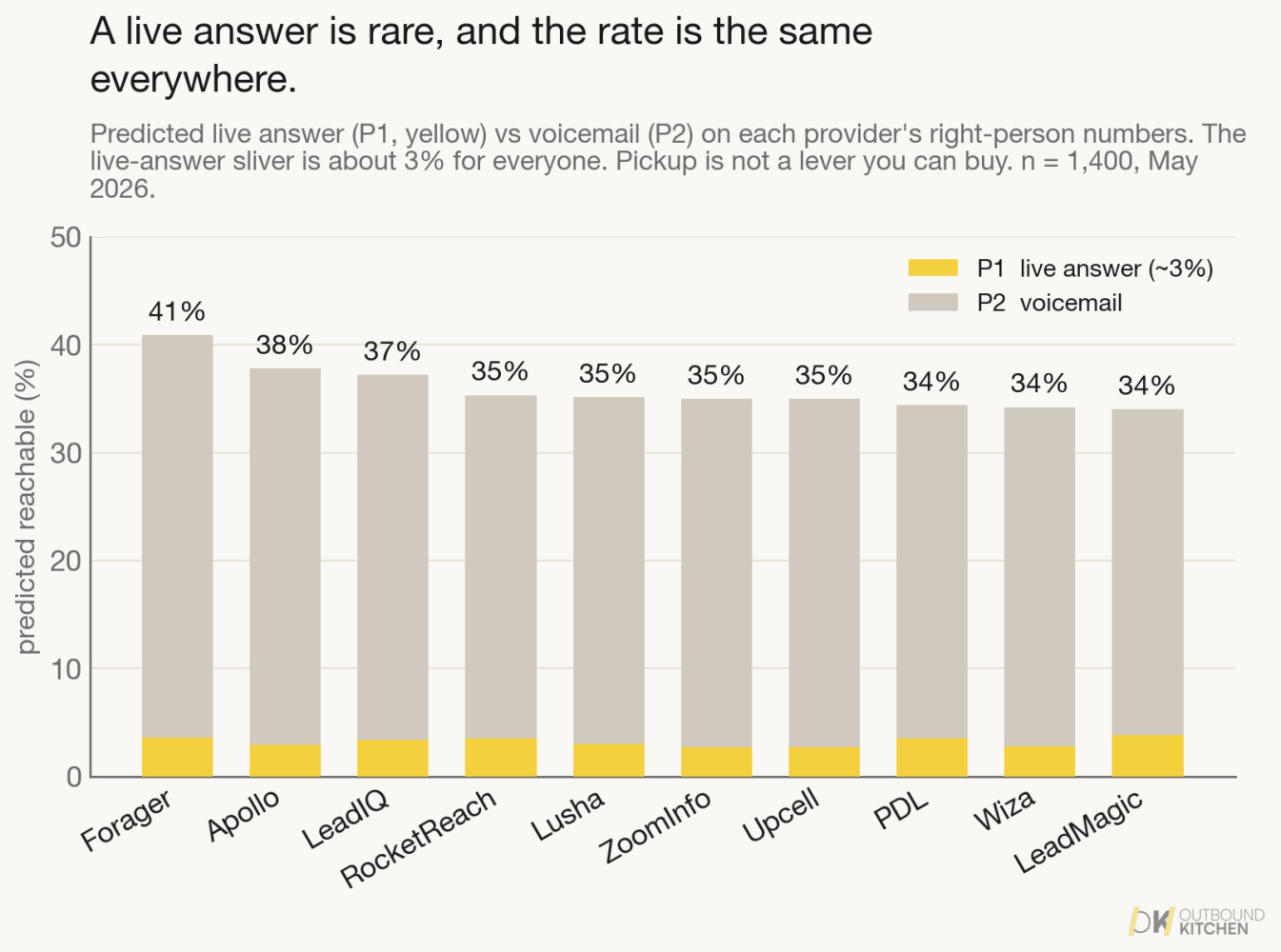
So the pickup rate is not yours to improve. The only thing you can change is how many right-person numbers you put in front of your reps, and that swings a lot by provider. If only about 1 in 5 of any market will ever answer, your one lever is to spend those scarce pickups on the right people instead of strangers. That is the goal of this whole benchmark. Better data does not raise the answer rate. It decides who is on the line when someone does answer. The provider that hands you more right-person numbers hands you more conversations. Full stop.
One more trap, and it is the sharpest one: reachable is not the same as right. Of the numbers SureConnect predicts will answer or hit voicemail, 1 in 6 belongs to a different person. And on the ones it is most confident will answer live, it is worse: more than 1 in 4 is a stranger, the same wrong-number rate as the list overall. A reachability score tells you a line will pick up; it cannot tell you whose line it is. That is why the right-person check is its own layer, and why a cheap “will it connect” score can never stand in for it.
No provider is both wide and accurate
That is the chart you saw at the top, and now you have walked the layers behind it. Coverage against quality (of the mobiles a provider returns, how many are the right person), every provider plotted, and the corner you would actually want, wide and accurate at once, is empty. The widest provider is only mid on quality. The ones whose mobiles are cleanest reach far fewer people.
That is the structural reason there is no single best provider, and why the stack starts at two. Everything that follows is how you pick your two for who you call.
The scorecard: all 10, ranked by how many right people they deliver
One base shows up on top every time: Wiza returns the most right-person numbers, for every persona and both company sizes. That is a count of right people delivered off the full list, not a per-number hit-rate, and it is the number that drives conversations. So the table is sorted by it.
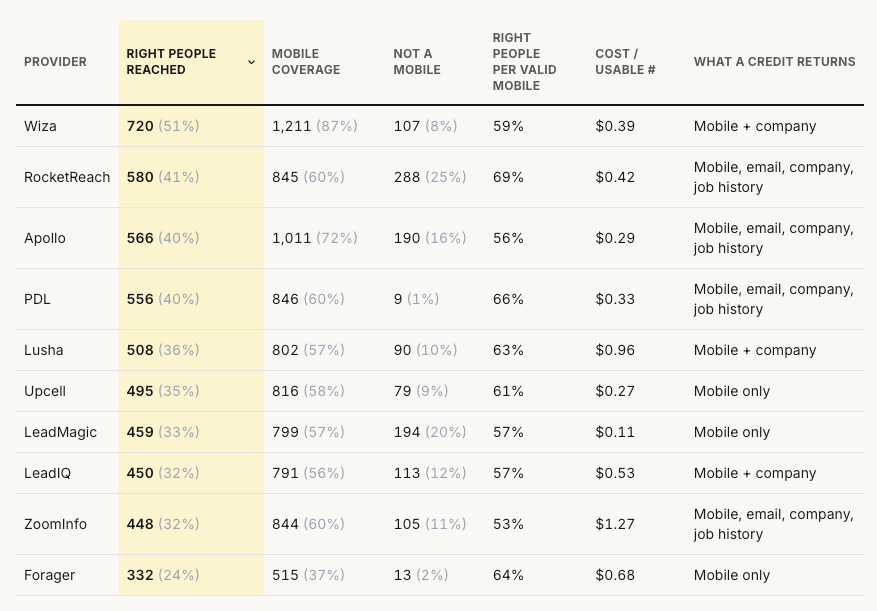
How to read it: Right people reached is the bottom line and the sort. It is already net of every kind of waste, so it is the only column that decides. The rest show why it is high or low. A returned number fails two ways, and both are useless to a rep: Not a mobile, a landline, VOIP, or dead line, and wrong person, a real mobile that belongs to a stranger. Mobile coverage is how many real mobiles you get. Right people per valid mobile is, of those, the share that are actually your prospect; the rest are the wrong person. Multiply the two and you land on Right people reached. Forager is the clean example: only 2% not a mobile, but 36% of its real mobiles are still a stranger, so it ends at 24%. Right person = an exact name match (IPQS) on a valid mobile. Cost = per right-person number, current pricing. n = 100 per persona-by-size cell, single run, May 2026. ZoomInfo is a borrowed-account estimate ($0.60/record, excludes its $15k/yr floor). Capability for Apollo and Lusha is from provider docs; the rest are confirmed from the test returns.
Reach and quality are different vendors.
Wiza reaches the most people, but of the mobiles it returns, only 59% are the right person. RocketReach is the cleanest at 69%, though it makes you filter the most non-mobiles to get there: about 1 in 4 of the numbers it returns is not even a mobile. PDL and Forager are right behind, at 66% and 64%, and cleaner. Those three reach far fewer people than Wiza. So the buy is base plus complement: Wiza for reach, then the provider that adds the most new right people on top of it. That second provider is RocketReach overall, though Apollo and ZoomInfo are within a few contacts of it. No single tool is enough, which is exactly the point: identity is the hard layer, no provider owns it, so you cover the right people by stacking the two that fit your market.
Explore it for who you call (Interactive dashboard)
The same data, filtered to your buyers. Pick a persona and size; every view recomputes.
Open the interactive dashboard here: https://outbound.kitchen/research/mobile-data-benchmark-2026

Best for what you care about most
The full board is above. If you just need the quick pick for your one priority, here it is.
Cheapest usable numbers: LeadMagic ($0.11 per right-person number), self-serve and direct, is the cheapest by a wide margin. Upcell ($0.27) is next, and the cheap way into it is through Clay.
Cleanest mobiles: of the mobiles a provider returns, RocketReach’s are the most likely to be the right person (69%), with PDL and Forager just behind (66% and 64%). PDL and Forager get there with few non-mobiles; RocketReach makes you filter more first. When a wrong dial is expensive, these hit the prospect most often per mobile dialed.
Most coverage: Wiza reaches the most of your list (1,211 valid mobiles, 87%, the most right people delivered), which is why it is the base of almost every stack.
A full record, not just a number: PDL and RocketReach return verified email, company, and job history alongside the mobile, so the credit does double duty.
And whatever you stack, run it as a waterfall ordered by cost: lead with the cheap, accurate ones and layer the wide one to mop up. Same reach, about 10% less.
Build your stack: find your row
No single second provider wins everywhere, so here is the whole decision in one table. Find who you sell to, take the two names, start there. That is the stack.
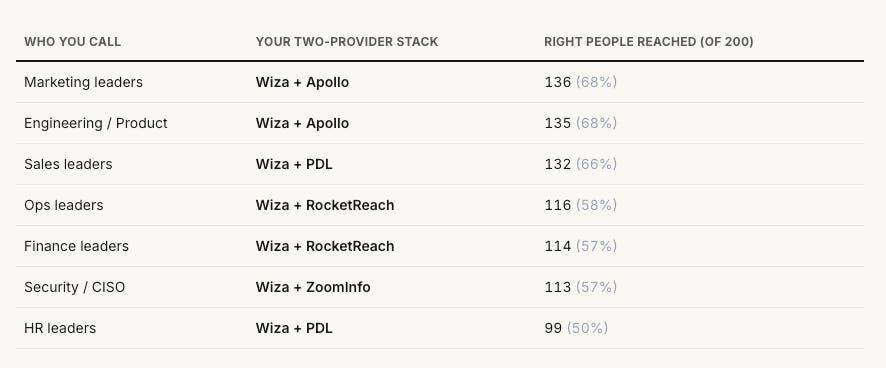
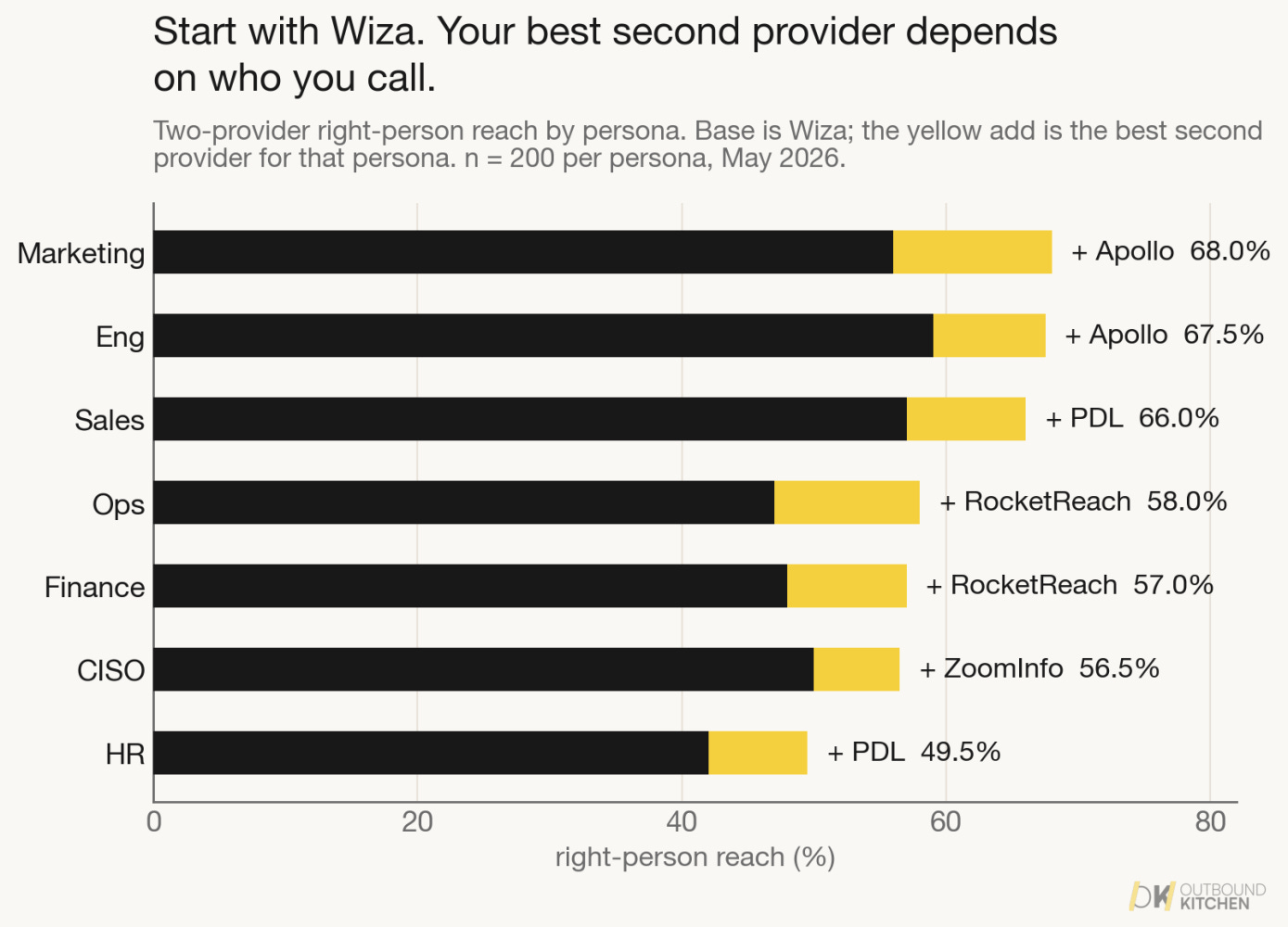
Lead with Wiza, then add the one partner for your row. Two providers get you to between 50% (HR, the hardest persona to reach) and 68% (marketing) of the right people. The third barely moves the line, so only add it when your dialer says you are running dry.
One cut I ran and left out on purpose: company size. I split the same data by mid-market (50 to 1,000) versus enterprise (1,000+), and the provider picture barely moves between them. The same names sit in the same corners. What actually changes the answer is the persona, who you call, not how big their company is. That is why this table is by persona and not by company size.
What a third provider actually adds
Stack the providers in order and each one adds less new reach than the last: Wiza gets you to 51% of the right people, a second provider takes you to 60%, the third adds three points, the fourth two, the fifth barely registers.
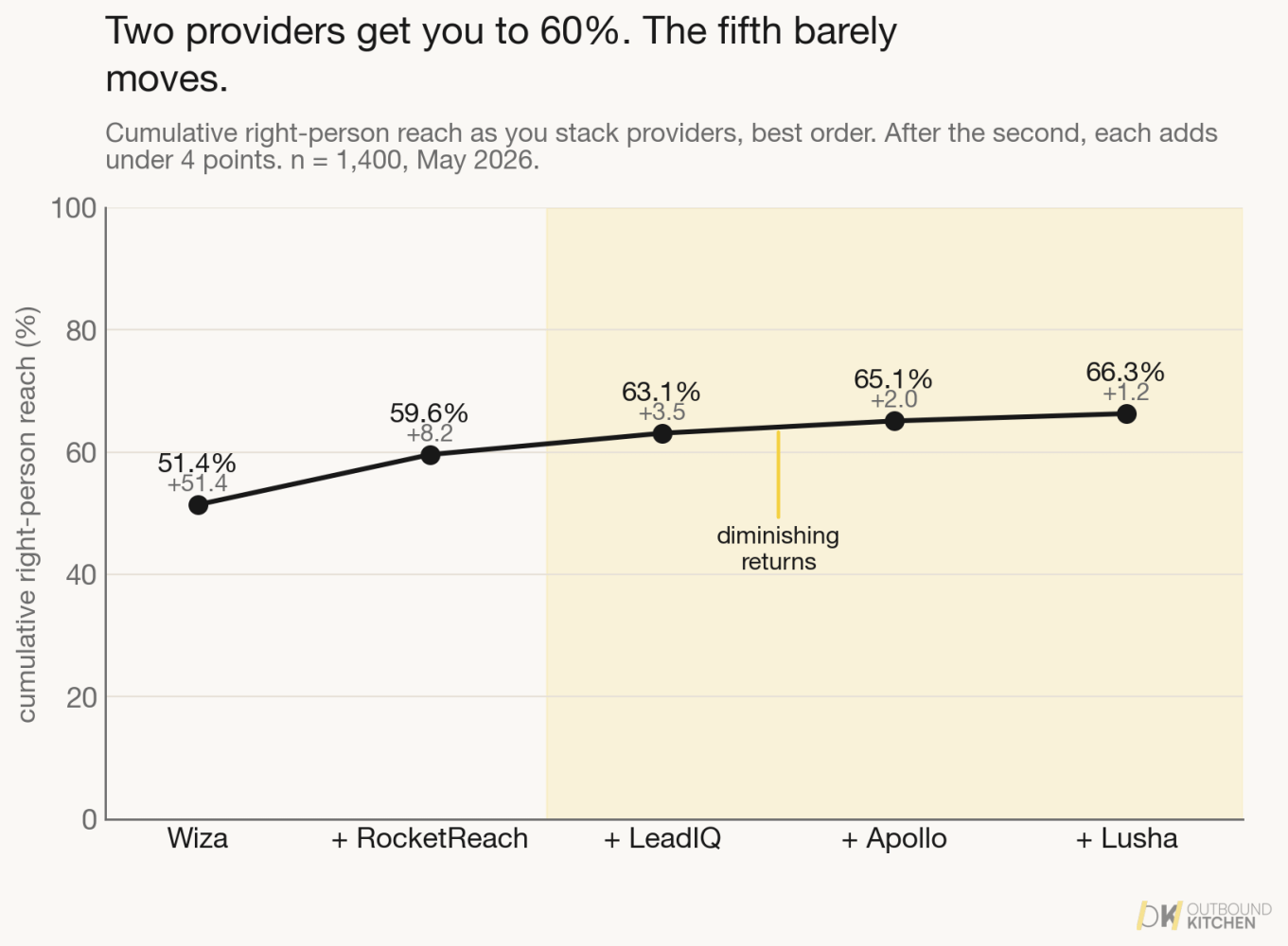
That does not mean cap your stack at two. If you run credit-based tools in a waterfall, you only pay for the numbers you actually use, so adding a third or fourth as a cheap fallback costs you almost nothing. It just changes why you add one: never for more coverage, since a third mostly hands you numbers you already had, but because that one is cheap and catches the few your first two missed. The decision is cost, not count. The only thing to avoid is paying for a second expensive contract to chase those last few points.
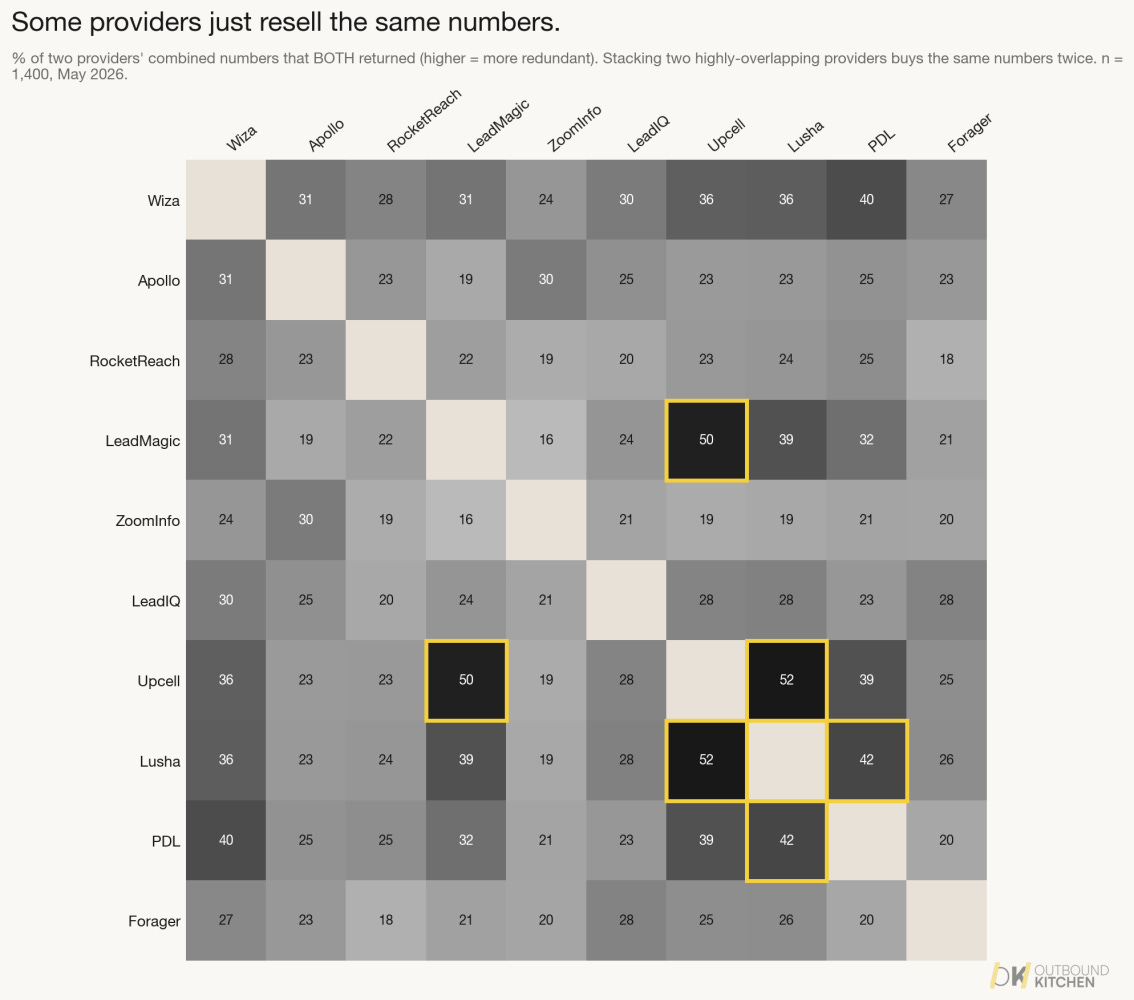
The reason is overlap. Some providers are largely reselling the same underlying numbers, so a second or third often returns mobiles you already have. Most pairs overlap 20 to 30 percent, and the most redundant, like Upcell and Lusha or LeadMagic and Upcell, overlap about half. Stack two that overlap heavily and the second barely widens your reach, which is exactly what the curve above shows.
Run it as a waterfall, and order it by cost
A data waterfall sequences your providers in priority order: you call provider A, and only on a miss call provider B, so you pay for the second provider only on the gaps the first one left. That is how you get two providers’ reach without paying twice for the overlap. Clay, n8n, and Cargo all build one.
The question is what order to run them in. There are a few ways to sequence a waterfall: by cost (cheapest provider first), by coverage (the provider that returns the most right people first), or greedily by best cost per new contact. I modeled all three, and cost-first wins. The cost and coverage orders both reach the same 68% ceiling, but cost-first gets there for about 10% less, because the widest provider’s coverage overlaps the cheap ones, so leading with it bills you for numbers a cheaper provider would have caught anyway.
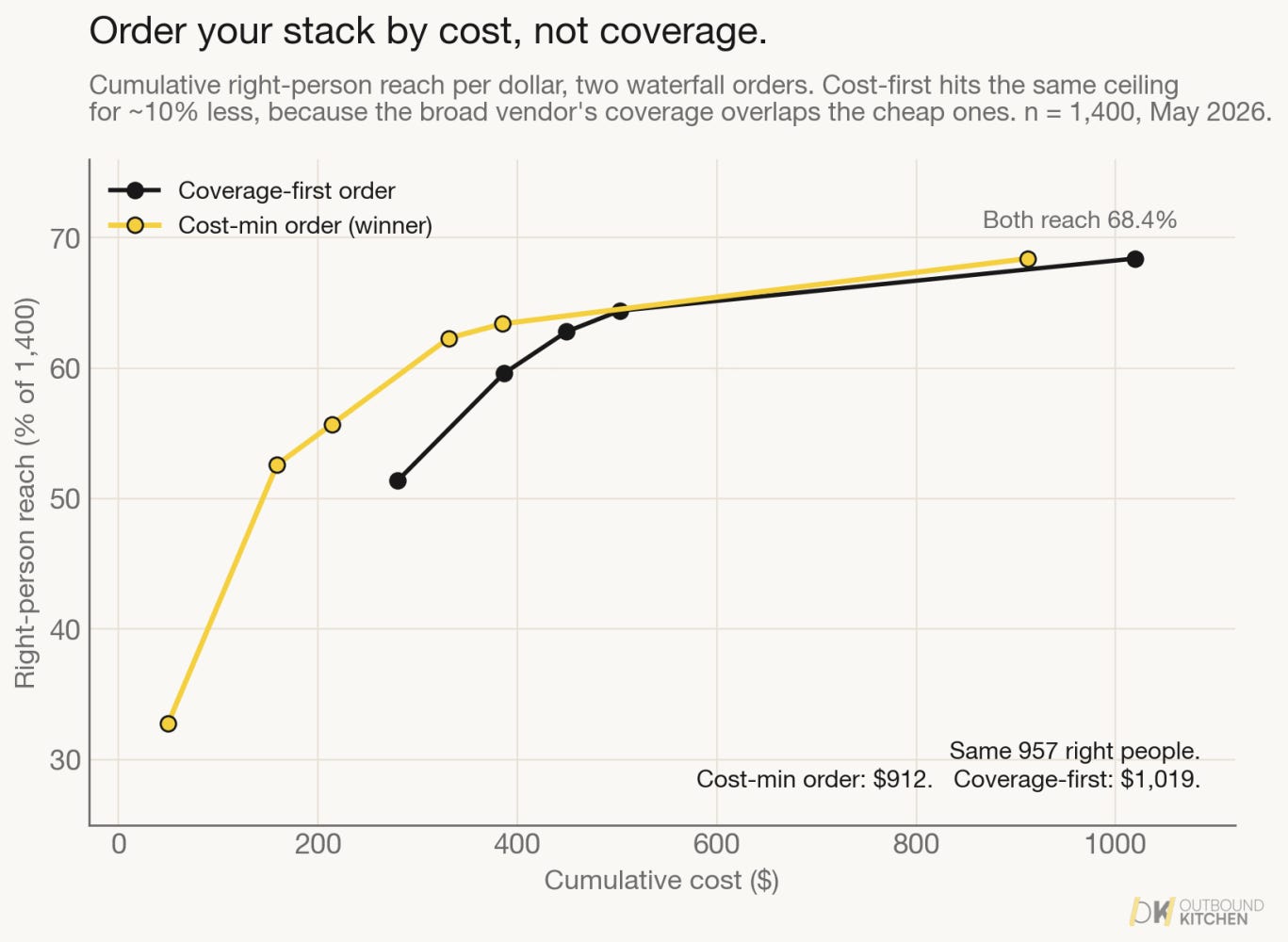
So: quality decides which providers, cost decides their order. Lead with the cheap, accurate ones (LeadMagic, Apollo), then layer Wiza to catch what they missed. This order is for this list.
What a usable number really costs, and what a credit buys
Sticker price per number is the wrong metric. You pay for every number, but only the right-person ones are usable, so the real cost is cost per right-person number.
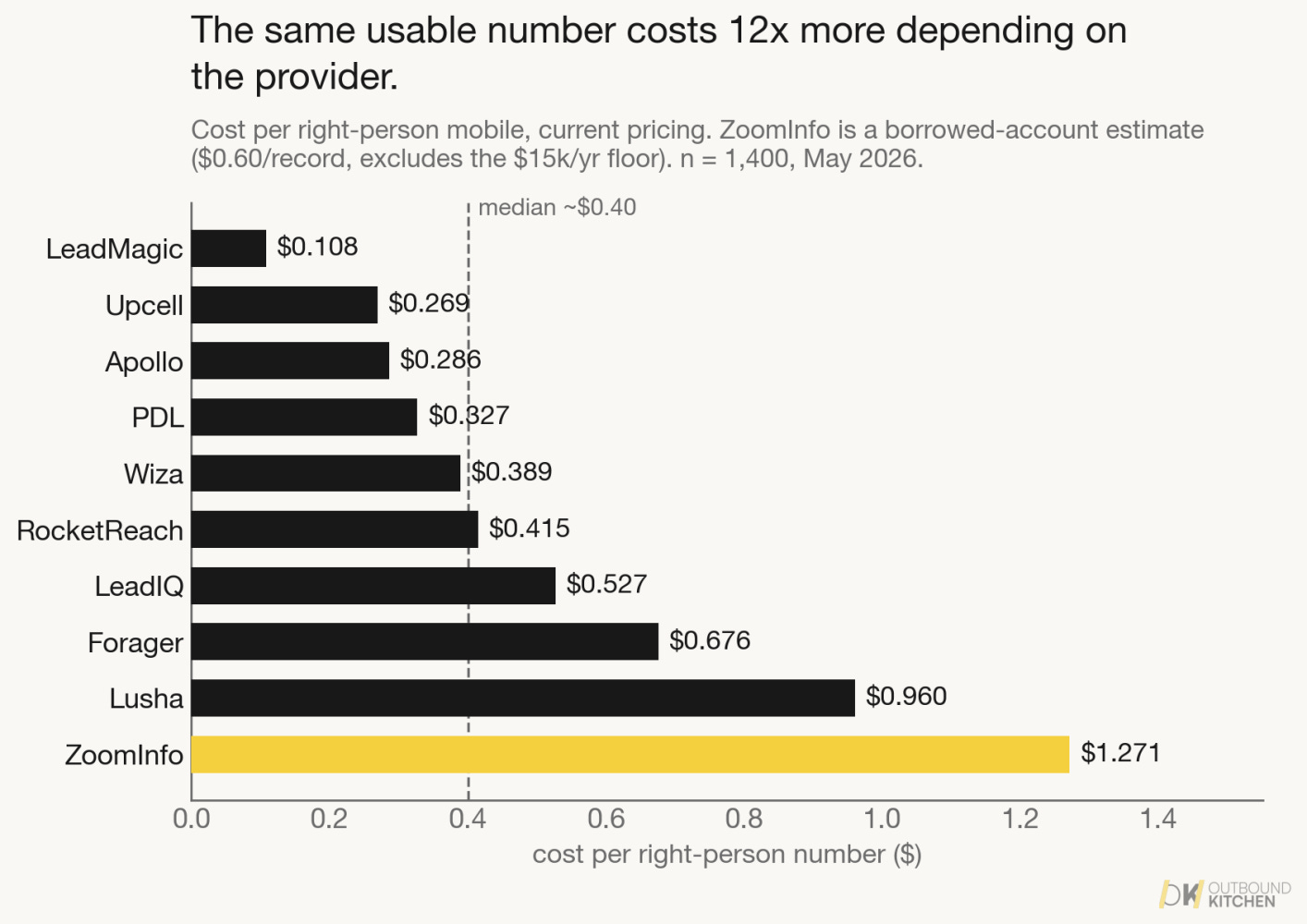
But even that is not apples to apples, because a credit does not buy the same thing everywhere.
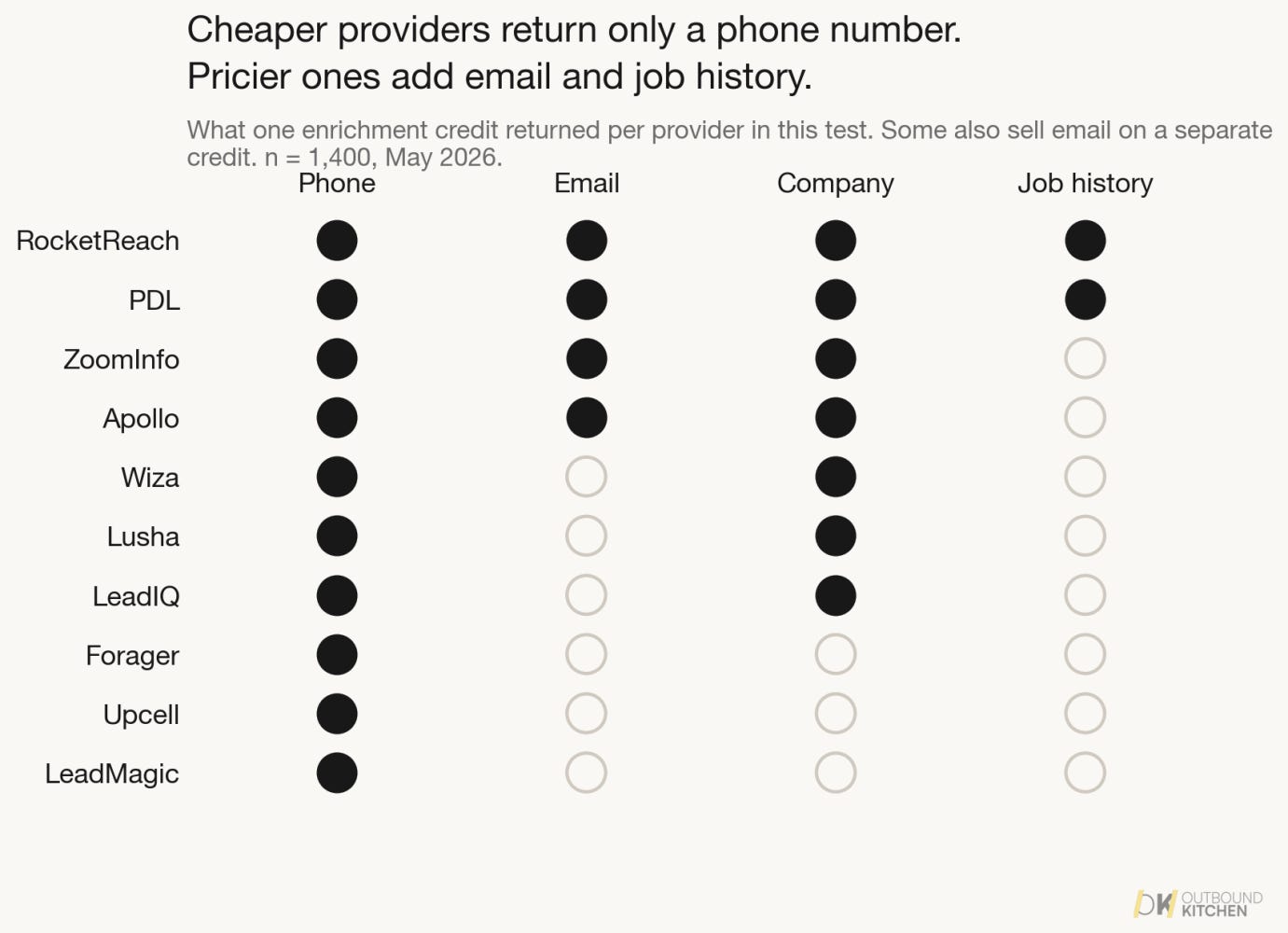
LeadMagic at $0.11 returns only a phone number. People Data Labs and RocketReach cost more, but they also return verified email, company, and job history alongside the number. Price the number against what else comes with it.
How you actually buy each one (and the catch)
The number is only half the cost. The other half is how you are allowed to buy it. Most of these are cheap and self-serve. Two force an expensive annual contract.
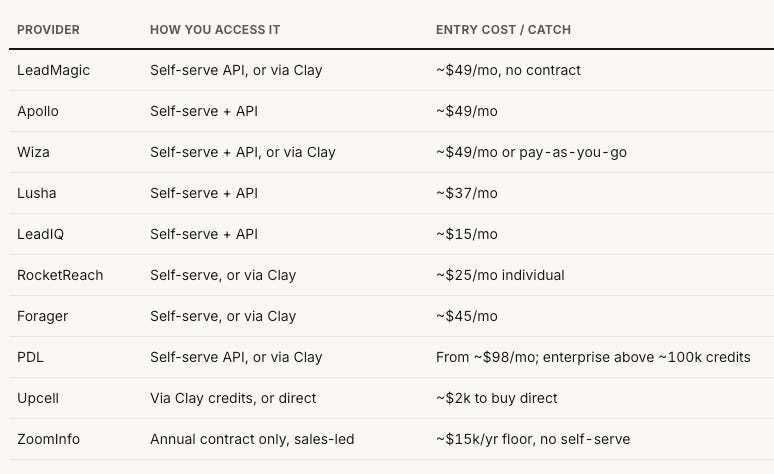
This is the hidden lever. ZoomInfo is the one you cannot just swipe a card for. Upcell is reachable for a fraction of its direct minimum if you pull it through Clay’s credits instead of signing direct. ZoomInfo has no self-serve at all, which is why I had to borrow an account to include it. Everything else you can start on this month for the price of a lunch.
What it cost me, and the Clay tax
I paid about $2,521 to run this. The same run today would cost roughly $4,990, nearly double, for one reason: in 2026 Clay raised its credit price 2.65x, from $0.016 to $0.0425 a credit. The five I ran through Clay got 11% to 166% more expensive overnight. The four I bought direct sit outside Clay, so that hike does not touch them. Even the scoring step, SureConnect, jumped from $880 to $2,337 from the same increase.
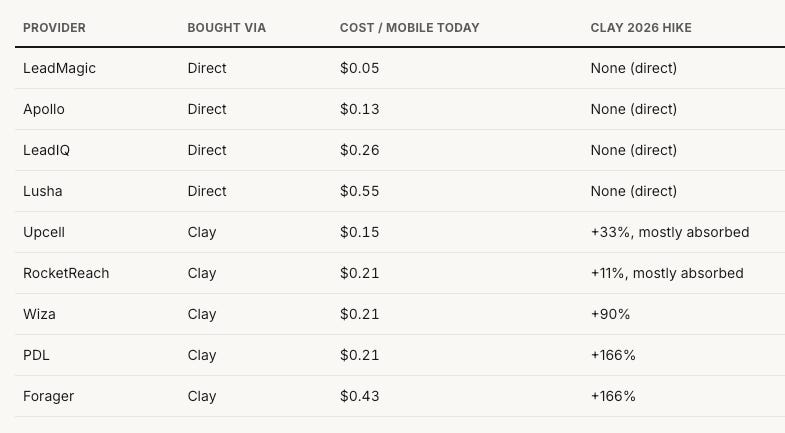
The takeaway: where a vendor sells direct, buying outside Clay stops your cost from depending on Clay’s rate, that is Apollo, Lusha, LeadIQ, and LeadMagic. The exception worth knowing is Upcell: it re-priced its credits to match Clay’s new rate, so the cheap way in is through Clay first (about $0.15 a number), and you only graduate to its roughly $2k direct deal once it has earned a place on your list. Among the Clay-routed five, only RocketReach also softened the hike; Wiza, PDL, and Forager pass Clay’s full increase straight through.
What I actually took away from this
The honest headline: no single tool is enough. There are winners by category. One provider leads on coverage, another on accuracy, another on cost. None leads on all three, and the gaps between them are smaller than the marketing suggests. Every provider has a strength and a soft spot, so the win is picking the two that fit who you call, not hunting for the one that does everything.
The bigger lever is what you do with the data after you buy it. No vendor can tell you whether a number is the right person on your specific list, that is the gap this whole benchmark is about, so your own dial results are the only ground truth there is. A team that validates numbers before dialing, never calls a dead one twice, and feeds those results back into which providers it keeps will beat a team sitting on “better” data with no loop, every time. The provider choice gets you in range. The feedback loop is the actual edge.
I built it with a team that books most of its meetings on the phone. We stacked a couple of mobile providers, validated each line was a real mobile before anyone dialed, scored reachability with the tools made for it (we tried TitanX and SureConnect), and fed every call result back into which provider earned the next list. That loop is the part that compounded.
The recommendation, in one place
If you read nothing else, this is what to do.
How many providers depends on how you pay. For reach, two get you most of the way and a third barely adds, so you do not need five for coverage. But if you buy credit-based tools and run them in a waterfall, you only pay for the numbers you actually use, so stacking several as cheap fallbacks costs almost nothing extra. The trap is contracts: do not sign multiple annual deals like ZoomInfo or Cognism. A clean setup is one contract tool as your base if you already have one, plus credit-based providers layered in a cost-ordered waterfall. For any provider that still locks you into an annual contract, run the experiment on your own list first with the month-to-month and credit providers, and sign the year only once the coverage proves out for your market.
Run them as a cost-ordered waterfall. Lead with the cheap, accurate ones and layer the wide one to mop up. Same reach, about 10% less spend.
Buy direct where you can. Apollo, Lusha, LeadIQ, and LeadMagic sell their own credits, insulated from Clay’s hikes. Through Clay you can pay up to 2.65x more for the same number.
Track the source. Stamp every number in your CRM or sequencer with the provider and date, or you will never know which one is earning its spend.
Validate before you dial, then score. Run each number through a line-type and name check (IPQS, Trestle) to confirm it is a live mobile that belongs to the prospect, about $0.10 each. That gets you most of the way on identity; the live call is the final confirmation. Then score for reachability (SureConnect, TitanX) so reps dial the best numbers first.
Close the loop. Pull dispositions back from the phone system, was it the right person, someone else, did they pick up, and feed that into which providers you keep.
The stack gets you in the game. The feedback loop is how you win it. The benchmark gives you the starting lineup; your dispositions tell you who to keep.
If you are already in one of these situations
You already pay for ZoomInfo. Keep it for what it is good at, the full record: email, firmographics, org charts. Do not lead your dialer with its mobiles. They are mid on quality (53% of their mobiles are the right person) and the most expensive per usable number ($1.27). Use it as the enrichment base, layer cheaper, higher-match-rate mobile providers on top, and put ZoomInfo last in the waterfall.
You run on Clay. Most of the credit-based providers are one toggle away: Wiza, Upcell, RocketReach, PDL, Forager. Order your waterfall cheap-and-accurate first, then Wiza for coverage. LeadMagic and Apollo are cheaper bought direct, so pull those in with your own keys. Upcell re-priced its credits to match Clay’s new rate, so start it through Clay before its direct deal.
You are starting from zero. Begin with Wiza plus the one partner for who you sell to (the lookup above), bought whichever way is cheaper for that vendor. Add a third only when your dialer says you are running dry.
What I did not test, and why
Waterfall aggregators (FullEnrich, BetterContact). Left out on purpose. They stack the same underlying providers I tested, so of course their coverage looks higher. It is not like-for-like, it is someone else’s stack with a markup. The waterfall section above is how you build the same thing and keep the margin.
One-year-contract providers (Cognism, SalesIntel, Seamless.AI). I could not get access without signing an annual contract, so I left them out rather than guess. ZoomInfo is in only because a friend ran my list through his account.
Live calling. I did not run a calling census, and even one has a ceiling: a dial only tells you the truth about the people who actually answer, and most will not. The pickup numbers here are predicted, not confirmed by an actual call. A future round with a human caller could measure real pickup, but it would still only confirm the share who pick up, not the rest.
Behind the numbers
The methodology
Elric Legloire, Outbound Kitchen. I help GTM leaders build and scale outbound teams and write a newsletter on it. I do not sell a data product, no provider here pays me, and none sponsored or reviewed this. Self-funded, about $2,521 out of pocket.
The sample. 1,400 US B2B contacts scraped fresh from LinkedIn in May 2026. 7 leader personas (security, engineering/product, finance, HR, ops, sales, marketing) at C-level, VP, and Head-of. 2 company sizes (mid-market 50 to 1,000, enterprise 1,000+), 100 contacts in each persona-by-size cell. Input to each provider: first name, last name, LinkedIn URL, and company name for some.
The depth. Those 1,400 people came back as 3,446 distinct phone numbers, 2.46 per contact across the 10 providers. I did not score one number per person and move on. Every number got checked on its own for line type and for the name on the line, which is what makes the right-person rates here measured rather than claimed.
How I sourced each provider. Phone numbers through my own Clay credits for five (Upcell, Wiza, RocketReach, Forager, People Data Labs). Direct via their own API for three I pay for (Lusha, Apollo, LeadIQ). My own account API for LeadMagic. ZoomInfo through Jed Mahrle’s account, since it is annual-only and I could not buy it on its own. Thanks Jed. If you want the sharpest outbound newsletter going, read his: Practical Prospecting.
The checks.
Coverage: a number came back.
Valid mobile: Trestle classified the line type, mobile versus VOIP versus landline. That is the only thing I used Trestle for.
Right person: IPQS is a fraud-and-identity tool that returns the name tied to a phone line. I took that name and matched it to the prospect, counting only exact matches as right-person (nicknames and truncated names that I could not confirm exactly are counted as not-confirmed, which is the strict, conservative call).
Predicted reachable: SureConnect predicts whether each number will connect, without dialing it. It is a prediction, not an actual pickup, and I report it separately, never folded into the funnel.
Right-person definition. Right person is an exact IPQS name match on a valid mobile, IPQS only, no second validator promoting partial matches. It is the strict definition, which is why these right-person rates read lower than a vendor’s own marketing number. The published dataset uses the same definition, so if you recompute it, you land on these numbers.
Limits. Single run, one snapshot in time. US, LinkedIn-sourced contacts only. The per-persona and per-size cuts are 100 to 200 contacts each, so treat those as direction, not gospel. The numbers move over time, so treat this as a snapshot.
Run it yourself
Filter the dashboard to your personas and company sizes, and every number recomputes for your exact segment. Sort all ten providers by coverage, by right-person accuracy, or by cost per right-person number. Put any two head to head. Read the best two-tool stack for who you actually call. Then download the full 1,400-row dataset and run the whole test against your own list.
Open the 2026 US B2B Mobile Data Benchmark:
Hope this benchmark was useful!
See you in the next newsletter.
Elric