


This newsletter is sponsored by Influ2
Free: The ABM That Starts With People Report
Most ABM targets accounts. But accounts don’t buy, people do. This report breaks down how to build ABM around the decision-makers who actually influence the deal.
An SDR leader I chatted with in Q1 had a problem:
He’d hired four BDRs the same week. Five weeks in, three had booked meetings. The fourth had booked zero.
Scaling SaaS org. Low patience. ROI watched closely. He wanted to let the rep go.
If you’ve led an outbound team, you’ve been there. The number is short. One rep is dragging it. Leadership wants to know what you’re doing. Firing the rep is the obvious answer. It also tells you the bar is high.
Before you pull the trigger, look at the data.
In 2025, 78% of B2B sellers missed quota (Ebsta). Right now, 44% of SDRs and 57% of AEs are missing their number (RepVue, May 2026, role-level).
Two different lenses, same direction.
Here is what most leaders do when a rep misses quota.
They look at the number. They check how long the rep has been ramped. They compare to the rest of the team. The rep is behind. The ramp window is closed. The rest of the team is on track. Decision made. PIP, then exit.
Shaunt Voskanian, CRO at Figma, said it on 20VC:
“I kind of don’t care if you as a rep hit your quota or not.”
His point: quota is a lagging indicator. It’s downstream of territory, ICP, messaging, enablement, comp design, and a dozen other things you control. Pinning the miss on the rep is the cheapest read of the data you have.
It also protects the leader more than the team. Firing the rep closes the loop. Nobody asks if the territory was carved fairly. Nobody audits the ramp. Nobody pulls the call recordings to see if the booking reps are running a different play.
HBR has a name for this: the Set-Up-to-Fail Syndrome. Manzoni and Barsoux’s research found managers default to blaming the employee even when their own behavior, attention, and resourcing are the cause.
So diagnose first. Five checks, in order. Three on the rep. Two on you.
Here’s how it runs:
The Five-Check Diagnostic
Run them in order. Don’t skip ahead. Each check rules out a cause before you spend time and money on the next one.
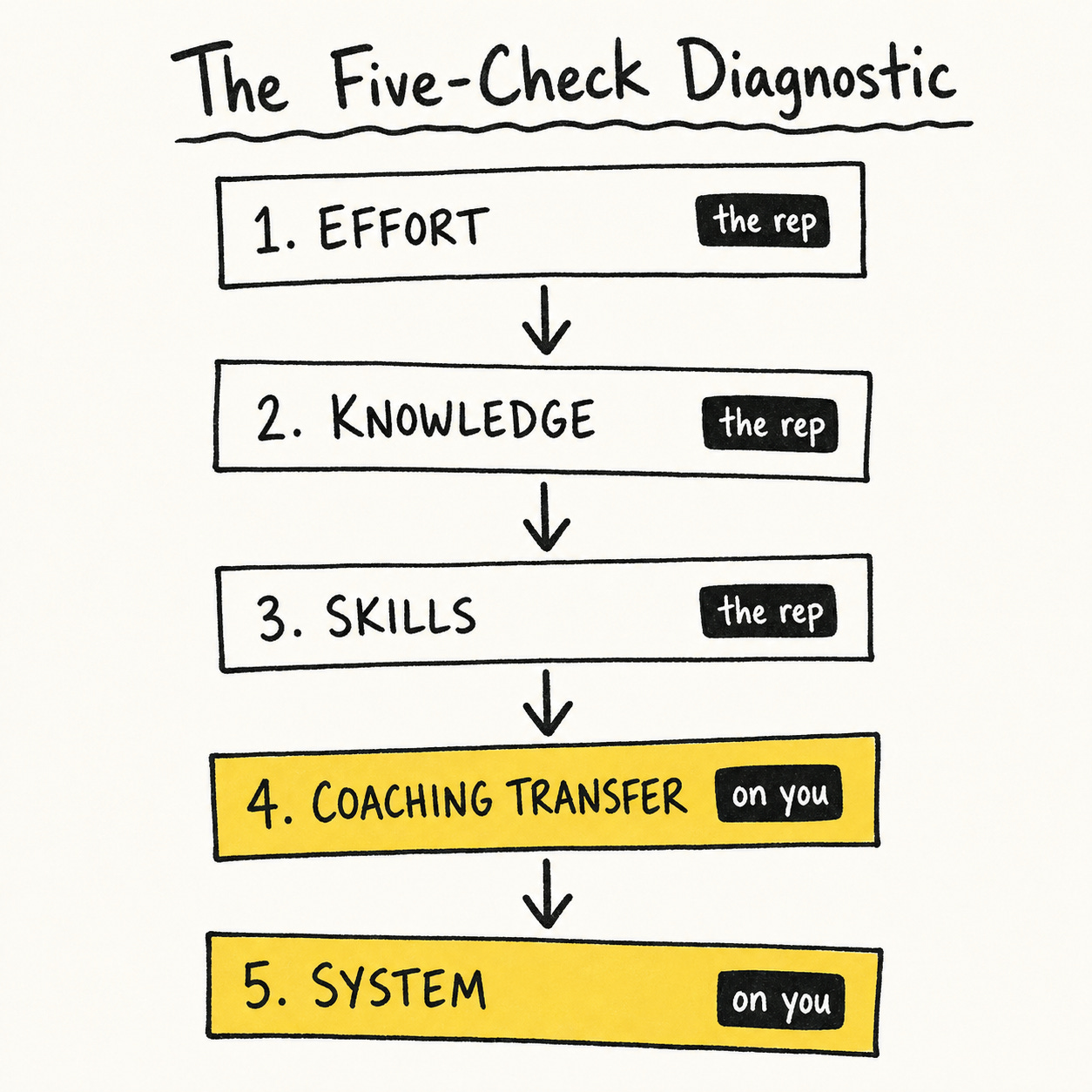
Check 1: Effort
Pull the activity:
Calls dialed
Emails sent, LinkedIn touches
Accounts worked.
Prep for discovery calls.
Compare to the reps who are booking.
If the volume isn’t there, you have a motivation problem. Talk to the rep. Find out what’s going on. Sometimes it’s personal. Sometimes the rep checked out two months ago and you missed it. Either way, this is the cleanest call on the list. If effort doesn’t come back in two weeks, exit.
If the volume is there but results aren’t, move to Check 2.
Check 2: Knowledge
Read five cold emails. Listen to a discovery recording.
Does the rep know the product?
Can they articulate the problem you solve in the buyer’s words?
Do they know the top three objections and have a response for each?
Can they map a use case to a persona without thinking about it?
If no, you have a knowledge gap. That’s a 2-week fix. Onboarding refresh, shadowing top reps, certification on objection handling. If knowledge is there, move to Check 3.
Check 3: Skills
Knowledge is what the rep knows. Skills are what they execute under pressure. Pitching cleanly with a script in front of them is not the same as handling a buyer who interrupts in the first 15 seconds.
Listen for: opener delivery, qualifying questions, objection handling, control of the call, next-step ask. Compare to your top performer’s calls on similar accounts.
If the rep knows what to do but can’t execute it live, you have a skill gap. That’s a 4-to-8-week fix with deliberate practice. Role-plays, call reviews, live coaching on skill reps, not deal reviews.
If the rep is executing the skills, move to Check 4. This is where most diagnoses stop. Don’t stop here.
Check 4: Coaching transfer
This is the first check on you.
Pull your coaching notes from the last six weeks. What did you tell the rep to change? Did it show up in the next call? The one after?
Training transfer research is brutal on this. Across 89 studies, what reps actually apply from coaching depends on three things: the rep’s cognitive ability and conscientiousness, the rep’s own motivation, and the support they get from you and their peers after the session. If two of those three are weak, coaching doesn’t stick.
Two failure modes here. One: you’re giving feedback but not following up, so the rep hears five contradicting notes and applies none of them. Two: you’re “coaching” but it’s deal review dressed up. Frank Cespedes’s HBR data says most managers can’t tell the difference.
If the rep is coachable and you’ve been running deal review, the fix is on your side, not theirs.
Check 5: System
This is the second check on you, and the one most leaders skip.
If the rep is putting in the effort, has the knowledge, has the skills, and is applying coaching, and the number still isn’t there, the system is broken. Walk it backwards:
Territory. Did this rep get the same account quality as the others? Run the ICP fit score on each book. If one rep is working a B-list, that’s not a rep problem.
Data. Is the contact data on this rep’s accounts as good as the others? Bad data quietly tanks conversion before the rep ever opens their mouth.
ICP and messaging. Sometimes one rep was handed the messaging deck that worked six months ago and the others figured out the new one in the Slack channel.
Quota design. Aggressive quota set in a market-push environment, no safety net. Shaunt’s frame: that’s a quota design miss, not a rep miss.
Enablement and process. Are the booking reps using an asset, a list source, or a workflow this rep doesn’t know exists?
The system check takes a week of your time. Most leaders skip it because it implicates them. That’s why you run it.
If the system is broken, firing the rep doesn’t fix it. The next hire walks into the same trap.
The Decision
After the five checks, you’re in one of three places.
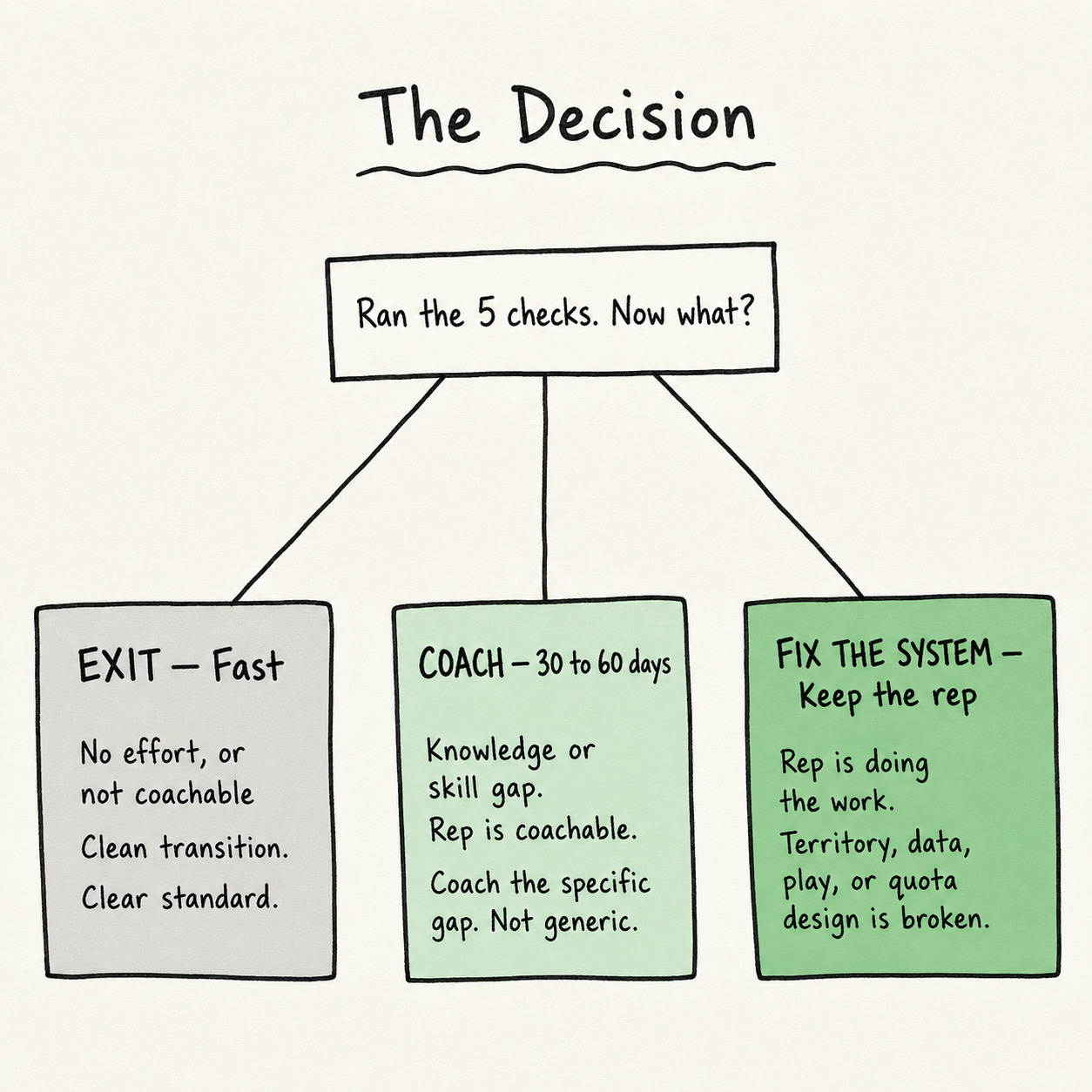
One. Effort is missing, or coaching isn’t sticking and the rep isn’t coachable. Exit. Fast.
Two. Knowledge or skill gap, rep is coachable, effort is there. Give it 30 to 60 days of focused work on the specific gap. Not generic coaching. The gap you diagnosed in Check 2 or 3. If the leading indicators move, keep going. If they don’t, exit.
Three. The rep is doing the work and the system is broken. Fix the system. Keep the rep. This is the call most leaders won’t make because it means going to their boss and saying “the miss isn’t the rep, it’s how we built the territory, the data, or the play.” That conversation is harder than firing someone, and it’s the one that compounds.
Fix the system once, the next four hires ramp faster.
Back to the SDR leader from the intro.
He ran the checks. Effort was there. Knowledge was there. Skills were there. Coaching was landing. The rep was working the same play as the others.
So he gave it more time instead of pulling the plug.
By Feb 27, the rep hit two of three meeting targets. One of those meetings turned into €30K of pipeline. By the end of the quarter, the rep had generated €120K of pipeline across four SQLs. That was more than the rest of the 11-rep BDR team combined.
If he’d fired in week five on instinct under leadership pressure, that pipeline doesn’t exist. The leader doesn’t look like he hired well. The team loses a quarter of its number. The next hire walks into the same broken-ramp setup and the cycle runs again.
One last thing.
If you only remember one line from this:
quota miss is a symptom, not a diagnosis.
Firing feels like the cheap, decisive move. It isn’t. You eat ramp time, severance, recruiter fees, lost pipeline, and the team’s read on whether you have their back. Hiring well is expensive whether the next rep works out or not.
The five checks cost a week of your time. They tell you which reps to keep, which to coach, and which part of the system to fix before the next hire walks into it.
One more loop to close. If the rep does exit, run a hiring post-mortem.
Did they have the right soft skills for the role and the stage of the company?
Did your interview process actually surface those skills, or did you find out three months in?
Feed every answer back into the next scorecard, the next reference call, the next interview.
That’s how you stop running the same diagnosis on the next rep.
Run the checks before the next exit conversation. If you’ve already had it this quarter, run them on the next rep before the pattern repeats.
See you in the next newsletter.
Elric
🔒 For Paid Members: Team Outbound Planner
The 5-check diagnostic above runs on one rep. The Team Outbound Planner runs the same logic on the whole team and tells you the two levers to pull this quarter.
It’s the same Root Cause Analysis I use with clients, packaged as a Google Sheet. Fill in your numbers, see where the team is leaking, get the two highest-ROI fixes.
P.S. The Pantry (the new product I’m building) will include an AI version of this. Same diagnostic, runs on your own data, no spreadsheet. More on that soon.
Grab the Google sheet here: