[Live Webinar] Why GTM Orchestration Breaks Without Contact-Level Execution
Every contact in a buying committee takes a different path. Most ABM nurtures them identically. Devin Reed (ex-Gong) joins Influ2 to break down where orchestration fails and how contact-level execution fixes it. May 6, 10 AM CST.
This newsletter is also available in video and audio version.
You can listen on YouTube, Spotify, Apple Podcasts, and Snipd.
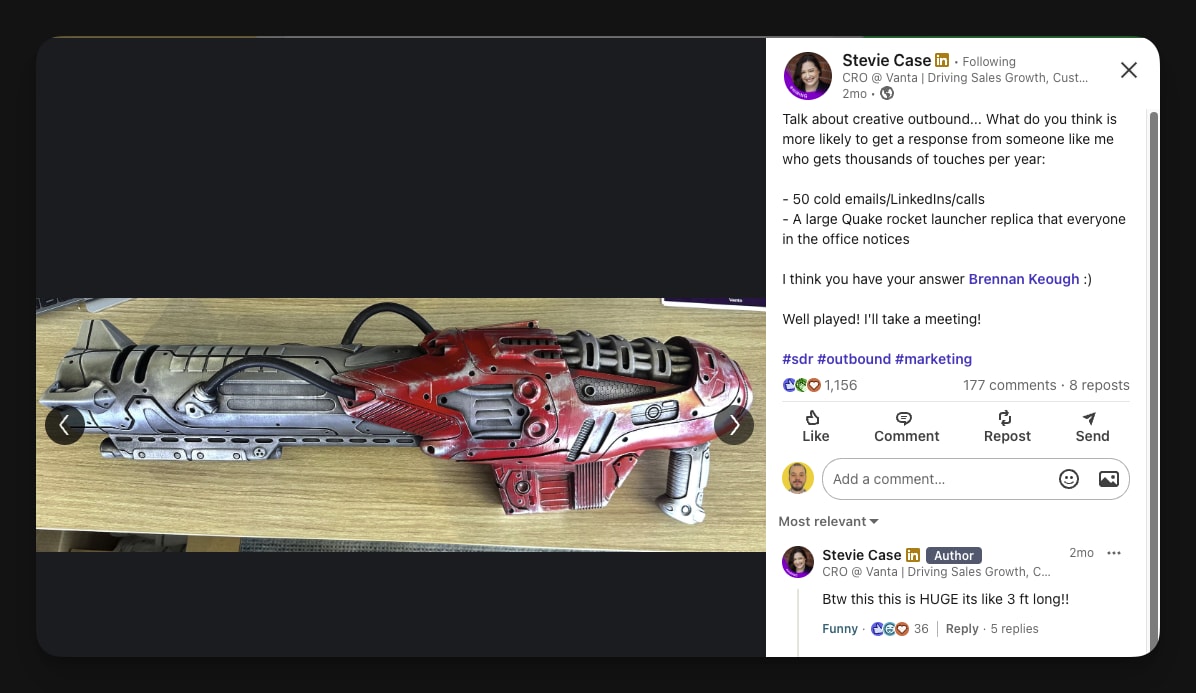
A few weeks ago I saw a post from the CRO of Vanta.
Someone sent her a Quake rocket launcher replica, a reference to her time as a professional Quake player. She posted about it. She took the meeting.
Then a similar post: the CMO at Incident.io got a signed vinyl of their favorite album of all time. Same reaction. Same outcome.
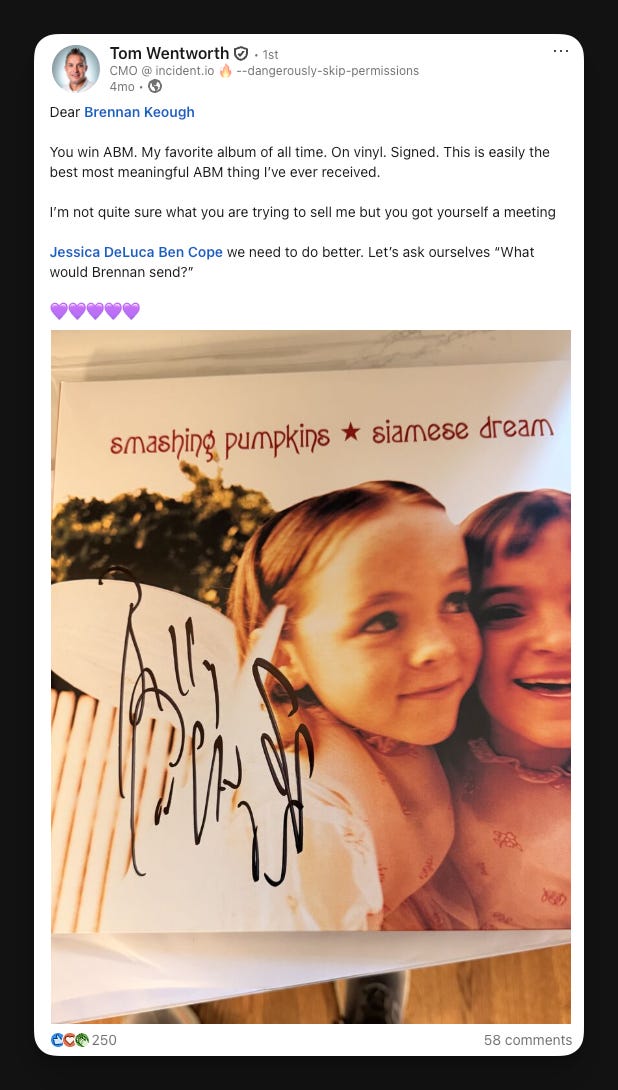
Both worked for the same reason. The research is the system. The gift is the output.
I went down a rabbit hole figuring out how to turn this into a repeatable system for a GTM team running ABM on tier-1 accounts.
Here’s the math. If your top accounts are worth $200k–$1M in ARR, a $300 gift is cheaper than the cold email sequence you’d run instead. You’re not adding to the budget. You’re moving acquisition spend from one channel to a better one.
Cold outreach is harder every quarter (not dead, harder). Generic gifting is the same problem in a new channel, a branded notebook is just another ignored touch. One of my SDR team already sent bottles of champagne or tequila to celebrate promotions and new jobs. Better than nothing. Not personal enough to break through on your top accounts.
The whole system scales with Clay and Claude Code (or any similar tool) once you’ve tested it by hand on 10–20 accounts. Then run it on your top 200 with your GTM team.
Prompts at the bottom.
The 2-step play
Step 1: Find the clue + score the prospect. A specific personal detail the prospect has publicly declared about themselves.
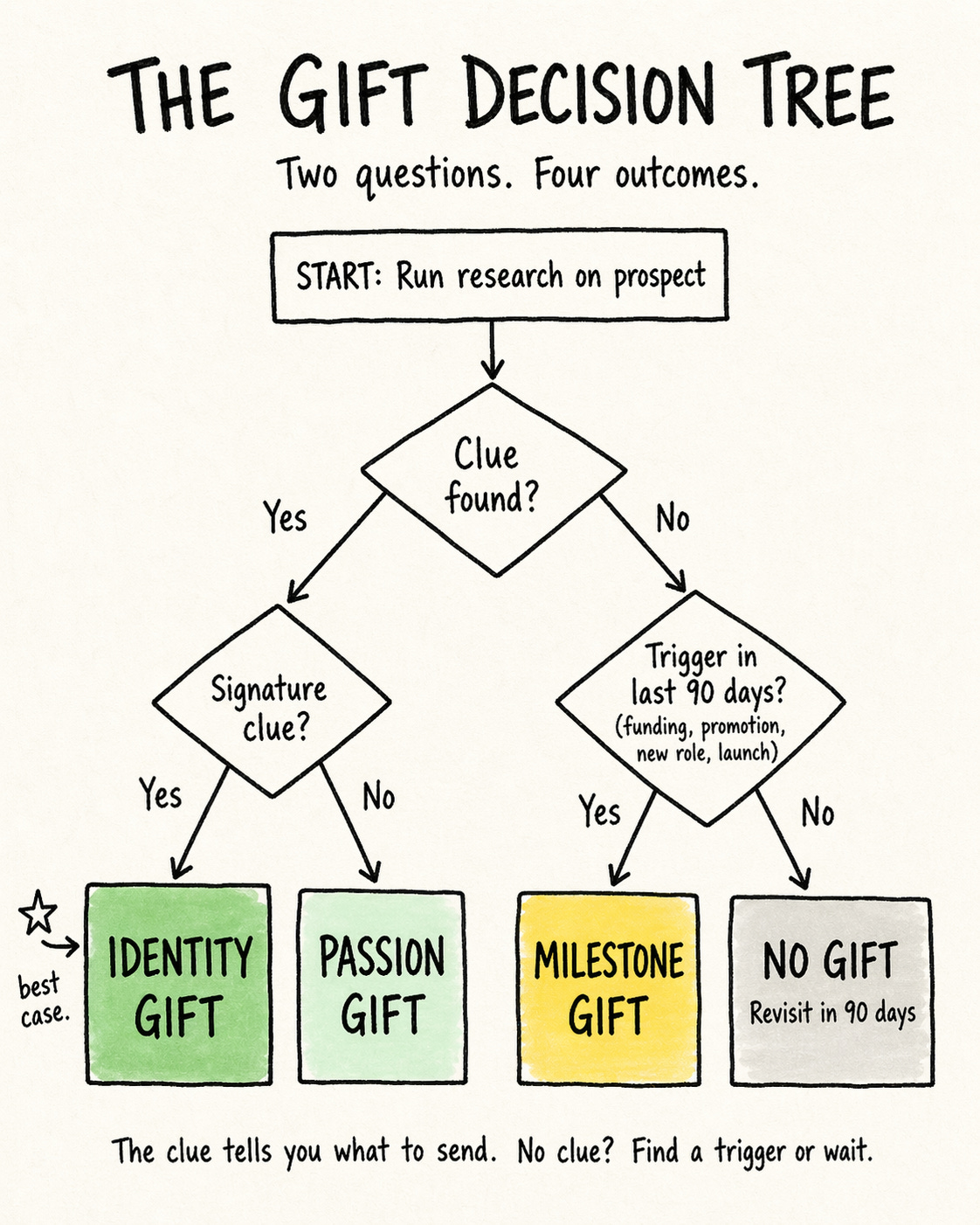
Each prospect lands in one of four buckets:
Identity: they declared a past identity (”ex-pro Quake player,” “former touring drummer”)
Passion: they declared a specific, narrow obsession (”favorite album of all time,” “seen Radiohead 7 times”)
Milestone: no clue, but a recent trigger in the last 90 days (funding, promotion, book launch)
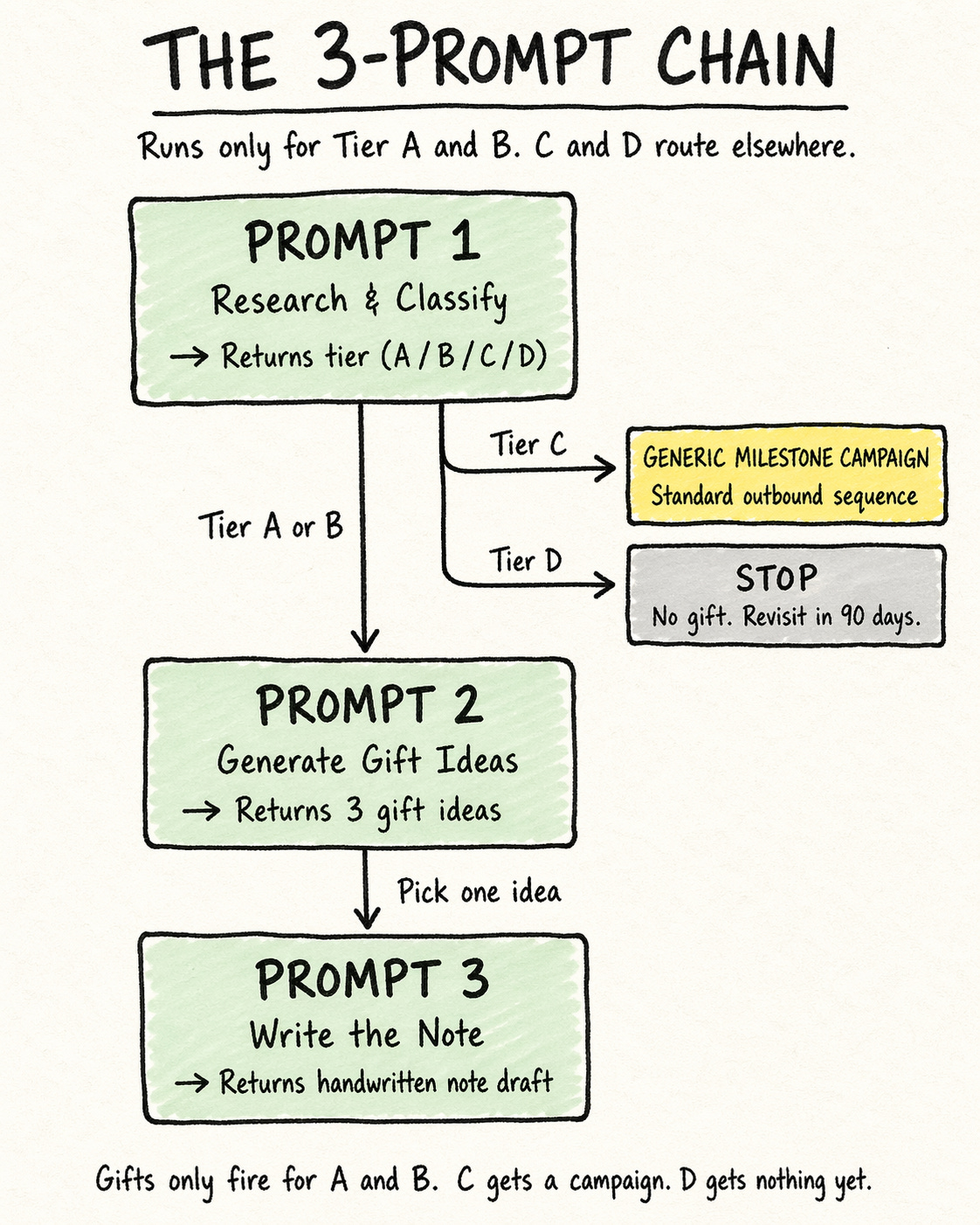
No gift: nothing strong. Revisit in 90 days. Expect this 70% of the time.
Step 2: Turn the clue into a gift + note. Specific to the clue, not the broader category.
If Step 1 fails, Step 2 doesn’t happen. Most of your prospects won’t have a strong enough clue. That’s the filter working. And realistically, not all prospects will share specific clues that you can use
P.S. I’m not talking about personal stuff from Facebook or Instagram. I mean public business stuff.
Step 1 - The clue
Not every personal detail qualifies. There’s a specificity ladder.
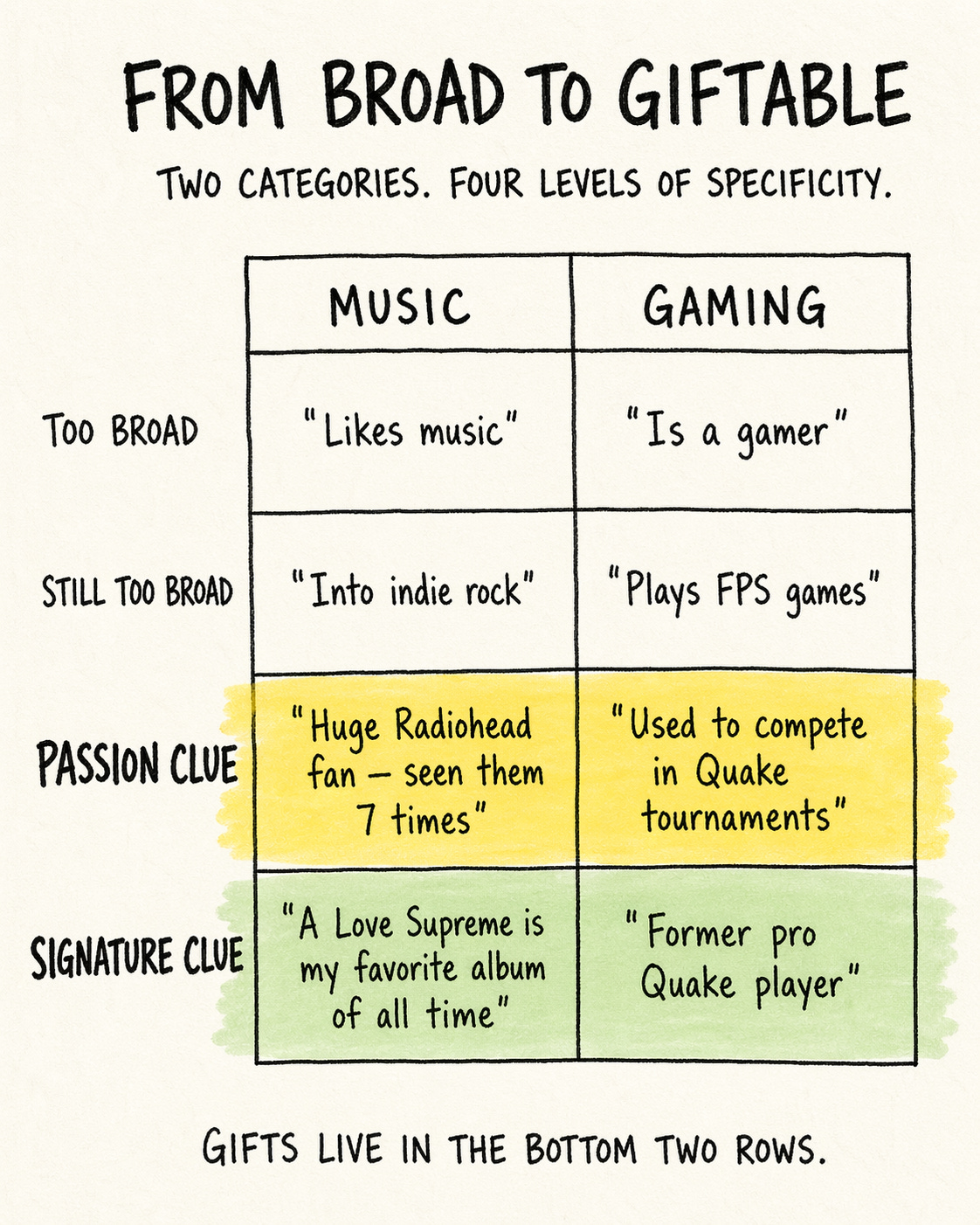
Only Passion and Signature clues qualify.
The rule: focus on the statement, not the source. A Signature clue in a LinkedIn About section is as valid as one on a 2-hour podcast. What matters is specificity and that the prospect said it themselves.
Look for Signature language in their own words: “favorite of all time,” “changed my life,” “in a past life I was...,” “I grew up doing X.” Most common in podcasts, long-form posts, and keynote intros.
Where to look:
LinkedIn (About section, posts, articles)
Podcast appearances and interviews
Conference talks, YouTube keynotes
Their own blog, Substack, Medium
Published articles, book forewords
Company page “About” and “Founding story”
Here’s the output when I ran this on Kyle Norton (CRO of Owner.com):
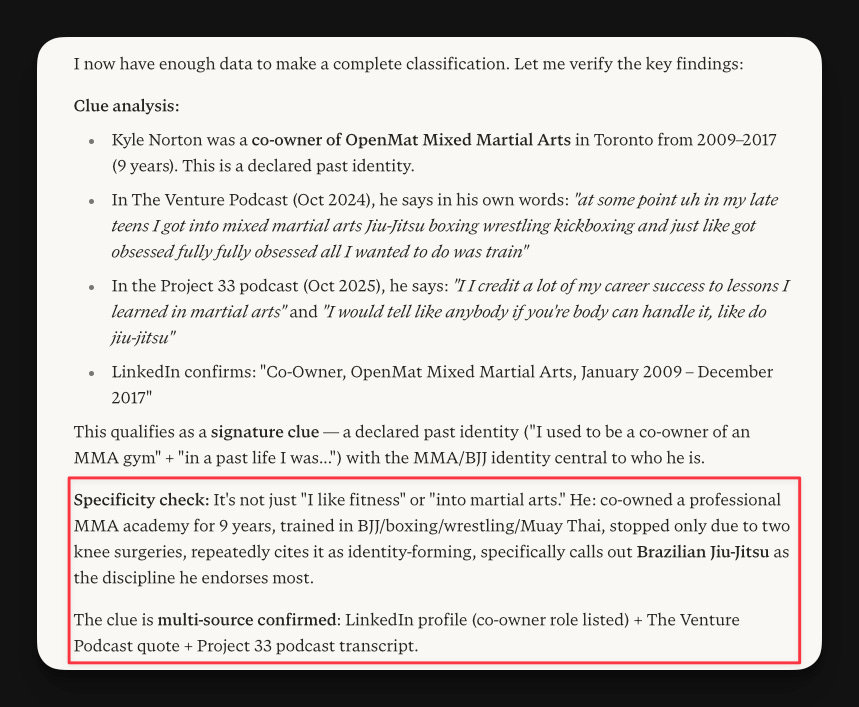
Interesting thing:
When I was testing the prompts, Perplexity was the one returning the best output. Just to let you know, last time I tested, Perplexity and ChatGPT were both equally finding stuff. This time, ChatGPT failed, so just for FYI. This a good reminder to always keep testing the AI models + benchmarking them.
The decision
Run the research on your prospects of your top accounts. For each one, the output is a tier.
Step 2 - The gift + the note
Once you have the clue, the gift has to map to the specific niche, not the broader category.
What to send for each bucket:
Identity gift: an artifact from the past identity. Quake CRO got a rocket launcher replica. A former touring drummer gets a signed pressing of the album they toured behind. A former chef gets the cookbook from their old kitchen. The rule: it has to be the specific artifact, not the category. Not “a guitar pick”, the pick from the show.
Passion gift: a high-signal item inside the niche they named.
“Huge Radiohead fan” → the limited Kid A Mnesia box.
“Deep into pour-over coffee” → a Lance Hedrick-recommended grinder.
Milestone gift: tied to the trigger.
New Series B → a framed print of their funding announcement.
Promotion to CRO → a signed copy of The Qualified Sales Leader.
Book launch → buy 10 copies, send to their team with a note.
No gift: don’t force it.
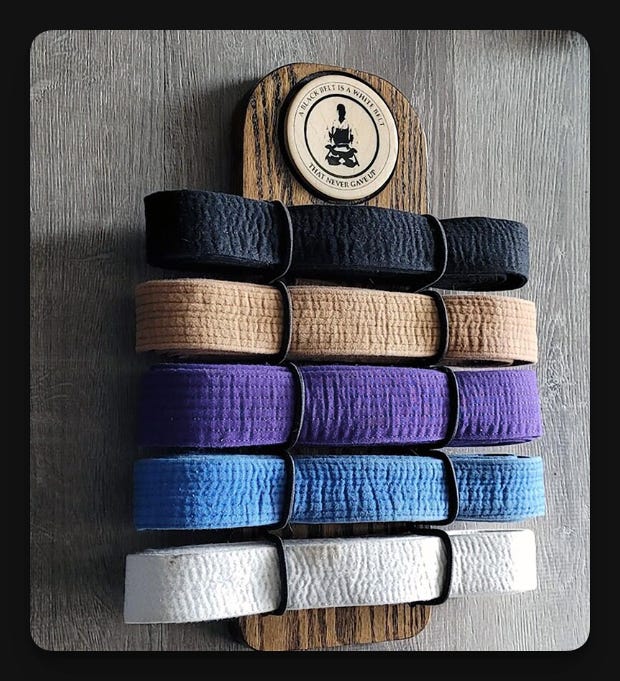
Here are some recommendations I got for Kyle:
Personalized Solid Oak Martial Arts Belt Display & Trophy Rack on Etsy:
Go to https://www.etsy.com/listing/667908227/martial-arts-belt-display-personalized.
Select ‘Oak’ finish and your preferred number of belt slots (1-slot is cleanest for a single black belt display).
In the ‘Personalization’ field enter: Top plaque line 1: ‘Slow is Smooth. Smooth is Fast.’ | Line 2: ‘Kyle Norton’ | Line 3: ‘Black Belt — OpenMat MMA’.
Add to cart. Production + shipping is approximately 7–14 days (seller ships from the US with free shipping).”
The note is the other half.
Here’s the actual handwritten note sent with the Quake replica to Vanta's CRO:
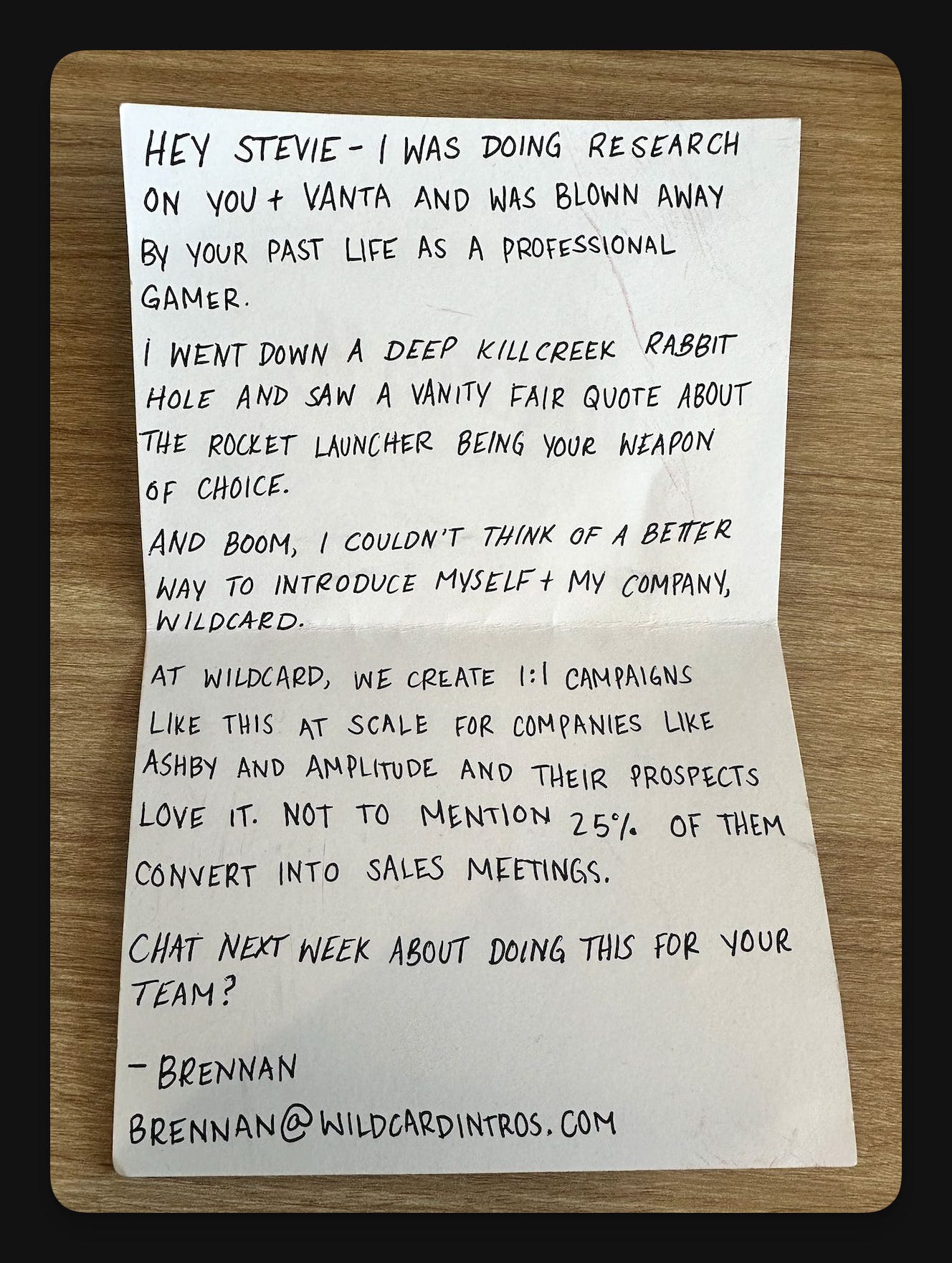
Two things make this note work:
First, the note stacks two references. “Professional gamer” is the surface clue. “Killcreek” is her old gamer handle, and the Vanity Fair quote about the rocket launcher is the flex. That’s the detail that proves the note wasn’t AI-written or outsourced.
Second, the pitch is one sentence with proof. Two recognizable customer logos (Ashby, Amplitude) + one hard number (25% convert).
Here’s the template you can use behind every note:
Research proof - the surface clue, in the prospect’s own language
The rabbit hole - a deeper detail that required real effort to find
Gift bridge - one line connecting research to why you’re sending this
Pitch + proof- one sentence on what you do, with logos or a number
Soft ask - specific, low-friction (”chat next week?” not “would love to connect”)
Name + direct email - not a calendar link
~60–90 words. Handwritten on a real card.
Here's an example for Kyle:
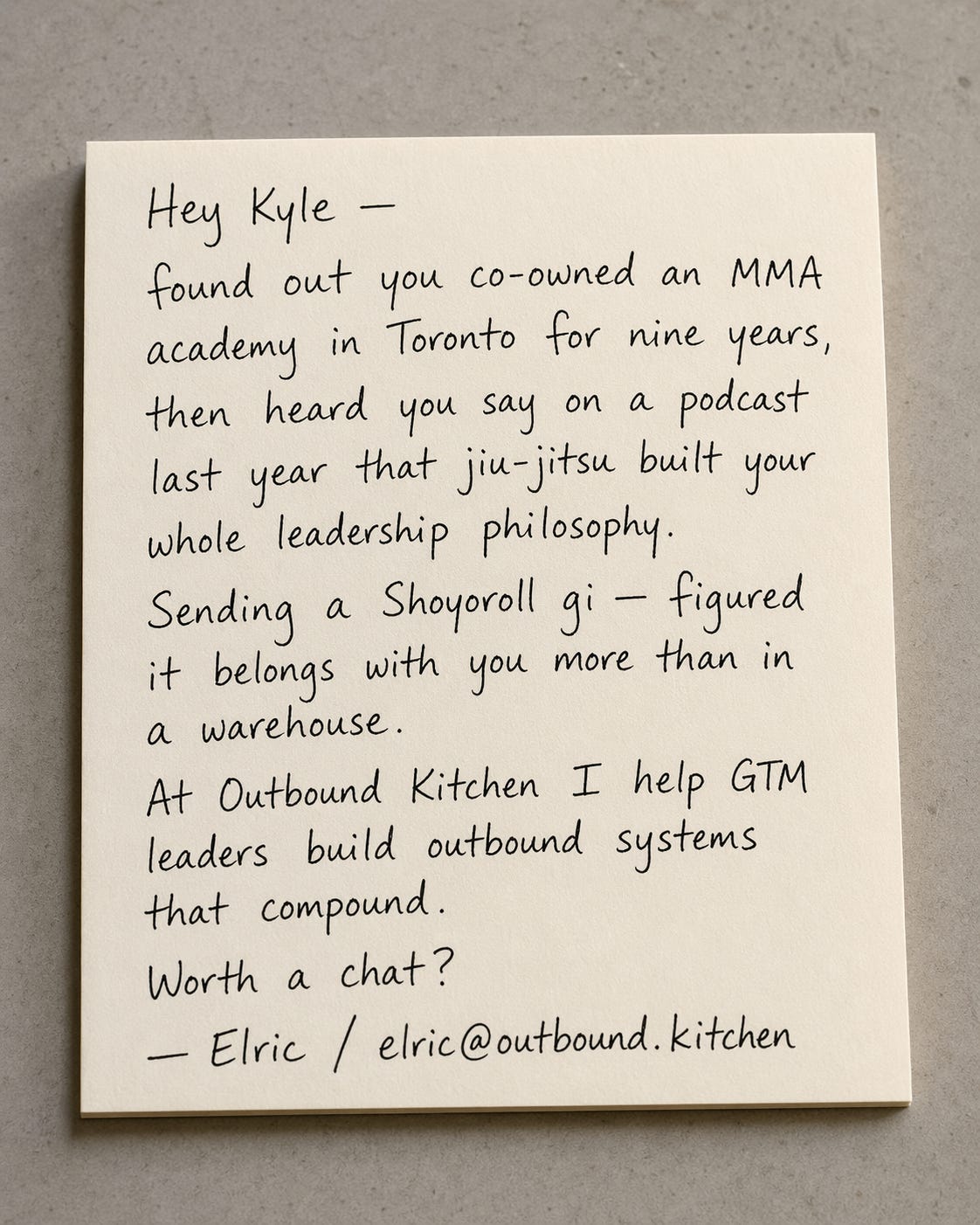
And that’s it!
Hope this is helpful.
Talk soon,
Elric
The 3 prompts
Three prompts: